| Author |
 Replies: 33 / Views: 6,519 Replies: 33 / Views: 6,519 |
Page 3 of 3
|
|
|
|
Valued Member
 Australia
363 Posts |
sorry about the pic stuff up. Here is the reverse of the coin: 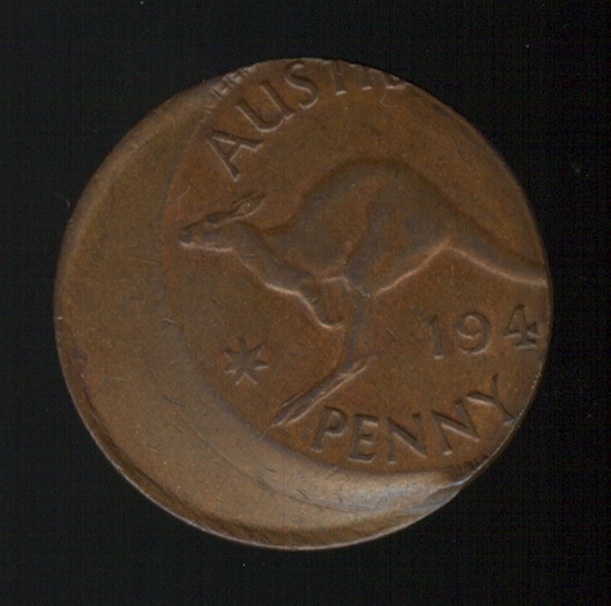 |
|
Valued Member
Australia
465 Posts |
It is funny that coin collectors have trouble finding dates!  |
|
Valued Member
Australia
51 Posts |
I think we can say this coin isn't a 1942-I or a 1943-I because there isn't an "I" mintmark below the king's neck & that this isn't one of those "missing I" types because on the reverse:-
1. the vertical strokes of the "U" in AUSTRALIA align with thick denticles &
2. the first vertical stroke of the second "N" in PENNY aligns between a thick & thin denticle &
3. The thick denticles themselves seem to be about as wide as they are long
Unfortunately, this doesn't preclude the possibility of the coin being a 1942-Y dot, a 1943 or a 1943-Y dot. Actually, we could have eliminated the possibility of 1942 altogether if we could definitely say that there wasn't a dot after the "Y" but the position & size of these dots is so variable that because of where the edge is cut, it couldn't be said that this coin hadn't had a small dot closer to the rim & far from the "Y".
|
|
Valued Member
Australia
318 Posts |
it would be delicious if you could somehow put match it up with 1946! Imagine that! I have nothing to add to the conversation, sovereign debt's notes are amazing++
Very jealous (of the coin, and sovereign's knowledge!)
|
|
Valued Member
Australia
51 Posts |
As Sir Isaac Newton said "If I have seen far, it is because I have stood on the shoulders of giants". Over the years, a lot of research has gone into Australian pre-decimal coins - I've just been lucky enough to have the time to read & compile it.
|
|
Pillar of the Community
Australia
2180 Posts |
According to Fred Lever's Reference Book, all Indian dates have a dropped 1 (see the 1943 on the previous page compared to the others). Hard to say from the given photo, but it might be a dropped 1. Otherwise you could try and count/match the obverse and reverse beads and try and narrow it down using information from here: http://triton.vg/pennyObv.html and http://triton.vg/pennyRev.html |
|
Pillar of the Community
Australia
1607 Posts |
Do any other years ( 1940 to 1949 ) other than the 1946 show weakness in the 19,this coin seems weak in the 19 & that is the first thing I always look at when looking at 1946 pennnies.
|
|
Valued Member
Australia
51 Posts |
And it's obviously not 1949.
Also, I think it would be very difficult to estimate the number of beads/denticles from the few that are available.
|
|
Pillar of the Community
Australia
2180 Posts |
Quote:
Also, I think it would be very difficult to estimate the number of beads/denticles from the few that are available. Yes, that's what I thought too. It might be possible depending on where the marker beads are and if they line up with whichever letter they're meant to (at least for the obverse side). |
|
Valued Member
Australia
465 Posts |
I need a break. I have posted the same "joke" twice!
|
|
Valued Member
Australia
465 Posts |
@Sovereign Debt "  |
|
Valued Member
Australia
51 Posts |
Quote:
It might be possible depending on where the marker beads are and if they line up with whichever letter they're meant to That would be great if such differences existed but if Paul M. Holland's articles for both "Journal of the Australian Numismatic Society" & "Journal of the Numismatic Association of Australia" are to be believed, then except for the coins minted in India, which I've dealt with & eliminated above, all the other coins minted from 1940 to 1948 at Perth or Melbourne, used the same obverse & reverse combination of dies & were only distinguished by Y-dot or K-dot-G mintmarks. As the areas of the positions of these marks are not on this misstrike coin, they're not very helpful. Even if they were present, or if we could definitely see that they weren't, it still wouldn't tie the date to one specific year. Relevant Y-dot years were 1941, 1942, 1943, 1944, 1945, 1947 & 1948 Relevant years of non Y-dot coins were 1940, 1941, 1943, 1944, 1946, 1947 & 1948 Relevant K-dot-G years were 1940 & 1941 Relevant years of non K-dot-G coins were all from 1942 to 1948 inclusive |
|
Valued Member
Australia
262 Posts |
that is a real error coin!! darn that's looks awesome!!
|
|
Valued Member
Australia
258 Posts |
I wouldnt say error, looks more like a catastrophe. someone had a rough time at the mint that day!
|
|
New Member
United States
1 Posts |
The direction of the "cupping" in this error coin indicates that the obverse was the upper die when it was struck. This suggests that your penny is from the Perth Mint (see Holland, JNAA volume 14, and especially Figure 3 and the Table on pages 44-45). Hope this helps! InforaPenny |
|
Page 3 of 3
|
Replies: 33 / Views: 6,519 |
Page 3 of 3
|






 First Page
 Previous Page


 Posted 04/06/2012 06:26 am





