I believe that most if not all of the dealers that I have met know how to grade coins. They would not be in the business very long if they did not. That being said, grading is still very subjective. It is one person's opinion, and their opinion of a grade may be somewhat different from yours. But this is part of what makes coin collecting so fun. Not all dealers overgrade their coins. Some are actually very conservative and you can pick up a great deal if you have a good eye and you know how to grade accurately. I guess this is why I have always preferred raw coins over slabbed ones. However, I will look at slabbed coins at a show so I can compare grades (someone else's opinion) for coins in the same series as I am looking for.
Too many steps in the VF grade. A VF-20 doesn't look any different than a F-15 to me, especially when looking at Buffalo nickels. A little off topic but it just bugs me.
I remember when dealers use to call real nice AU's (AU-58) Commercial Unc's.
Quote: You're wrong there. Most do know exactly what they have.
Well, I did say 'a lot', not most.
Also, it may be worth pointing out that dealers from one area have a different culture than dealers from another. Much like Americans from different states/regions.
So it may be perfectly normal for dealers in your area to be dishonest and know they are lying to their customers. That might be part of your dealer culture.
But for a lot dealers in my area, they aren't big on knowing how to grade very accurately, every series they deal in. Nor how to recognize a non original surface coin.
However, there are many that can and do, and those dealers are usually more successful than the aforementioned.
Quote: A dealer of coins is normally there to make money, not friends.
Why not both? Be honest and friendly and you will.
With that said, back to the topic.
Quote:
Brilliant Uncirculated (BU can be MS 60, MS 61 or MS 62) Choice Uncirculated (CH BU can be MS 63 or MS 64) Gem Uncirculated (Gem BU can be MS 65 or higher)
This is a good explanation of the approximation separation for MS grades, similar to lower letter grades.
The big thing to note here I think is, GemBU should mean an MS65 or higher.
andoyan62, Does this help clear it all up? If not, how can we help further.
As 'just carl' suggested, this info is present in the ' Red Book', but I can understand if you don't have one, and don't want to buy one.
It's not necessary to purchase a Red Book for that info. For a really good explanation, just go to Google. Type in Coin Grading and you would find: What Is The Sheldon Scale Of Coin Grading - Coins - About.com Or use the Glossary at the left. Lots of places where this is all explained.
Quote: Quote: A dealer of coins is normally there to make money, not friends.
Why not both? Be honest and friendly and you will.
In most instances serves no purpose. At many coin shows dealers come from sometimes great distances. Some will never come back to that show. Some may but infrequent. Making a freind of someone you may never see again to most dalers is useless.
The real problem with any grading system is the difficulty attempting to differentiating from one grade to the next. You could take a AU-55 to one dealer and find it's AU-53 then to the next one and it is now AU-50. Even the so called professionals can't make up their minds. If you read enough posts here, you see how many take a coin from a TPGS slab, send to a different one, get a different grade.
Quote: GR58: Same thing is noted on page 9 in the Red Book. And with a larger explanation.
Carl I was just trying to give a very basic explanation of how the grading system work, I posted it with out looking it up, so I was not sure if I had all the information correct.
Yes most grading books and online grading site will give more detailed information.
Yes there is much more to learn than just the grades and the number scale. Like how the scale was developed by Sheldon. Also how each coin series will have different criteria to determine how a particular coin will fall into each grade. Let's not forget market grading vs technical grading.
I will go back and read page nine just in case I missed something
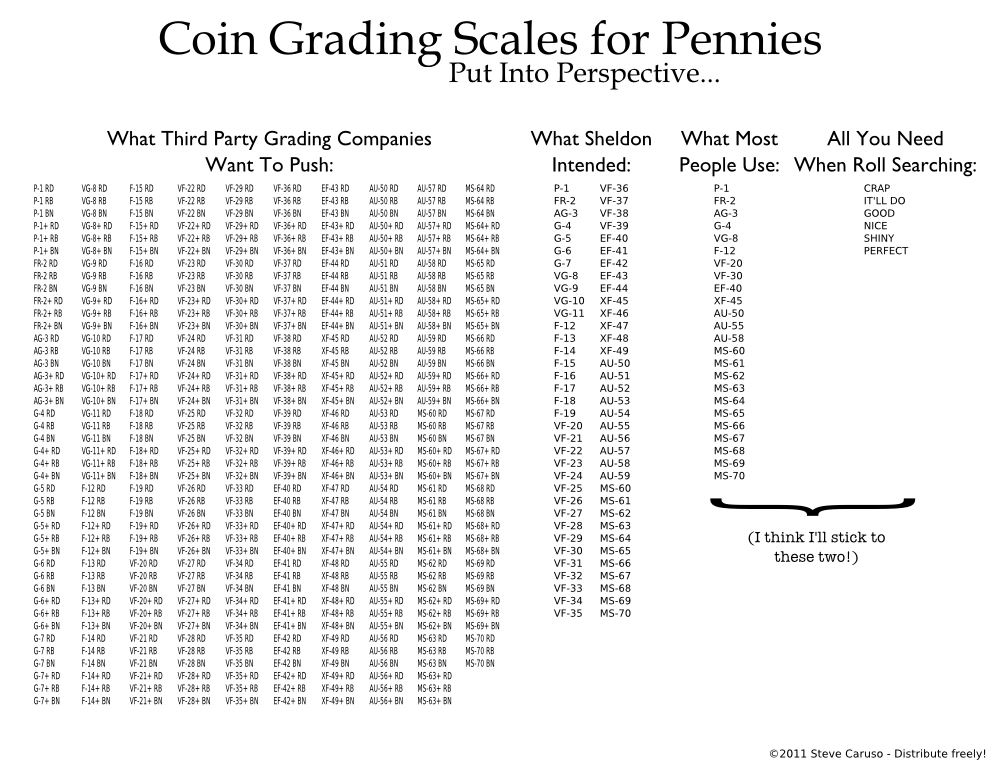
Here is my own handy-dandy guide for understanding all of the different grading scale gobbildygook, distilled down from the most complex (on the left) to the most simple:
Although it says "Pennies" (as it was in the context of my penny albums) it tends to "work" like this with everything else too. :-)
Quote: I don't understand what the numbers mean? as an example (VF20) what is a 20 stand for
They actually don't mean anything. They are merely an additional name for the grade. They could have used Pr-A,Fr-B,AG-C,G-D,VG-E or 1,2,3,4,5 ore even John, Joe, Mark, and George. The reason they use those numbers is because back in 1949 Dr Sheldon prices of 1794 large cents and to roughly the same extend all early date cents were priced at a consistant group of ratios. A Good coin sold for 4 times what a Poor coin sold for. A VG coin sold for twice what a Good sold for or eight times what a poor one did and so on. If you had a 1794 cent variety that sold for $1 in Poor, it sold for $4 in Good, $8 in VG, $12 in Fine, $20 in VF, $40 in XF, $60 in Unc and $65 for a high end Unc. Dr Sheldon thought he had discovered a natural law covering values of early date cents and if you knew the price in any grade by using the ratios you knew its value in all the other grades as well.
What he had actually discovered was a group of ratios that happened to be true AT THAT TIME. But as more collectors entered the hobby they naturally chased the better condition coins. So demand rose faster at the high end than at the low end and the ratios changed. By 1958 Sheldon was adding on layers of "special rules" and adjusting prices on the low end coins to try and force early date large cent prices back into those original ratios from 1949. Believe it or not the people in EAC continued trying to tweak rules and values up until 1972 to try and force them to obey the old ratios before the who idea of the ratio numbers was officially junked.
Then in 1977 the ANA decided to produce a book with the official written standards for the different grades. (Grade names which by the way had been in use since the 19th century) and they stuck those old ratio numbers back on to the grades. Its a mistake. Numbers imply precision and that something can be measured and/or calculated. But there is no measuring, calculating or precision in the subjective world of grading.
As the other member stated, honesty. But they also have their reputation to consider.
If the coin dealer is a member of the ANA, PCDA (Professional Coin Dealers Association), or other coin dealer group they must abide by their organizations code of ethics which requires them to disclose a coin has been cleaned or otherwise tampered with and to hide such and they have a complaint filed against them to whatever organizations they belong to the penalties if found guilty and are deemed serious enough they can be expelled and their expulsion is published publicly for all to see and the reason why.
Quote: just_carl: He has this coin and it is cleaned. It has a price on it of $100. Now if he also added it's been cleaned, he would know he now has to lower the price. Why would he do that? Someone that doesn't know, might just buy it for that $100. And as to grading, if they can get away with a AU-50 instead of a EF-40, just more money for them. Most dealers at coin shows I've met do know grading and what has been cleaned. But why should they tell anyone?
Yeah they're just trying to catch whatever fish are in the sea. They're hoping you can't see the problems, or grade it correctly, or tell that its really not RD or PL etc etc.... when in all probability THEY bought the coin for a fair price in order to try to pass it off as better. I mean they might as well try, even if its in a slab by PCGS or NGC.
Yeah, a fair reason, but I still feel it would be naive to rely on and expect honesty (even with the various codes of ethics). First of all, it's really hard to prove someone was intentionally not disclosing a problem with a coin (how often do these get enforced?), and secondly, money is involved. Never underestimate how much money can change someone's behavior.
You have to be relentless in watching out for yourself. I think most active people on here probably do because they are serious about learning, but its worth repeating to any lurkers that are tempted to trust their dealers.
Reminds me of this PCGS video (in this case, this guy got punished because it involved PCGS):
Oh and the grade number joke Steve posted is good it isn't fair to Sheldon. He never suggested using all those grades. Sheldon used 1,2,3,4,5,6,7,10, 12,15, 20,25,30,35,40, 45, 50, 55, 60, 65, and 70. More at the lower end and less at the upper end, and fewer than the "What most people use" catagory.
@SteveCaruso: Thanks for the laugh on the chart. I'm going to have to print this up for my girlfriend. While she is not a full blown collector (the only coin in her 'collection' is a US quarter someone used spray glitter on), she does ask the bank tellers she see for work and personal business if they have any interesting coins. When she finds something, she sends me an excited text describing it using the "All you need when roll searching" scale.
I was wondering though: So I understand the Scale for the most part... except the + symbols next to some grades. I've noticed them in a few places. So if I am grasping the scale... if I saw a MS 65+ coin that means that it is missing some requirement to be a MS 66 coin (or what ever the next step up is), but it is a exceptional example of a MS 65 coin? Meaning it meets every requirement for a MS 65 coin, but is in better condition than other known examples of that particular coin of that grade?
Quote: So I understand the Scale for the most part... except the + symbols next to some grades.
Something PCGS started a couple years ago. Originally the gradng services only used 60.65, and 70. Then to get you to send your coins in and pay them again they pushed for the addition of 63 and 67. Then they added 64. Then they went all out and when to all the numbers from 60 to 70. After several rounds of coin submitting until most everything is maxed out, they had to come up with a new way to get you to pay to have your coins graded yet again, so they added on the + grade for high end for the grade coins. When everything gets maxed out again, they will probably either go to decimal point grading or the will finally introduce a new 1-100 grading scale.
Disclaimer: While a tremendous amount of effort goes into ensuring the accuracy of the information contained in this site, Coin Community assumes no liability for errors. Copyright 2005 - 2026 Coin Community Family- all rights reserved worldwide. Use of any images or content on this website without prior written permission of Coin Community or the original lender is strictly prohibited. Contact Us | Advertise Here | Privacy Policy / Terms of Use






 First Page
 Previous Page


 Posted 06/13/2012 09:14 am