| Author |
 Replies: 17 / Views: 2,230 Replies: 17 / Views: 2,230 |
Page 2 of 2
|
|
|
|
New Member
 Greece
19 Posts |
Edited by pit
11/24/2012 8:23 pm
|
|
Pillar of the Community
United States
5155 Posts |
well I looked around and I am almost certain that the coin is not Byzantine but rather Roman Provincial.. Look here....There is one of Trajan....from that area...with a left facing bust, on yours I am almost sure its a right facing bust, but thats where the big time Roman guys come in.... Varbanov 1638 http://www.wildwinds.com/coins/gree...ntium/t.html 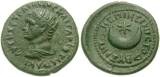 Edited by Ancientnoob
11/24/2012 8:33 pm
|
|
Pillar of the Community
United States
4778 Posts |
Byzantion (or Byzantium) was a provincial city in the Roman Empire, and would later become Constantinople, the capital of the Byzantine Empire. This coin (which I am pretty sure is a Roman provincial) would have been minted during the Roman imperial era (probably minted around 2nd/3rd century from the looks of it), not the Byzantine era (its coinage starts around the late 5th century AD).
|
|
Pillar of the Community
United Kingdom
2838 Posts |
Interesting coin pit.
Byzantium (later Constantinople now Istanbul) adopted the crescent moon as its symbol. According to some reports in honor of the goddess Diana, goddess of the hunt, the moon and birthing.
When the Turks conquered Constantinople in 1453, they adopted the city's existing flag and it can still be seen in many Muslim items today. Incredible journey.
|
|
New Member
Greece
19 Posts |
thanks for the info.
I'm starting to think that too is Roman
I can not understand that about the Greek letters
|
|
Pillar of the Community
United States
5155 Posts |
Not everyone in the Empire was a Latin speaker and even fewer could read and write it let alone engrave it. It is quite common to see Roman coins of Greek and former Greek lands to retain the original language. In the provinces you will see coins with Latin, Greek and or a mixture of the both, it is also common to see coins with a completely Latin Legend and a mint mark symbolized by a Greek Letter, for Example Siscia mint with an Greek Letter "Gamma" in later pieces indicating what shop produced the coin.
|
|
Moderator
 United States
23731 Posts |
 to the community It is a Roman Provinical coin from Byzantium in Thrace, sadly unless you can make out the legend on the obverse it is going to be difficult to tell who it is. |
|
Pillar of the Community
United States
5155 Posts |
I sweat the head looks like Hadrian but the coin is very similar to that of Trajan....hum I believe echizento is correct.
|
|
New Member
Greece
19 Posts |
Thank you very much ...
I think the first letter is A
and the last from the right side is K
from what I can see
Edited by pit
11/24/2012 9:39 pm
|
|
Pillar of the Community
United States
5010 Posts |
that's a cool coin pit, haven't seen one of those. |
|
Pillar of the Community
United States
1316 Posts |
...pit, you might want to soak your coin, try distilled water or extra virgin olive oil..soak for week at a time ,pull out brush with tooth brush... nice find... 
|
|
New Member
Greece
19 Posts |
and I'd not seen again ...
may not have much value
although I would like to know of curiosity what is the value.
but I believe it is a rare coin ...
I do not know what other people think here who know about these
Thanks for the advice. :)
|
|
Valued Member
Canada
472 Posts |
|
|
Pillar of the Community
United States
1549 Posts |
When a provincial legends ends in K we suspect a Caesar rather than an Augustus. We can see ANOCK which really only leaves Diadumenian as likely since Caracalla would be INOCK and Geta would be ETACK. My hat is off to Dionysos for fast work finding the image but notice that the linked site forgot to quote the K in the legend even though it shows on their coin.
|
|
New Member
Greece
19 Posts |
Dionysos you are the best! Thank you vary mach! Now I know more about this coin! Thanks again all of you for the help!
|
|
Page 2 of 2
|
Replies: 17 / Views: 2,230 |
Page 2 of 2
|








 First Page


 Posted 11/24/2012 8:32 pm


