| Author |
 Replies: 25 / Views: 4,463 Replies: 25 / Views: 4,463 |
Page 2 of 2
|
|
|
|
Pillar of the Community
Australia
674 Posts |
|
|
Valued Member
 United States
160 Posts |
Robster,
You certainly have some fine coins in your collection, I have a lot to learn about the Australian coining process.
I am just fascinated by all the different type errors and the magnitude at which they occur.
I've just started the Half Penny found two nice ones out of the first three.
|
|
Pillar of the Community
Australia
750 Posts |
Excellent doubling Robster!! No mistaking that one.  |
|
Valued Member
United States
160 Posts |
Would just like to ask a quick question here, I have searched the forum for discussions on amount of strikes per die for the pre-decimal Penny and Half Penny. I am just completely amazed by the amount of damage that shows on these coins. I assume most is caused by the hardness of the bronze rather than some type of die manufacturing problem.
Does anyone have an estimate of strikes one would get out of a set of dies? I picked up a few Australian pennies real cheap from a dealer who has some but doesn't know much about them, out of 20 coins, 8 had some type of doubling or die cracks, that's almost 50%. That seems a little high to me, but again, I know very little about the dies and die making of Australian coins.
Dave
|
|
Pillar of the Community
Australia
674 Posts |
Perhaps the person who owned those coins previously had a penchant for error coins. Certainly wouldn't see such a high percentage in a normal group of pennies.! As far as number of strikes I am not sure but someone will provide the info. soon.!!
|
|
Pillar of the Community
Australia
674 Posts |
|
|
Pillar of the Community
Australia
2180 Posts |
daveyn I think the amount of strikes per die varied a bit. The alloy changed a few times for starters I think, and I remember reading somewhere that sometimes dies would break after striking no more than 50 coins (though I assume die quality improved with time).
|
|
Pillar of the Community
Australia
852 Posts |
Daveyn and Robster
Doubling (machine) very common for some years in the late 1940s-early 1950s.
Die life varied with some dies lasting for a 0 count and others over 200,000. It also depended on the year as to die problems causing early die failure. Die clashing was common (in some years of the 1920s over half the dies ended up producing coins from clashed dies) and that must have cracked plenty of dies.
Robster, was that hub doubled obverse from 1921?
|
|
Pillar of the Community
Australia
750 Posts |
That's a nice consecutive set Robster. Quadoubling?
|
|
Valued Member
United States
160 Posts |
Thanks for the replys, one thing I have noticed with the Rennicks listing is some years have a large amount of errors compared to other years. Not knowing the workings of the Australian mints and die processes very well I wonder why a year like 1943 or 1948 would have so many more die damage type varieties then the others. Here is one I believe I actually found in my Rennicks book: 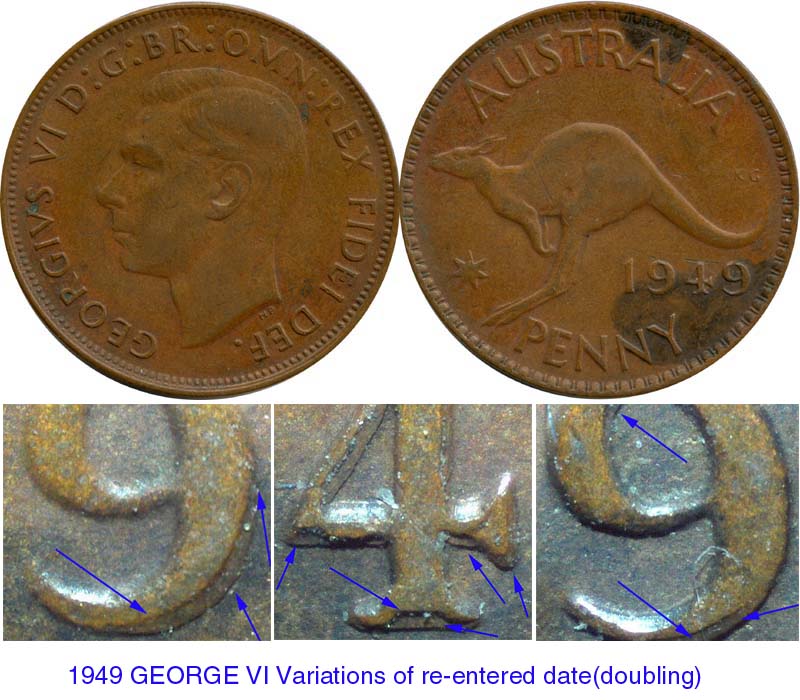 |
|
Pillar of the Community
United Kingdom
2145 Posts |
Do Australian coins with doubling cost more or less than the equivalent coin without doubling ?
|
|
Pillar of the Community
Australia
674 Posts |
Neal, yes- correct as usual.!! Daveyn- looks like we have twins.! Pertinax- Error coins do command a slightly higher price depending on rarity and quality. I have been fortunate that all of mine are from my early noodling in the 1960's. Almost all of mine are well circulated but I don't mind.! |
|
Valued Member
United States
160 Posts |
Hello Everyone,
in an earlier post I stated that I went through 20 coins and found an unusual amount of errors and mint damage, robster suggested the group of coins may have come from an error collector. I now suspect he is correct, I've been to two pretty large shows looking through 100 coins and found only one with a small die crack through OF, I did however find quite a few with the Head of GEORGE VI pushed through and seen above the Roo's back, just wondering how common that is.
Dave
|
|
Pillar of the Community
Australia
2180 Posts |
Seeing George VI's head through the obverse isn't that uncommon and it's reasonably prevalent early in the George VI series.
|
|
Pillar of the Community
Australia
4411 Posts |
I agree with Mr T. Ghosting is very common on KGV pennies, especially on those dates from 1940-1944 I have noticed.
|
|
Page 2 of 2
|
Replies: 25 / Views: 4,463 |
Page 2 of 2
|







 First Page


 Posted 07/04/2013 10:19 pm


