| Author |
 Replies: 19 / Views: 5,609 Replies: 19 / Views: 5,609 |
Page 2 of 2
|
|
|
|
Valued Member
United States
462 Posts |
|
|
Valued Member
 United States
136 Posts |
|
|
Valued Member
United States
266 Posts |
the 3 things that I am seeing here is, first, the multiple balls of metal like the ones around the "1 1/4" under the wildman. those are caused by voids in the mold used. Second is the voids in the coin itself, most notably under the "dux" on the reverse and around the middle helmet also on the reverse. These are caused by air bubbles in the molten metal poured into the mold. Lastly there is a general lack of fine detail in things like the wildmans hair, often this is described as "mushy details". Also just looking at the overall condition the coin will be graded due to the apparent wear no higher than XF, probably VF. But overall the fields are way too clean for a coin that would have seen that amount of circulation, in my opinion
|
|
Valued Member
United States
136 Posts |
True True.
Also there is something that looks like a double die on the wildmans leg.
I guess that would be due to the metal flowing into the mold which has a empty area around there ?
Also the lettering looks just off the metal by H of Honesta looks like its melted and in general that area around there has this "molten" feature.
mmmh
|
|
Pillar of the Community
United Kingdom
2145 Posts |
|
|
Valued Member
United States
136 Posts |
It does have similarities in appearance to the 1 1/4th thaler.
For Pcgs to grade it as genuine they must have their reasons.
If it would be cast counterfeit then under the right magnification no matter how good it is the pros would always be able to identify it as such right ?
|
|
Valued Member
United States
136 Posts |
Also one thing that I am wondering about is.
The coin appears to have been double struck.
What if the die that was used for striking already was very used and had little detail...
this might explain the muddy details and they had to strike it twice because of that ?
Also those casting bubbles might it have been a flaw already present in the planchet ?
Just some thoughts....
|
|
Valued Member
United States
462 Posts |
Thanks I didn't realize it was a 1/ 1/4 thaler. BTW how much your coin weigh and where did you get it from ? I have a 2/3 thaler or 24 Mariengroschen. Its 13.01 g and doesn't sound like silver. I got it from the local coin shop for cheap, looks genuine except for the silver ring test. 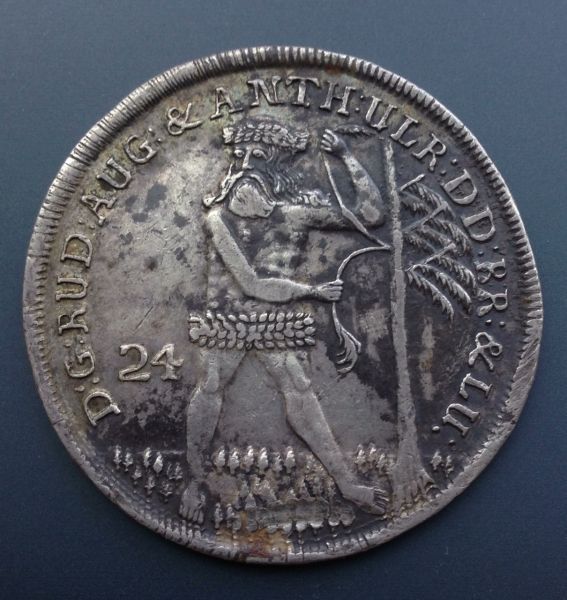 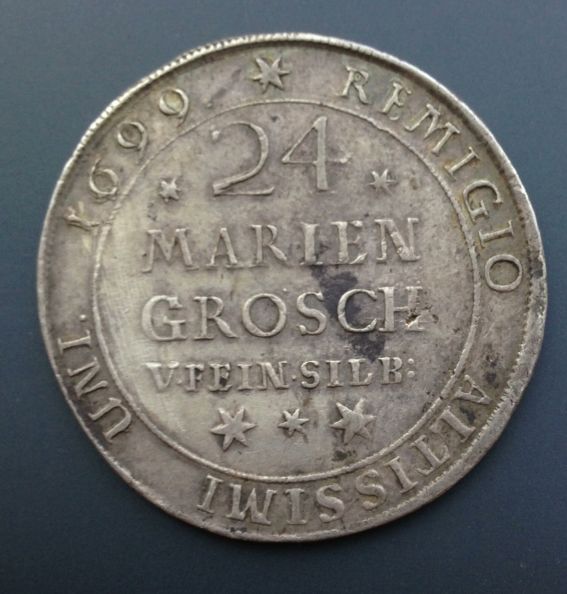 |
|
Valued Member
United States
136 Posts |
The coin is 50mm and 36g I dont have any more specifics because I did not buy it yet.
I just wanted to know what you guys think to spare me the trouble of having my $ tied up.
What Rdwarrior said is to be considered however the planchets used to strike these coins are cast anyway so
whatever ill give it a shot and get it certified.
I looked up your piece but I couldnt find any 24 mariengroschen with the same design.
I found 2 types in krause but both look different....
The ring test for me has proven to be very reliable in many cases.
Even low content silver coins always have that specific sound.
|
|
Pillar of the Community
United Kingdom
2145 Posts |
|
|
Valued Member
United States
136 Posts |
I went on the german google and went on with my research there. This coin is extremely rare and its so hard to find references for it But I stumbled upon a genuine piece here it is  Just looking at it makes me think that there is no way that the piece on ebay is real. Also the exact specifications should be 53mm and 35.9 g Looking a bit further I found out that in 1978 someone made a replica with 51mm and 36.25g but I couldnt access the pictures for this. No way the 1 1/4 taler is genuine the metal looks off too more like tin or something like that. Yours looks off too plonker I found 2 specimen take a look   Edited by GEKO
09/01/2013 03:53 am
|
|
Valued Member
United States
462 Posts |
Gecko, thank you very much for looking up my coin as well. That 1 1/4 thaler looks awesome. These German state thalers are special. I don't know if you noticed on your coin seems to have a mount removed on 12' clock. Doesn't mean that could be real. I think also the weight and diameter can vary during different dies back then so some variations accepted but not sure 3 inches in diameter could be an acceptable. Could you tell me where you see my coin is off ? I cant seem to find much difference. However I dont like the fact ring test doesn't work and a something looks like a rust spot at 6'clock. 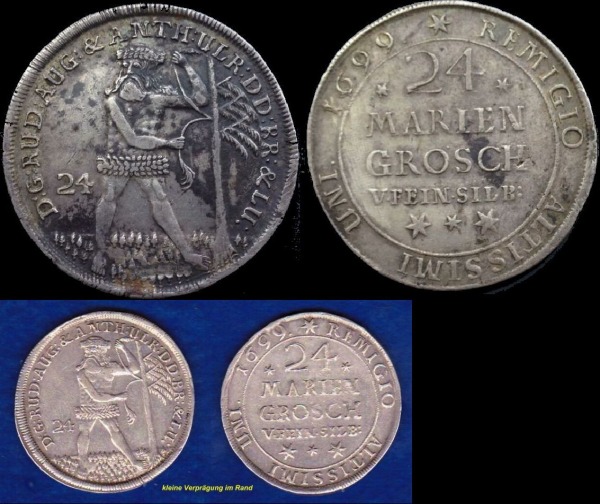 |
|
Valued Member
United States
136 Posts |
I dont know how many types there are out there of your coin but what I can see is that the obverse design
of yours appears to be similar to the one from 1701 if you look at the alignment of the trees on the bottom.
However the tree that the wildman is holding looks like the 1699. The Skirt doesn't look like neither of them and if you look at the right forearm it looks very round.
The reverse looks like the 1699 but the stars are thicker and the lettering is slightly shifted.
The Stars in general look very off....
Although I would not worry about the rust spot I have found a couple of austrian silver kreuzer that exhibited the same kind of wear
|
|
Pillar of the Community
United Kingdom
2145 Posts |
plonker,
I certainly wouldn't recommend you believing that because a coin had been mounted that it was real.
In the 1970s, when there were East German, Russian and Lebanese fakes in the collectors' market, I was given a fake Gothic crown and a fake Una and the Lion £5 coin.
I had them both mounted and gave the gold one to my mum, and the silver one to my girlfriend. My mum's was stolen and is presumably around somewhere.
I have also seen jeweller's imitation coins mounted in pendants in auctions occasionally.
|
|
Valued Member
United States
136 Posts |
I have been browsing the german coin forums and I am going to ask around there too.
From what I read there is a lot of fakes from old german coins coming from china and apparently the bay is full of it, of course.... but there might be more out there than one might think
|
|
Page 2 of 2
|
Replies: 19 / Views: 5,609 |
Page 2 of 2
|






 First Page


 Posted 08/29/2013 8:53 pm





