| Author |
 Replies: 16 / Views: 5,526 Replies: 16 / Views: 5,526 |
Page 2 of 2
|
|
|
|
Pillar of the Community
United States
1511 Posts |
I'd have to bet graffiti... No one aside of a signature expert could compare that with Morgan initials... but I think that's a reach and a half.. And really don't see him defacing one of "his coins"... If anything I think he'd have the means to have it done nicely. So again would be willing to bet alot on graffiti.
|
|
Pillar of the Community
 United States
1950 Posts |
|
|
New Member
 United States
8 Posts |
Thanks for the input. As you point out,even if they were G.M.'s initials, there's no way of knowing for sure.
I was thinking that maybe they were fiddling around with the design of the coin, and G.M. said: "Okay boys, this is how I want it." and quickly put his initials on the coins so everyone would know which coin was which. The scratches between the stars sort of reinforced that line of thought.
Plus the fact that the handwriting is so delicate compared to the depth of the gouges--as if the metal was still soft. But I don't know the process of coin minting; it may be that the metal is never heated to the point of becoming pliable.
How about that funky "O", is that just a bag mark?
|
|
Moderator
 United States
23522 Posts |
Morgan created the design himself, without outside influence. By the time it reached the stage where coins were actually minted, the design was final. Except for a couple little things, which make for an interesting story and a *lot* of Morgan varieties. But the point is, they weren't doing design approvals by looking at the coins themselves.
Silver is quite soft enough to make a fine gouge like these with any knife.
|
|
Valued Member
United States
149 Posts |
Plain old graffiti. Feeble attempt to do an engraving. I would have to think that if Morgan were to engrave one of his coins, he'd do a better job.
|
|
Moderator
Australia
17006 Posts |
The first letter (repeated twice) is not a "g", anyway; it's the letter "i", or maybe "j". Quote:
But I don't know the process of coin minting; it may be that the metal is never heated to the point of becoming pliable. Coin blanks aren't pre-heated these days. All coins struck for the last 1500 years or so have been cold-struck. Don't say "infinitely" when you mean "very"; otherwise, you'll have no word left when you want to talk about something really infinite. - C. S. Lewis
|
|
Pillar of the Community
Canada
5417 Posts |
Just Graffiti. Would've been nice to see Morgan's initials though.
|
|
Pillar of the Community
United States
1314 Posts |
Sometimes people will scratch an identifying mark on something of value to prevent or aid in the recovery of theft. Also done on firearms etc.
So far, it only proves that you have a sharp eye and an open mind.
Few people catch a record fish on their first try, but some stick with it and are destined to add their names to the record books.
I smell worms on your fingers.
Welcome aboard
|
|
Pillar of the Community
United States
1314 Posts |
Oh, and your pictures are so much better than mine when I was getting started. I seriously considered drawing pictures and scanning them to share images.
Hope you'll stick around.
|
|
New Member
United States
8 Posts |
Thanks, everyone for your comments. Wouldn't it have been great if my long shot suspicion was correct?! I'm really pleased with the responses you all gave--this forum is great! I inherited a bunch of Morgan dollars, Peace dollars, and other assorted coins. I have never considered coin collecting until these coins came to me. If you don't mind, I'll probably be posting a lot of questions. Thanks again. |
|
Pillar of the Community
United States
1511 Posts |
No problem at all, we're happy to try to help... We love questions, and pics even more!! So post away! And I love Morgans more than anything.... So post this first  just playing, post at your leisure. |
|
Rest in Peace
United States
10625 Posts |
 We love looking at other member's Morgans.  |
|
New Member
United States
24 Posts |
Looks to me like someone had nothing better to do one day and said I'll just scratch on this hear coin and one day someone else will say WTH...
|
|
New Member
United States
8 Posts |
I agree. Now that I've been dabbling in numismatics for a few weeks,it's much more obvious that the initials are just chicken scratch. But, as they say: if you don't ask questions, and you don't make mistakes, you're probably not learning. And speaking of questions, would it be a mistake clean coins with an ultrasonic cleaner using only distilled water? The coins that I inherited have all been circulated. My Grandmother and Grandfather owned a soda shop in the 1930's - 1960's and would save the Morgan/Peace dollars they got from their customers; they have been sitting in various desk drawers, in various houses for roughly 50 to 80 years, and they're pretty grubby. I'd like to be able to remove the loose surface crud if it wouldn't ruin the value of the coins. |
|
Moderator
United States
23522 Posts |
Excellent attitude, vn3100. That's how you become a numismatist. Don't clean the coins. Full stop. Just don't. Originality is imperative in coin collecting, and as you gain experience you'll understand how easy it is to detect cleaning of any type, even a non-invasive method like ultrasound. You'll learn the relationship between level of wear and expected "patina" (read: grubbiness ), and the small signs of a past cleaning like minute amounts of remaining grub in the nooks and crannies. A coin whose surfaces have been altered loses much of its' numismatic value in the eyes of collectors. Of course, like all rules there are exceptions here. These, however, must be learned on a case-by-case basis; there is but one general exception: PVC damage. Some coin storage flips have been made using softened PVC plastic - flips and album pages - and the plasticizers used to soften the PVC outgas chemicals which attack the metals of the coin. This is visible as a greenish deposit on the coin (in early stages, possibly a clear/whitish haze), and it must be treated when found or it will eventually destroy the coin. Fortunately, there's a perfect solution in the form of acetone, an organic solvent which is chemically incapable of affecting the coin's metal while being a deadly enemy of PVC damage. Here's an example of a coin I treated: 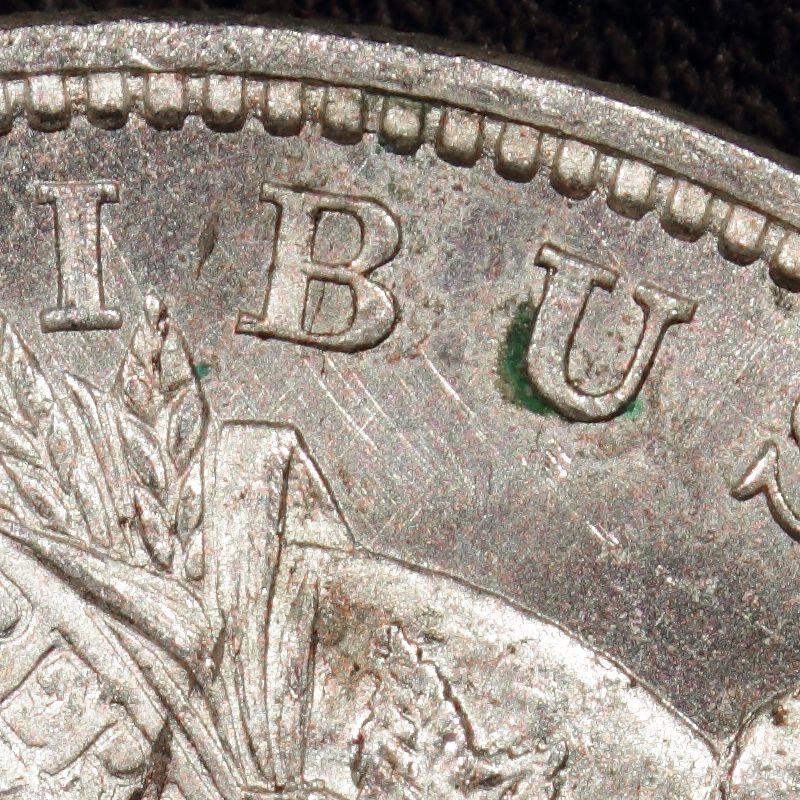 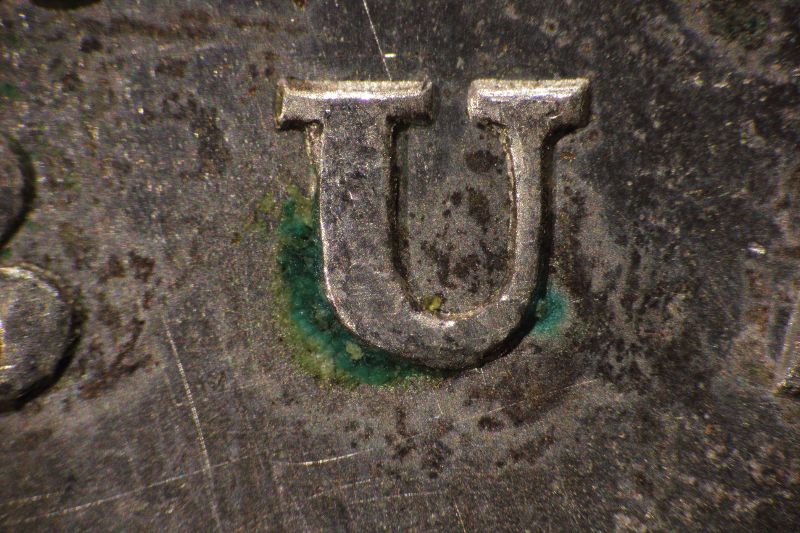 That's what PVC infestation looks like. This is what it looks like after the acetone is done with it: 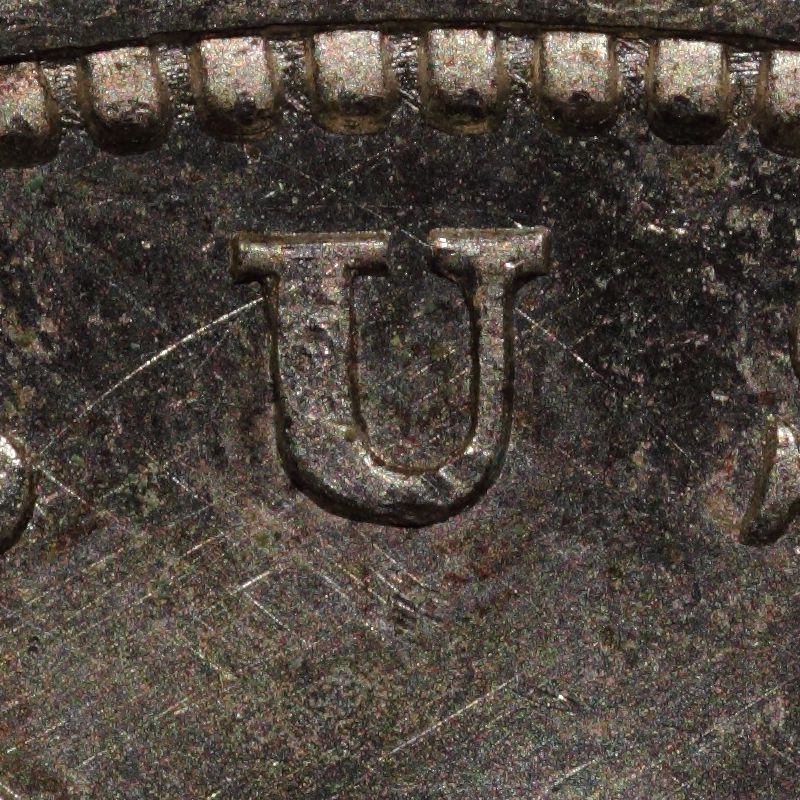 This was an extreme case. If you're sharp, you can see the permanent damage caused by the PVC, but in this case it's a very small area and it was just getting to the point of being permanent. With all that said, the natural "toning" process of silver - tarnishing, to those who don't like it (poor sods ) - also creates such a color on the surface of a coin. So, if you see it, don't necessarily panic. Get images up here, and we'll look at it case-by-case to see what's necessary. |
|
Page 2 of 2
|
Replies: 16 / Views: 5,526 |
Page 2 of 2
|







 First Page


 Posted 04/30/2014 5:02 pm





