








 Posted 06/22/2026 6:53 pm


In a sense, "Taiwan" is not wrong - from a continuity, and from a numismatic, point of view "Taiwan" and "pre-1949 China" are one and the same country (though the coin catalogues usually separate them). The name of the country on Taiwanese coins is always "Republic of China", and the dating system on Taiwanese coins is the same as that used on this Chinese coin: Years of the Republic.
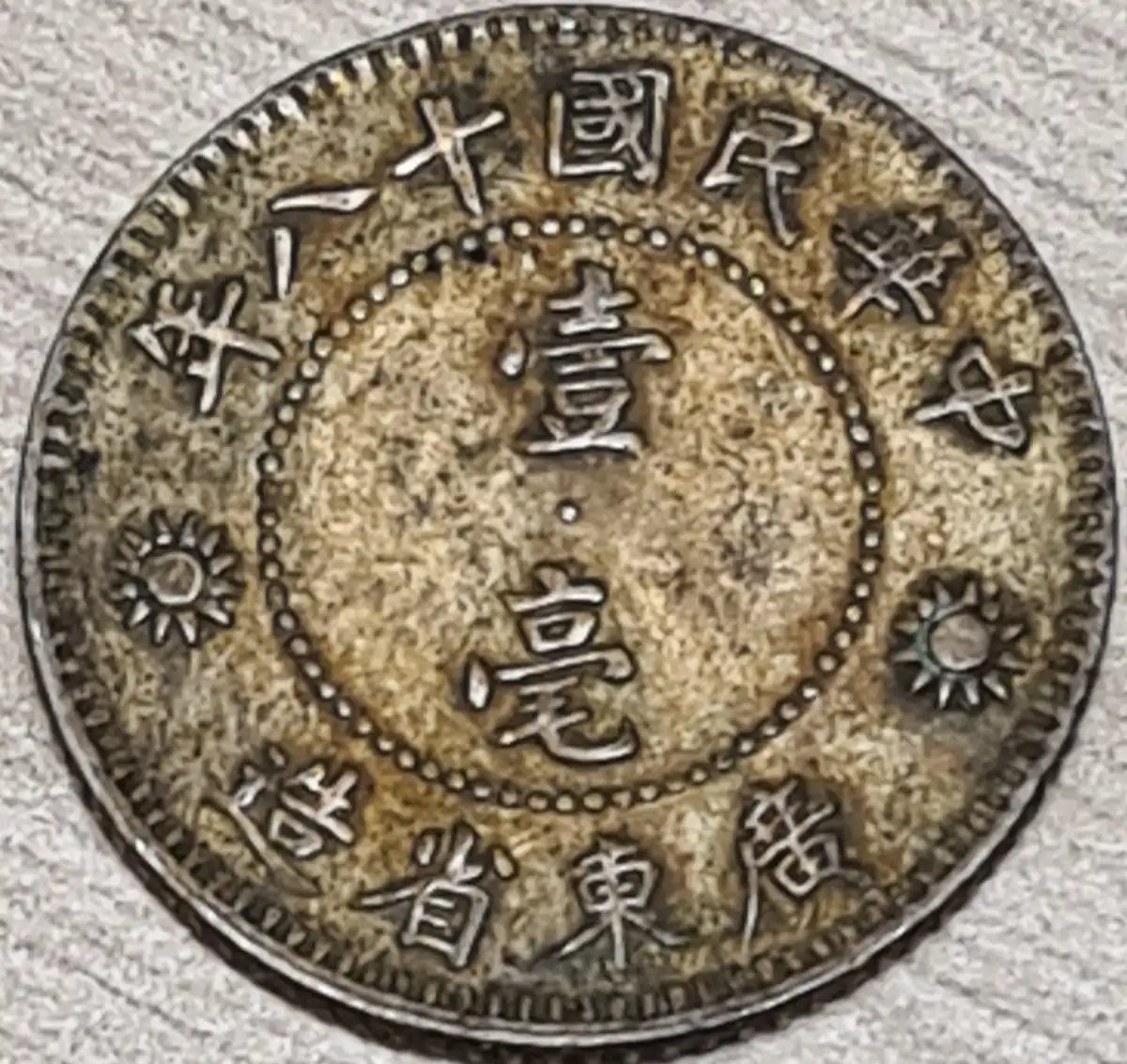
It will help you in your quest to identify East Asian coins if you can learn to recognize those four characters to the right of your date-numerals, which you've correctly read as "18". This is both the name of the country and the name of the dating system. These characters are, from right to left, "Zhong hua min guo", literally "middle magnificence people nation", but "Zhonghua" together means "China" and "minguo" means "Republic". Even if recognizing those four specific characters is difficult, counting them is easy: Imperial coins (whether from China, Japan or Korea) always use two-character reign-names, rather than this four-character era name.
You also mentioned denomination. The coin does have a denomination, but it's written using characters that are different from the regular Chinese numerals. Just like in Western culture it was normal to write out the value on a cheque in full rather than just relying on numerals because numerals were easier to fraudulently edit, so in Chinese they have "financial" numeral-characters which are more complicated in shape and thus harder for anyone to fraudulently alter one numeral into another. In the central circle of the reverse of your coin are two characters. The bottom is "jiao", the unit of money, the top character is the "financial" form of the numeral 1. You can see the "financial" and "everyday" forms of each of the numerals on the Wikipedia page: https://en.wikipedia.org/wiki/Chinese_numerals
Both Communist China and Taiwan use commercial numerals to denote values on their modern coins and banknotes, but the issue doesn't arise as often because these coins and notes usually also have Western numerals.
It will help you in your quest to identify East Asian coins if you can learn to recognize those four characters to the right of your date-numerals, which you've correctly read as "18". This is both the name of the country and the name of the dating system. These characters are, from right to left, "Zhong hua min guo", literally "middle magnificence people nation", but "Zhonghua" together means "China" and "minguo" means "Republic". Even if recognizing those four specific characters is difficult, counting them is easy: Imperial coins (whether from China, Japan or Korea) always use two-character reign-names, rather than this four-character era name.
You also mentioned denomination. The coin does have a denomination, but it's written using characters that are different from the regular Chinese numerals. Just like in Western culture it was normal to write out the value on a cheque in full rather than just relying on numerals because numerals were easier to fraudulently edit, so in Chinese they have "financial" numeral-characters which are more complicated in shape and thus harder for anyone to fraudulently alter one numeral into another. In the central circle of the reverse of your coin are two characters. The bottom is "jiao", the unit of money, the top character is the "financial" form of the numeral 1. You can see the "financial" and "everyday" forms of each of the numerals on the Wikipedia page: https://en.wikipedia.org/wiki/Chinese_numerals
Both Communist China and Taiwan use commercial numerals to denote values on their modern coins and banknotes, but the issue doesn't arise as often because these coins and notes usually also have Western numerals.
Don't say "infinitely" when you mean "very"; otherwise, you'll have no word left when you want to talk about something really infinite. - C. S. Lewis


