First Page
 Previous Page




 Posted 05/31/2014 05:48 am


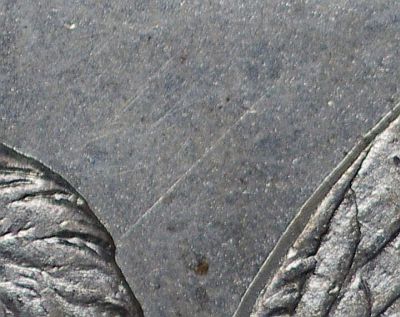
Interesting points Chute. As a counter (I like to play Devil's advocate!) as a result of another thread I happened to take a look at PCGS European website.
There I found this:

Frankly .. I was a bit horrified.
But why you might ask? It's just a bit of crud!
But it's not.
Back in the 19th and early 20th century people struggled to get good images of coins with the photographic equipment available. Consequently if an image was wanted for a learned journal or auction catalogue they made a wax cast of the coin. This avoided reflection and tone problems suffered when photographing the coins directly. Red wax was commonest.
But this was a time-consuming process and photographs were expensive to add to printed material. Hence only the best or most interesting coins were photographed.
The trace of red wax on this coin is a good indication that an image of it appeared in an early sales catalogue. And, if you could find the image, that would both serve to add to the known provenance of the coin and provide reassurance to its authenticity.
Removing the wax 'pretties' up the coin, yes. But it also destroys a small link to its history and is not something I, or many of the collectors I know, would want for our coins.
Which, I guess, all goes to show that there's a diversity of opinion amongst collectors as to how to handle and store coins. What some regard as improvement will to others be the spoiling of a coin. Do you try to stop time, so a coin remains unchanged from the moment you obtain it, or do you let natural processes carry on? Do you plug a hole in a coin or leave it as part of that coin's history?
Not everyone will agree which approaches are right or wrong. Slabs don't damage a coin (though they do make it impossible to weigh and difficult to inspect the rims). But personally if I wanted to preserve coins, I'd use capsules.
But the fact that PCGS used that particular example to promote their restoration service shows to me that they simply don't understand collectors like me. It's a different mentality I guess, perhaps born of different collecting markets.
I just feel that the culture of slabbing has gone far beyond it's original intent (which AFAIK was to enable dealers to swap coins unseen, confident in the grades stated). Nowadays as billymac said earlier, "it commodifies a coin". And some of us just don't want that.
Even so, slabbing would be fine if it wasn't all pervasive. Looking on CCF, people slab coins that to my view just don't need slabbing. And if TPGS gave the confidence that's claimed then why are there so many threads discussing (and sometimes complaining about) what grades have been given?
So as I said before, slabbing is fine. So long as I continue to have the option to buy the coins I want raw. Unfortunately the commercial aspects mean that, as in Paris, TPGS appear to be trying to increasingly break into new markets. So where previously I and my fellow collectors were take-it-or-leave it about slabbing, I suspect increasingly we are becoming hostile to it. Worried that eventually we may need to seek out the last few raw coins before they are ruined by "preservation" and plastic.

There I found this:
Frankly .. I was a bit horrified.
But why you might ask? It's just a bit of crud!
But it's not.
Back in the 19th and early 20th century people struggled to get good images of coins with the photographic equipment available. Consequently if an image was wanted for a learned journal or auction catalogue they made a wax cast of the coin. This avoided reflection and tone problems suffered when photographing the coins directly. Red wax was commonest.
But this was a time-consuming process and photographs were expensive to add to printed material. Hence only the best or most interesting coins were photographed.
The trace of red wax on this coin is a good indication that an image of it appeared in an early sales catalogue. And, if you could find the image, that would both serve to add to the known provenance of the coin and provide reassurance to its authenticity.
Removing the wax 'pretties' up the coin, yes. But it also destroys a small link to its history and is not something I, or many of the collectors I know, would want for our coins.
Which, I guess, all goes to show that there's a diversity of opinion amongst collectors as to how to handle and store coins. What some regard as improvement will to others be the spoiling of a coin. Do you try to stop time, so a coin remains unchanged from the moment you obtain it, or do you let natural processes carry on? Do you plug a hole in a coin or leave it as part of that coin's history?
Not everyone will agree which approaches are right or wrong. Slabs don't damage a coin (though they do make it impossible to weigh and difficult to inspect the rims). But personally if I wanted to preserve coins, I'd use capsules.
But the fact that PCGS used that particular example to promote their restoration service shows to me that they simply don't understand collectors like me. It's a different mentality I guess, perhaps born of different collecting markets.
I just feel that the culture of slabbing has gone far beyond it's original intent (which AFAIK was to enable dealers to swap coins unseen, confident in the grades stated). Nowadays as billymac said earlier, "it commodifies a coin". And some of us just don't want that.
Even so, slabbing would be fine if it wasn't all pervasive. Looking on CCF, people slab coins that to my view just don't need slabbing. And if TPGS gave the confidence that's claimed then why are there so many threads discussing (and sometimes complaining about) what grades have been given?
So as I said before, slabbing is fine. So long as I continue to have the option to buy the coins I want raw. Unfortunately the commercial aspects mean that, as in Paris, TPGS appear to be trying to increasingly break into new markets. So where previously I and my fellow collectors were take-it-or-leave it about slabbing, I suspect increasingly we are becoming hostile to it. Worried that eventually we may need to seek out the last few raw coins before they are ruined by "preservation" and plastic.
Edited by Tom Goodheart
05/31/2014 07:33 am
05/31/2014 07:33 am




 here on CCF