| Author |
 Replies: 21 / Views: 4,266 Replies: 21 / Views: 4,266 |
Page 2 of 2
|
|
|
|
Pillar of the Community
 United States
591 Posts |
wow moxking, good point, I didn't know that. as this seller is from europe, and I understand certain US counterfeits are created outside the US, can anyone here discern if this is likely genuine or not: http://r.ebay.com/c9hv1nEdited by one_fine_dime
01/29/2016 1:59 pm
|
|
Rest in Peace
United States
17900 Posts |
That's absolutely a very bad fake. Note the loss of almost all fine details especially on the reverse. All of the letters both obverse and reverse appear "fat" and round. Fake tone to make the design elements appear stronger. Very unlikely that it's even silver.
Very probably a cast counterfeit. The edge would show the two halves of the mold on the edge.
|
|
Rest in Peace
United States
17900 Posts |
Reported that one, along with the other two fakes this guy is selling.
|
|
Pillar of the Community
United States
4901 Posts |
Ummm....an old Oregon commem from Lithuania? What could possible be wrong with it?
|
|
Pillar of the Community
United States
797 Posts |
I think photos make it extremely difficult to judge simply based on lighting. It is easy for somebody to angle the lights, change the brightness, use different bulbs, etc in order to highlight some part of the coin or to minimize flaws in a coin. Lighting is often used to disguise cleaning, hairlines, excess wear, dipping and all sorts of other things that the seller doesn't want you to know. However, even honest sellers can have a hard time showing the true look of a coin via photographs and can often make the coin look worse than it really is. Most of the reputable sellers will have a return policy that lets you actually see the coin in hand and you will be able to return it if there is a problem. Luckily the majority of people selling coins are honest and forthright.
|
|
New Member
Italy
27 Posts |
I bought a lot of raw coins.
But always evaluating them in person and in his hand.
And always discarding those that gave me the slightest doubt.
I bought online only certified coins or coins from a reliable source.
This is my experience
|
|
Rest in Peace
United States
17900 Posts |
Spaceace -I agree completely. It's even tough to show a picture of a problem you know exists and you can't count on simply telling of the problem verbally since so few buyers ever take time to READ a description. Likewise, sometimes a photo makes it look like a coin has a problem it doesn't have.
|
|
Pillar of the Community
United States
591 Posts |
moxking - I'll take your word for it, as I'm not sure I can't discern these details (i.e., "Note the loss of almost all fine details especially on the reverse. All of the letters both obverse and reverse appear "fat" and round"). Thanks! How did you assess the Hawaiian half dollar he/she is selling is fake - certain details don't look right there too?
spaceace - I recently got burned buying an 1836 bust half dollar via a local auction (but an hour away so I placed an absentee bid). When the coin arrived, it was evident to have been harshly cleaned. The auction house did precisely as you say in the photos they supplied (i.e., angle of the lights, brightness). My expectation of honesty and presumed quality was flawed, now I'm stuck with it as they won't take it back. I hope to minimize such mistakes like this going forward.
Foxwoods Man - yes, the Lithuanian seller and low total sales made me suspect. Trying to use this example as a learning experience to be able to discern problems from just looking at the coin itself...unfortunately, only non-close-up photos here.
|
|
Pillar of the Community
United States
4901 Posts |
If you check previous sales there are a few duped buyers that think they have original old commems...sad
When I look at a coin auction and see China, Lithuania, Russia yada, yada, yada ...I just move on. Not worth the grief. Plenty of real coins out there...
|
|
Pillar of the Community
United States
591 Posts |
How about this one: http://r.ebay.com/FTygLaDo folks believe it would come back from a TPG as "Details - Improperly Cleaned"? I see dark toning all around the edge of the Native American chief and in other crevices, which suggest cleaning to me. However, I also see what looks like patina in places (i.e., not just solid blast white that one would expect from dipping). |
|
Pillar of the Community
United States
591 Posts |
Ok, I put the Lithuanian's coin next to one from PCGS coin facts (MS67+). Now although the grades are way different, I do notice something odd in the tail of the number 2. The edge of the bottom line seems to extend farther to the right in the PCGS coin than in the Lithuanian's. I think I see what moxking is referring to here as well (i.e., fatter font on the date numbers), but wouldn't one expect that due to wear (i.e., flattening out of lettering)? 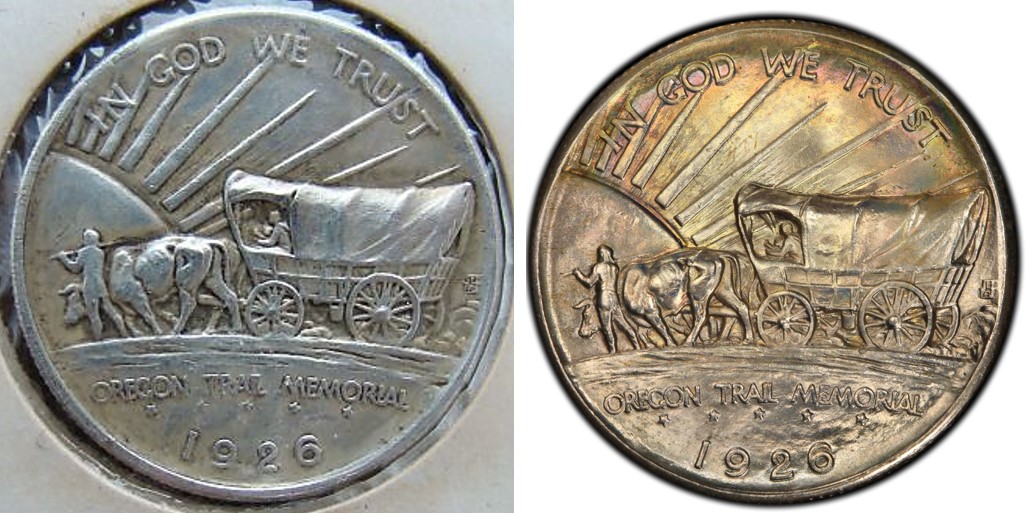 Edited by one_fine_dime
01/29/2016 4:48 pm
|
|
Pillar of the Community
United States
4085 Posts |
I am not sure I would agree that the first coin in the original post was cleaned. It has some spotted toning which decreases its appeal somewhat, but it still retains some nice luster as far as I can tell. Not all coins tone in desirable ways.
I still prefer it to the second AU details coin personally. The second coin has zero luster based on the pictures. Not attractive to me at least.
That said, in the interest of full disclosure, the Oregon in my 7070 has been (I am pretty sure) artificially toned to give it a highlighted look. I like it and consider it a type of folk art, but others probably see it as not original. To each his own as they say.
|
|
Rest in Peace
United States
17900 Posts |
one_fine_dime - you already did what I would have suggested, which was to place the fake next to a known authentic example. Since the fake photos are so unclear I can't pick out the most common tell on cast counterfeits, which are raised dots or marks above the fields (most commonly). This happens during the relief process from the original coin.
Everything is thicker on a cast counterfeit, not just the dates or words, but the dates or words are usually the easiest to detect as enlarged. Note any detail and your comparison will show the 'fatness' of everything which also "squishes out" those small details.
|
|
Valued Member
United States
265 Posts |
Informative thread guys thank ya. I see the difference in detail when placed side by side. I'm afraid I'd be in trouble without the comparison, tho. Looks like only slabbed for me until I learn the gift.
|
|
Valued Member
299 Posts |
Oregon Trail coins are a wonderful testimony to the great artistic couple of James and Laura Fraser. Caution must be utilized as the various date/mint combinations possess enough differences between them to cause confusion in expectations and therefore grading either numeric or subjective. For luster and superb toning, it is difficult to beat the 1926-s. For duller and somewhat lifeless surfaces, the 1939-P comes to mind first with the 1938-P often the least attractive of the 1938-PDS set. Of course, like every rule, there are exceptions but I think it's generally as I've indicated. The plethora of original packaging has contributed to abuse at the hands of the uninformed and cleaned or lightly circulated coins are rampant. Sulfur can be a great toning agent or the angel of death depending on the thickness of silver sulfoxide and the coin's surface type. |
|
Page 2 of 2
|
Replies: 21 / Views: 4,266 |
Page 2 of 2
|








 First Page


 Posted 01/29/2016 2:21 pm


