| Author |
 Replies: 21 / Views: 6,176 Replies: 21 / Views: 6,176 |
Page 2 of 2
|
|
|
|
Pillar of the Community
United States
9395 Posts |
Quote:
My guess is that it would have to be a very expensive 4X microscope objective to match the performance of this lens. I don't know, but I would guess few microscope objectives would be as fast as this lens. It has a has a 22.5mm entrance pupil. A standard F 2.8 50mm lens only has a 17.8mm entrance pupil. The 4X photos I posted are from a full frame sensor( 36mm X 24mm) Are there actually any 4 X objectives that can cover that sized sensor and retain a flat field and cnr to cnr sharpness?
Your lens has a much bigger entrance pupil than a microscope objective, but: If this lens 50mm f/2.2 at infinity focus, the working distance at 4x would be (5/4)*50 = 62.5mm. With a 22.5mm entrance pupil, I guess this means the subject-side effective f-ratio is (5/4)*2.2 = f/2.75, or 62.5/22.5 = f/2.77. Maybe my math is erroneous, here? At 4x, the sensor-side effective f-ratio is around f/11. I'm looking at a Nikon 4X/0.20 oo/- WD. 15.7 Plan APO objective. The front element is only 13mm in diameter, but the working distance is only 15.7mm. The NA=0.20 should work out to an effective subject-side around f/2.5 = 1/(2*NA), and an effective sensor-side f-ratio of about f/10. In theory, the objective could be as sharp as this lens, if everything is diffraction limited, within the 25mm? image circle. The big advantage of the lens is much longer working distance (presumably), and much larger subject-side coverage. The reversed lens would cover about 43mm on the subject side, vs just several mm with the 4x objective. The big question is: Does the actual performance of the lens (with much greater coverage and working distance) equal or exceed the microcope objective, optimized to cover a much smaller subject image circle and much smaller working distance? I suppose a good comparison would be this f/2.2 lens compared to the Olympus 50mm f/2 macro lens. I suppose I could run tests with the AF test chart comparing the 50mm f/2 at 4x with the Nikon 4x infinity-corrected objective. |
|
Pillar of the Community
 2087 Posts |
your maths looks ok to me. Here is photos of the lens next to a SK APO 40mm F 2.8 (note marks that appear to be on the glass of the lens are actually on the white board behind it. The 50mm has an F mount it designed to attach to an extension tube and then the focus is adjusted by messing with the lens in or out of the mount. The mount locks via a hex screw( visible just)  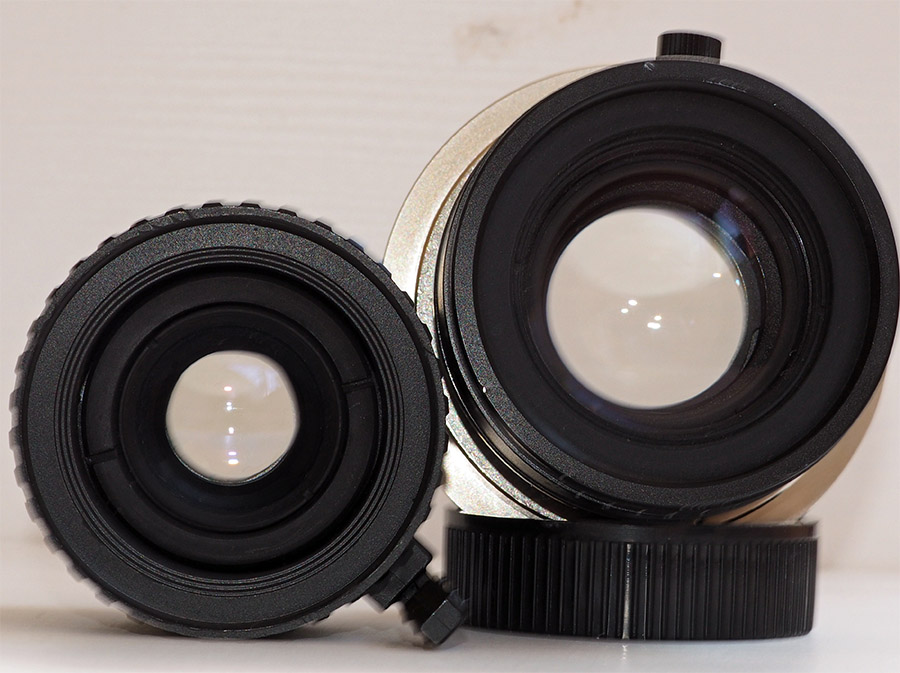 OMG who programed in the censorship.. they owe me a Whiskey! I wrote a word beginning with "S" that means "rotate on a thread" and it ends up as "messing with"! Rotating on a thread actually sounds ruder than what I wrote! LOL back on topic How much does the Nikon 4X/0.20 oo/- WD. 15.7 Plan APO objective cost? Edited by austrokiwi
05/21/2016 09:55 am
|
|
New Member
United Kingdom
1 Posts |
Quote:
( 36mm X 24mm) Are there actually any 4 X objectives that can cover that sized sensor and retain a flat field and cnr to cnr sharpness? Not that I'm aware of. Nikon 4x NA 0.1 BE is good for coverage but not the sharpest. Quote:
the objective (4 x 0.2) could be as sharp as this lens, if everything is diffraction limited, within the 25mm? image circle. Image circle isn't good to 25mm, iirc. Quote:
How much does the Nikon 4X/0.20 oo/- WD. 15.7 Plan APO objective cost? I bought one at $400, then another one popped up at $250 so I had two for a while. |
|
Pillar of the Community
2087 Posts |
Thanks ChrisR and welcome.
|
|
Pillar of the Community
2087 Posts |
|
|
Pillar of the Community
Canada
2784 Posts |
wow austrokiwi. how do you think this lens. would work for just checking coins for errors. having the tethered camera in liveview.
|
|
Pillar of the Community
2087 Posts |
I assume you mean the 40mm F2.8. I would anticipate it would do reasonably well it seems to be sharp from wide open so diffraction is less of a worry. Remember I was using a subject that was much more 2 dimensional than a coin so DOF wasn't to much of a problem. So with a coin in live view you might well find some issues, but you would have that issue with most lenses. The 40mm is hard to find economically I hunted for mine for at least 18 months...I let many go because the sellers were real dreamers
|
|
Pillar of the Community
United States
9395 Posts |
Based on these tests, it looks like we'd be better off sticking to the 4x microscope objectives then?
Of course, there's also the Canon Macro Photo 35mm (MP35) and the Olympus Zuiko Auto Macro 38mm (ZAM38), as well as the ZAM20 and MP20 versions. The reversed Olympus 50mm f/2 macro lens might also be interesting.
|
|
Pillar of the Community
2087 Posts |
Quote:
Based on these tests, it looks like we'd be better off sticking to the 4x microscope objectives then Where exactly does that comment come from? The 402.8 is brilliant on a MFT camera right way round and reversed covers from 1X through 5 X magnification on a full frame sensor. 50.2.2 was a cheap find that looked interesting? How many microscope lenses would I have to buy to get the same use? |
|
Valued Member
United States
441 Posts |
So are you basically showing on the first two shots that this particular lens cannot be focused properly at these apertures?
What exactly is being conveyed info-wise with your eval of this lens as compared to the SK?
|
|
Pillar of the Community
 United States
4051 Posts |
Hard to tell if f3.5 is the optimum aperture for the 40mm at 5x, but if so then it's operating at NA 0.11. If it needs to be stopped-down further it's NA is even smaller. So likely a 4x or 5x NA 0.1 objective can do as well or better on small sensors. Large sensors are a different story.
|
|
Pillar of the Community
2087 Posts |
Quote:
So are you basically showing on the first two shots that this particular lens cannot be focused properly at these apertures?
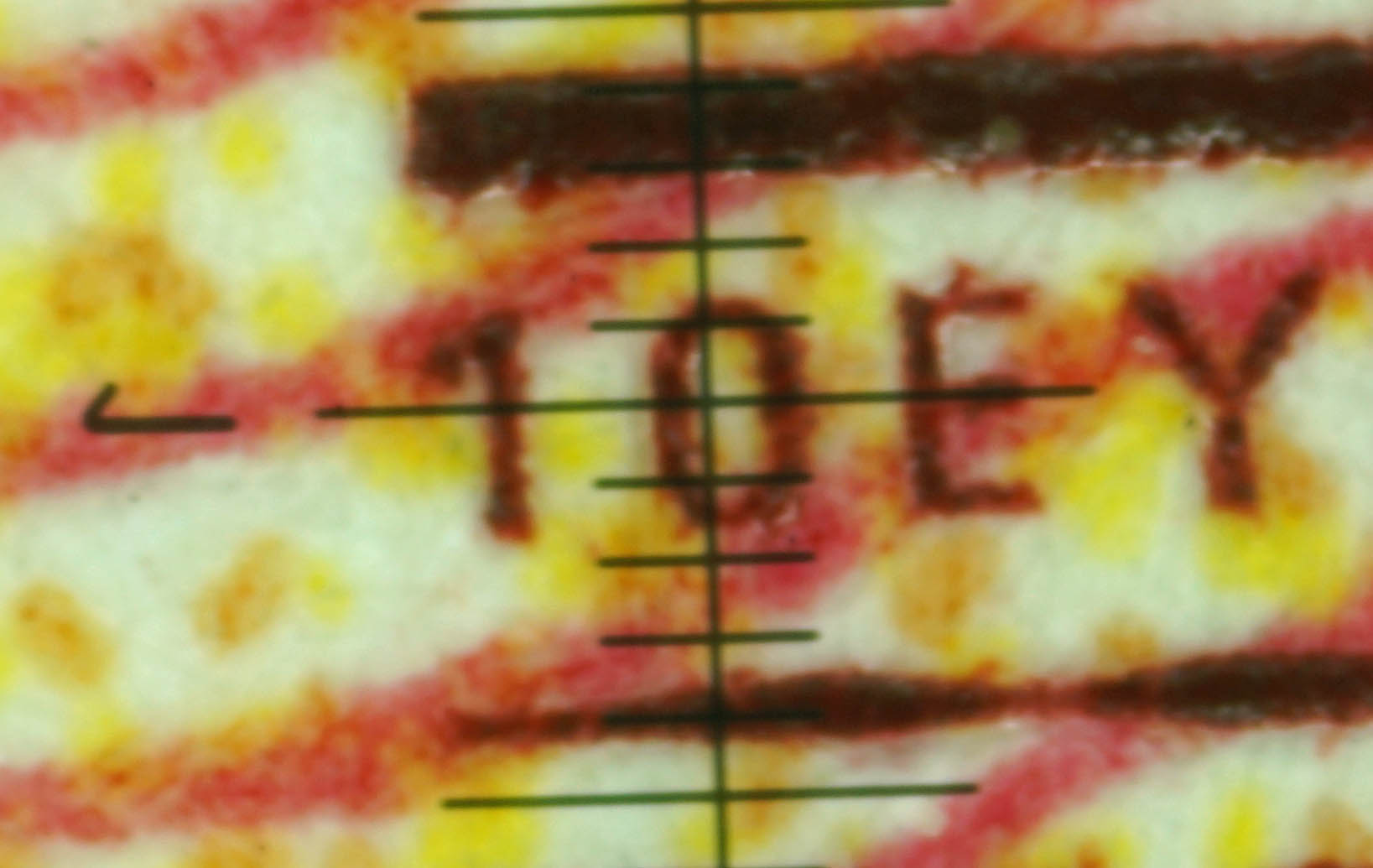
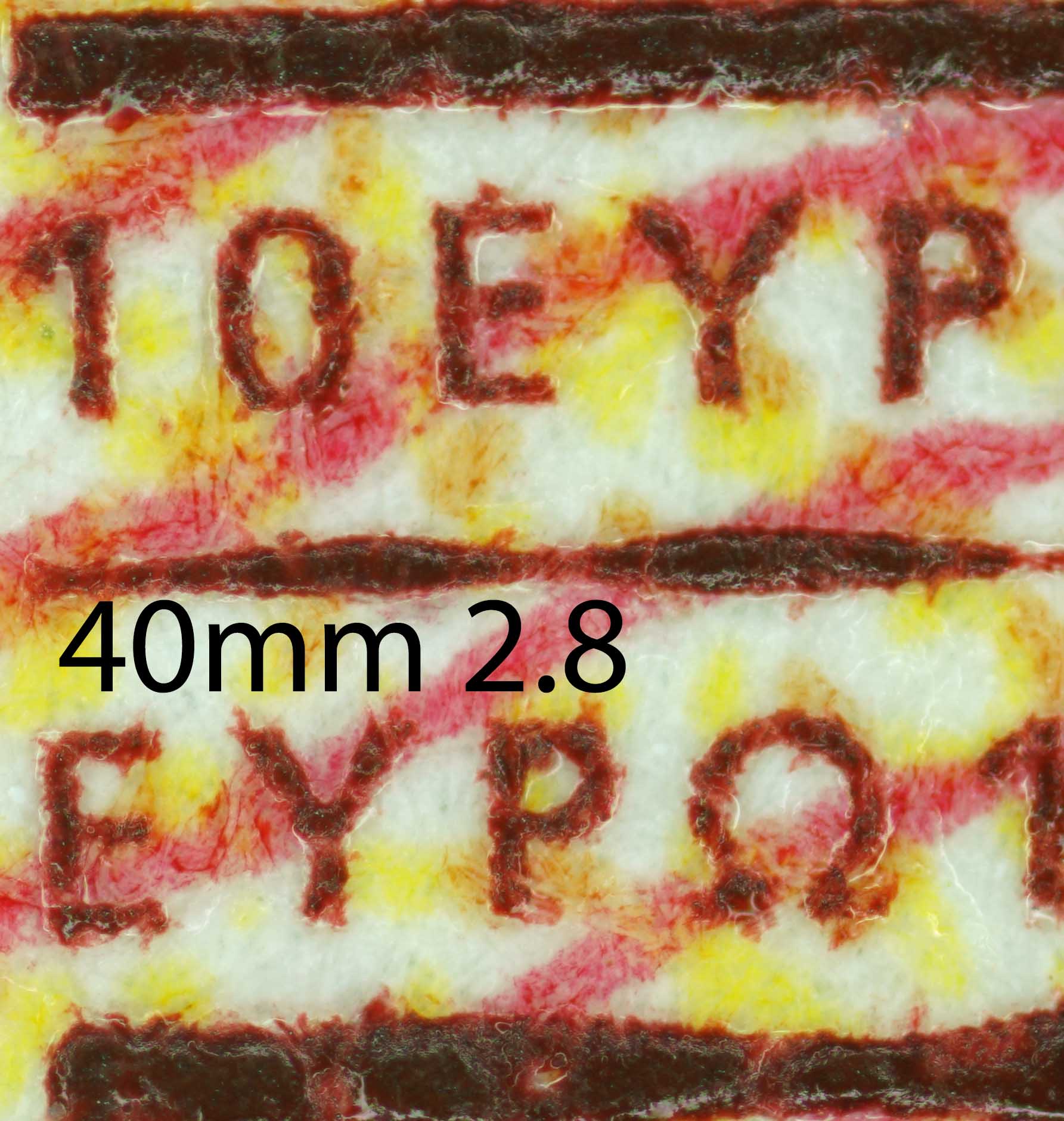
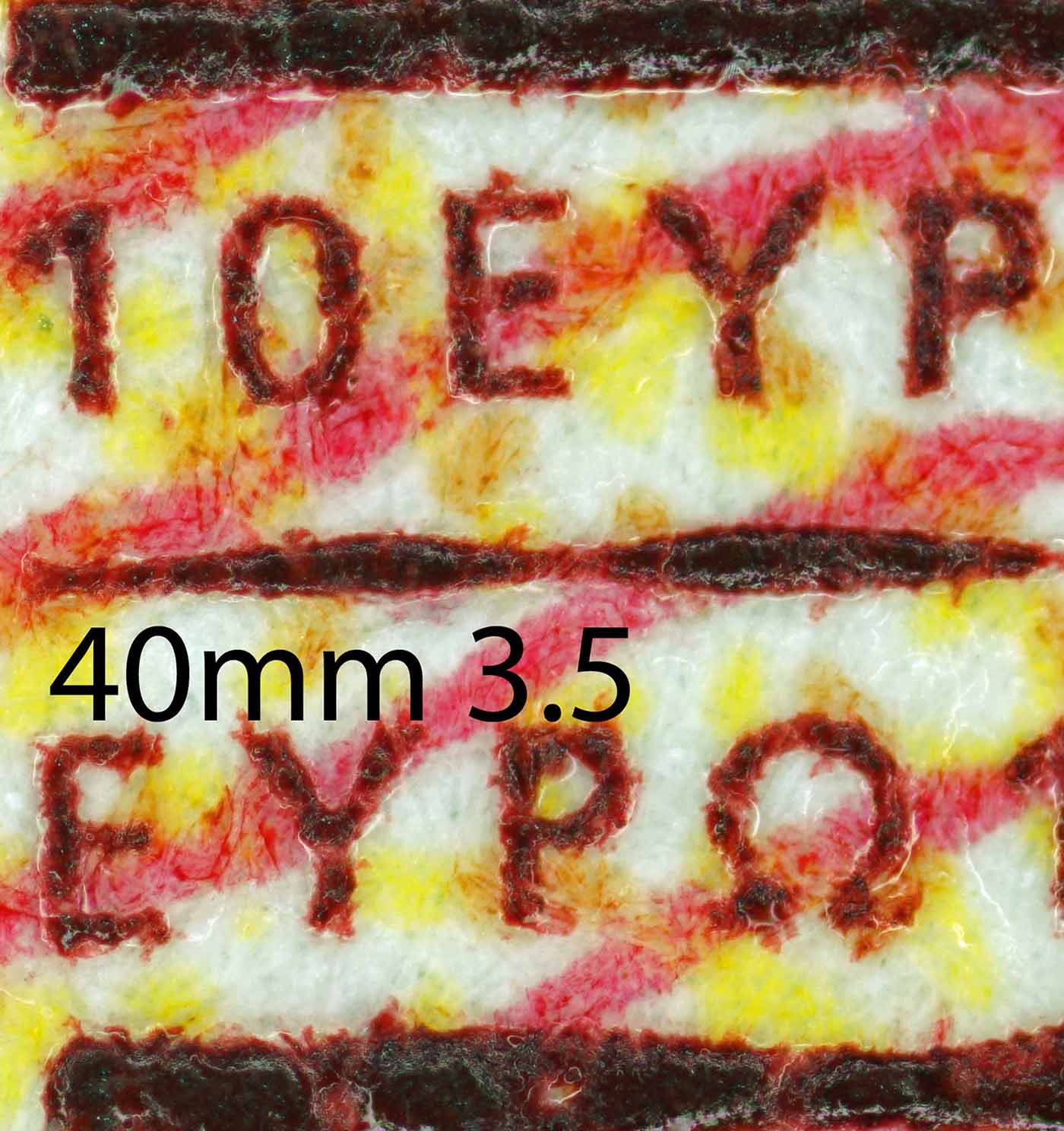
What exactly is being conveyed info-wise with your eval of this lens as compared to the SK? What I am showing is the SK50.2.2 is a bad lens for our purposes. rmpsrmps had noted it just kept on getting sharper as he closed down the aperture, which is a bad sign. Believe it or not those first two soft shots were in focus( as much as that lens could do on the full frame sensor it was amazing to see the transition when I changed the aperture to F4 from F 3.5. The subject suddenly became sharp. Now my point on using the lenses reversed is a general comment. Good Microscope objectives are expensive US$200-US$800 ( and much higher) and for the use I get out of them just a basic 50mm F 2.8 mm lens reversed gives me all I need, a magnification range of up to 5X. I had long ago thought about getting the canon MPE 65mm macro ( because it covers that magnification range) but, in the end I realized it was just collectors avarice. I was just not going to use a lens like the MPE 65 enough to warrant the expense. I could go and buy a good 14th century Florin or Ducat for the price. For my purposes a reversed enlarger lens( or even a reversed wide angle 21-24mm range) would suffice. On the full frame I didn't take the 40mm beyond 3.5 because in the past I had found there was only slight improvement and the effects of diffraction cut in pretty quickly after 3.5. |
|
Pillar of the Community
United States
4051 Posts |
To further AK's point, a more general-purpose lens is very useful in many imaging applications. My typical application is 3D image rendering, and in this work the highest quality objectives with thinnest DOF are required for vertical resolution. On the other end of the spectrum, if only a single image is desired for documenting varieties and such, then a much lower quality objective/lens is acceptable, because to get enough DOF for a single image to be sufficient the lens must be heavily stopped-down. Between these extremes, where vertical resolution is not needed for 3D, but the user is willing to do focus stacking, there is a wide range of acceptability. Even the 50/2.2 can operate in this range, but at lower quality than AK's 40/2.8. With these lenses the user has control over the DOF, and thus the number of images required for the stack. The user can even stop-down these general-purpose lenses to give wide DOF so stacking is not necessary, of course with lower resolution.
|
|
Pillar of the Community
United States
9395 Posts |
Quote:
Where exactly does that comment come from? It looks like you have to stop this lens down from f/2.2 to f/4, before it gets sharp, so a 4x / .20 microscope objective ought to give better sharpness, at least near the center. The advantages of the 50/2.2 would be better working distance, and when reversed, it might cover a medium format sensor. One advantage of the 4x / .20 is that it doesn't attach via a flimsy and vibration-prone bellows, but rather by a rigid metal tube, containing the tube lens (edited to fix problem with disappearing dots in ".20") Edited by pepactonius
06/09/2016 3:58 pm
|
|
Pillar of the Community
United States
4051 Posts |
I've never noticed any vibration in my system due to any of several brands and models of bellows.
A 4x/0.20 objective is a rare and expensive beast, and of course will do better than any other optic at 4x for center sharpness. I have one, but very rarely use it since it lacks coverage even for APS-C. I find that a 4x/0.13 gives sufficient vertical resolution for 3D rendering. A lowly 4x/0.1 is generally good enough for most coin photography purposes, having narrow enough DOF to require several images in the stack.
|
|
Page 2 of 2
|
Replies: 21 / Views: 6,176 |
Page 2 of 2
|







 First Page


 Posted 05/21/2016 08:53 am