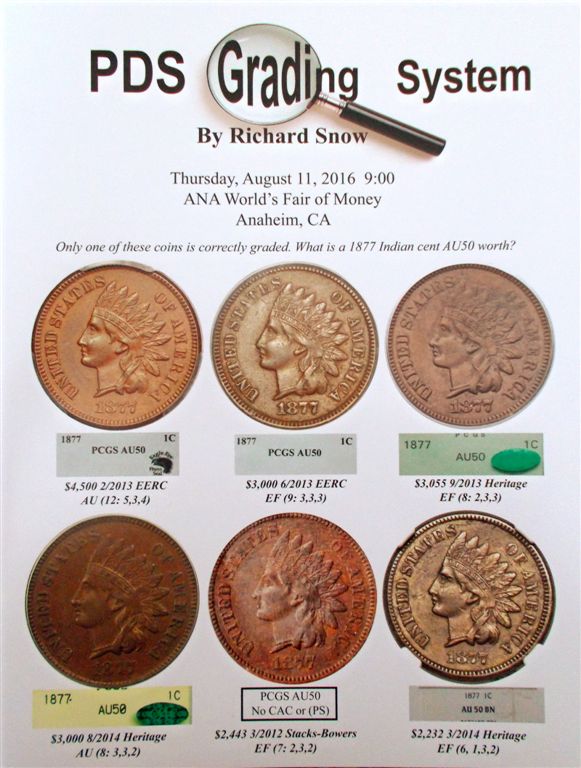
Quote: With CAC already stickering coins that are (allegedly) top end in their assigned grades, why is this even necessary?
Because Snow has some intentions of creating a better mousetrap as the marketing success of the green bean is obvious. Now, is the success of the green bean itself a worthy cause to copy? Maybe not but its revenue stream is quite promising. The reason I say CAC might not be worth its weight from an authoritative perspective is due to the number of coins I have seen that made me go And the fact that I know of some prominent dealers that can get anything a green bean due to decades long relationships with J.A. So favors being done ruins the integrity of the system.
The rest of Snow's intentions are probably honorable. I mean look at how they grade Ancients. IMO What Snow is proposing is seemingly a hybrid of modern and ancient grading with a sprinkling of CAC inspiration again, due to a proven marketing success story.
ArrowsandRays nailed it. I have had so many experiences with graders reversing themselves I have grown to question the validity of most professionally graded coins.
Any system is subjective to a degree, but the current system is extremely so.
I think that with computer AI becoming better every day that in the not terribly far in the future I could see being able to program them to grade coins. I'm not saying it will be easy and it would require a lot of testing, but eventually that could become the best way to standardize things.
I spoke with Rick today, and he said his presentation was attended by about fifty people, and thought it was received well. He presented me with the accompanying publication setting forth his proposals which I will have to give some close attention over the next few days. He also mentioned to me recently being shown a 1909 VDB graded by PCGS as a proof that distinctive diagnostics told him definitively was in fact a business strike....
my issue with the slide shown above is that the grading is utterly and simply subjective. "Only one of these 1877 IHCs is graded correctly"...says who? the guy making the slide? the guy(s) that did the grading? the person buying one of the coins? Its too obnoxiously presumptuous in nature for any one person to declare they've got it "right" regardless of pedigree.
My guess is that this system will fail to reach the masses and will only be used for certain issues of coins, i.e., IHCs and there will be an attempt made to create a business model centered around custom Snow Slabs for IHC coinage utilizing the red light green light 1,2,3 method. Yet another slab for the market to be confused by.
If it gives clarity to Snow's descriptions, it will be useful to him as a communication tool about his own products. DS, there is no one more qualified to give an opinion on an IHC or Flying Eagle cent than Snow, so that alone gives the process credibility. I don't see it working outside of small cents as the name does not have that same sort of cachet in other areas of coins.
To use Rick's PDS system to compare to PCGS or NGC graded coins muddies the water of what is the actual grade and value. For Example coin #1 has a PDS of AU12:534, What is the actual grade on this coin? Is it a high end 50, 53, 55, or 58? The person paying $4500 for the coin thought it most likely would grade higher. The PDS grade did nothing to help me determine the value or grade. I would find more use in the PDS system when comparing to a graded coin that PDS uses the same 70 point grading. For example, coin #1 is a AU55 12:534.
More to my statement that the major purpose of numerical grades is to bridge a gap between coin and price via price guides. If you have a total disconnect, you have a useless system.
He's returning to strict ANA Grading with the named values (EF instead of EF40, EF45)
I'm fine with that
He's proposing to add 3 additional scores together to create a single modifier, with 0-8 being an inferior coin, 9 or 10 being correctly graded and 10-15 being correctly graded but superior in some respects
too complicated
Why not use -3 -2 -1 0 1 2 for each of the scores (vs. 0-5) so that 0 is correctly graded, average, +1 -> +5 is superior and -1 -> -5 is inferior.
He also says that the modifiers change with the grade. But they shouldn't... if the coin is strongly struck, it's strongly struck whether you call it MS63 or AU58 or Average Uncirculated or Gem About Uncirculated.
Quote: the Strike factor is lowered since some might argue that the wear is actually a strike deficiency
Nope. If it's "The three factors are easily determined and do not rely too much on a judgment call." then they are what they are and the statement "If the grade assigned goes up, some aspects of these factors will go down." is nonsense. Technical grading does not depend on strike.
-----Burton
50+ year / Life / Emeritus ANA member (joined 12/1/1973)
Life member: Numismatics International, CONECA
Member: TNA, FtWCC, NETCC, EveryCountry (online) coin club
Owned by three cats and a wife of 40+ years (joined 1983)
This is going to be a riot. Try picturing all the coin books, magazines, etc. that use the present system being all redone. I wonder who will pay for that. And even in the famous Red Book, there are many places that still use the old G, VG, F, etc. system. Slabs everywhere will then too have to be redone or a tag with the new system interpretation added. True the present system is sort of lousy but changing it now may well be to late. Look how long it's taking to change the USA to the Metric system. All our cars still use MPG, not the metric system so changing the present coin grading system will probably have the same results. I've a better idea. Just change it all to Nice or not so Nice.
How about this: turn the third-party graders into the third-party authenticators. "Grading" services have ruined the hobby. It is now an investment game that is set to push out most of the collectors as prices rise because of investors that rely on the TPG labels and care nothing for the coin inside.
As is the case in many other hobbies, when investors start rushing in, it's the collectors who lose out, as the hobby transitions into a market-based, investor-oriented approach. Collectors of less than wealthy financial means are stuck fighting over the scraps and trying to cherry-pick decent coins from a flood of junk. The same situation occurred in classic (pre-1980) sports card collecting as well -- junk wax era collectors decided they were investors and drove prices to a ridiculous bubble, which burst in the mid 90s, only to be replaced within a few years by a new bubble caused by the introduction of third-party graded slabs. This virtually eliminated the ability of budget-minded collectors to put together higher grade (Ex-Mt+ / TPG 7.5+) sets of cards, as prices rose very rapidly, especially on the already-popular series such as 1952-1969 Topps Baseball.
I bought up a couple of original-owner small collections when I was in the card hobby, and most of the cards were in "bad to ugly" shape, many held together with decayed rubber bands, gum residue, creases, bicycle spoke damage, etc. Back in the 90s I was at a show table and the dealer had just bought a couple hundred worn out late 50s-early 60s Topps Football from the original owner. I offered $75 (almost my entire $100 show budget!) sight unseen and won the cards, then stepped off the floor and was surprised to find Bart Starr, Johnny Unitas, Otto Graham, and many other Hall of Famers staring back at me, along with a mostly complete set of 1960 Topps Football, and a nice Bobby Mitchell RC. Downside is, not a single one would have graded above a SGC 1.5-2/20-30, and a couple were creased so bad they quite literally split in half.
My mom collected as a kid in the 50s and early 60s. She did not save any of their cards, either. Mom, in fact, used to throw out all of the ones that were not Cardinals players. (!!)
A system similar to Mr. Snow's has already been tried out in raw sports card grading, where color, cut/centering, corners/edges, front and back surfaces, and printing sharpness were used to "qualify" a starting grade.
Didn't work too well there either, the TPG's just adapted it to numeric grades, much more easily understood by inexperienced collectors, which is why SGC now has "two" grades per card: 1-10 (technical grade) and 1-100 in 5, 10, or 2 point increments (quality grade.)
Disclaimer: While a tremendous amount of effort goes into ensuring the accuracy of the information contained in this site, Coin Community assumes no liability for errors. Copyright 2005 - 2026 Coin Community Family- all rights reserved worldwide. Use of any images or content on this website without prior written permission of Coin Community or the original lender is strictly prohibited. Contact Us | Advertise Here | Privacy Policy / Terms of Use







 First Page
 Previous Page


 And the fact that I know of some prominent dealers that can get anything a green bean due to decades long relationships with J.A. So favors being done ruins the integrity of the system.

 Posted 08/16/2016 09:56 am