| Author |
 Replies: 17 / Views: 2,027 Replies: 17 / Views: 2,027 |
Page 2 of 2
|
|
|
|
Bedrock of the Community
United States
94367 Posts |
Boy, I often get fooled by these, so I'll just listen.  |
|
Valued Member
 Denmark
126 Posts |
Wooow, this comes as a big surprise. I haven't seen this coming. This coin is actually up for auction at the very most serious numismatic society (coin club) - we have here in Denmark, and we have many very experienced members all over the world. However a very few of us - if any - are experts in US coins, so maybe this specimen could be a cast. If I should take this information to the board in the numismatic society, I would like to have more information. Could anyone hand over more details about this coin compared to other US Trade dollars? Regards, Palle DK |
|
Pillar of the Community
United States
4509 Posts |
Trade dollars are one of the most counterfeited coins in the US. I am not making a judgement on the coin being genuine or fake. The coin has a type 2 obverse and a type 2 reverse with a mini S mint mark that were used on the 1877 S. There appears what could be some casting bumps on the reverse above the eagle's eye, below the G in grains and above the arrows. The denticles at 4 o'clock on the reverse do not look full and there is some field imperfection in front of the denticles. You may want to recommend to your group that the coin is sent for grading and authenticity before being auctioned.
Edited by Slider23
10/21/2016 7:39 pm
|
|
Bedrock of the Community
United States
11951 Posts |
Trade really worry U.S. collectors.
China started faking them in the 1870's, I don't think they
have stopped.
So many U.S. collectors will hesitate to give a opinion.
(The first three of these I bought were fake)
If it is real, I would agree the grade looks AU.
I am not seeing anything that screams fake.
I would want to do some basic checks.
- weight
- check with magnet
- Check the edge/reeding to look for a cast line,
but make sure the reeding looks even.
If someone has a way to check the finess of the silver,
I would do that.
Also it was mentioned it might have a cast look.
Check the coins surface .. for a cast look
|
|
Pillar of the Community
United States
4211 Posts |
I am just here to listen and learn also as I would easily be fooled by the better counterfeits.
I assume it has been weighed already. Most counterfeits are underweight but some are overweight.
|
|
Bedrock of the Community
United States
12057 Posts |
AU details, harshly cleaned, ribbon, arrowhead and leaf diagnostics look correct, looks like the Micro S variety, but this may be a cast copy of a real coin; it needs professional authentication. As Slider noted above, there are certain things that are commonly seen on cast coins that are present on this example, although they may also be caused by die issues, abrasive cleaning, and wear.
Member ANA - EAC - TNA - SSDC - CCT #890 "Most of the things worth doing in the world had been declared impossible before they were done." -- Louis D. Brandeis |
|
Pillar of the Community
United States
6370 Posts |
Micro S variety. The surfaces do not look right. It may be genuine, but I usually call coins that look like this fakes and move on. Not worth my money to risk it.
|
|
Bedrock of the Community
 United States
18929 Posts |
maybe this is due to different dies used but here are two differences I noticed. the big toe looks different and the positioning of the date is different than the genuine example on the right 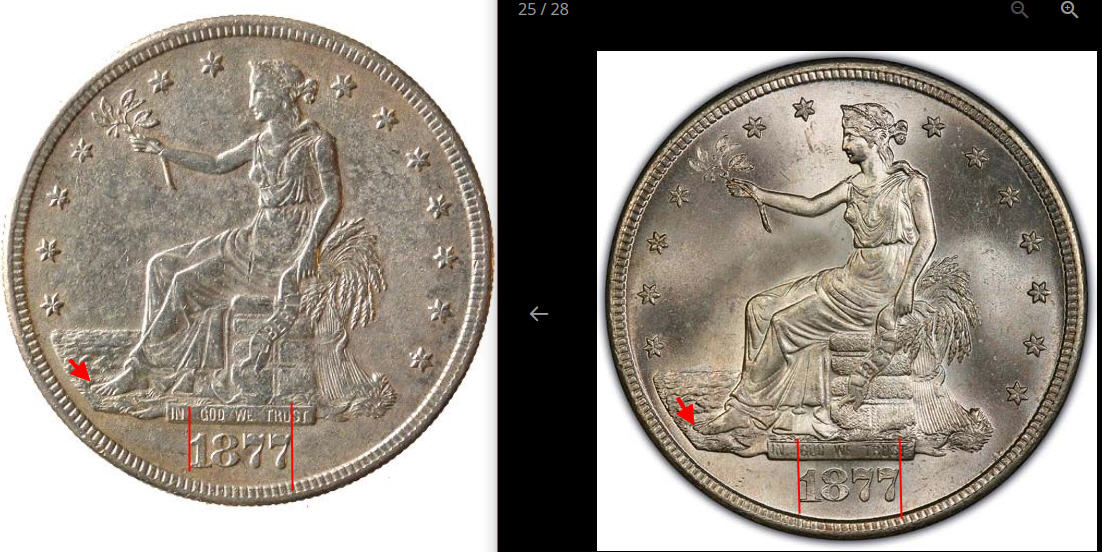 |
|
Valued Member
Denmark
126 Posts |
Thanks again for the lot of information. I am not sure of what to believe. I am pretty sure the very experienced valuer(s) has been checking things likes the weight and used a magnet too. I cannot understand if they haven't recognized a cast. We do in general not use nor like encapsulated coins here in Scandinavia. This is mainly a US and maybe Canadian thing - and even the best of these companies are not fully good enough grading our coins - they make several BIG errors! I just told a very experienced seller from Spain - whom had a very expensive Norwegian coin encapsulated from NGC - that the coin was a modern fake. He just answered with a "thank you" - he did not believe me but NGC - BIG mistake as I know more about coins from Scandinavia than any US grading company. However I will send the chairman a link to this site about the Trade dollar. If this coin is genuine - what will it sell for to a collector in the US? Thanks. Palle/Prncoins |
|
Pillar of the Community
United States
4509 Posts |
If the coin was genuine and problem free in a NGC or PCGS holder graded AU50, it would sell for around $250. If the coin was raw, it would sell from $150 to $190. NGC as a US company is very good at authenticity on the Trade dollar. Many US collectors that collect type coins in albums will often buy the Trade dollar in a holder because of the high number of counterfeits and crack it out for their album. |
|
Bedrock of the Community
United States
37193 Posts |
I have purchased many raw TD's over the years, but this is one I would not touch at any price.
|
|
Valued Member
Denmark
126 Posts |
The number has been withdrawn. I am very happy for the information you all provided.
This means a collector will not buy a (most likely) - counterfeit coin. Thanks.
Palle - DK
|
|
Pillar of the Community
United States
1691 Posts |
I read there are two die types for both the obv and reverse and and for this year they made type II only.....as pictured by Panzaldi above, appears to be type II dies...may not be counterfeit after all...IMHO.  Edited by atlashealth
10/24/2016 6:47 pm
|
|
Moderator
 United States
54297 Posts |
Quote:
I read there are two die types for both the obv and reverse
and and for this year they made both..... Starting in 1877, the year of this Trade dollar, they made ONLY type 2 obverse and type 2 reverse (which this coin has). The dates were hand engraved, so there could be differences between dies as to date position, however the rest of the coin should match. The areas that I notice quickly on this coin that could be of concern on the obverse are the weakness of the wheat stalks near where they are tied together and the graininess of the flat areas around Lady Liberty particularly around her outstretched arm; and on the reverse the weakness of the arrows, the weakness of the eagle's tail and the weakness of the denticles on the lower right side of the coin. Show your financial support of the Coin Community Family (click here)See my topic on Mexican Numismatic Medals (click here) |
|
Pillar of the Community
United States
4509 Posts |
As NSS-52 notes the date position could be different between dies. There are a number of known varieties within the type 2 obverse and type 2 reverse on the 1877 S as Breen identified 5 different varieties. One of the problems I find with Trade dollars and detecting counterfeits is the lack of documentation available on the different Trade dollar varieties within the type 1 & 2 obverse and type 1 & 2 reverse. |
|
Page 2 of 2
|
Replies: 17 / Views: 2,027 |
Page 2 of 2
|







 First Page

 Posted 10/21/2016 4:54 pm


