And finally:
Vespasian (71 A.D.)
Titus Flavius Sabinus Vespiasianus
BMCRE 453; RSC 67; RIC 329
Minted in Ephesus
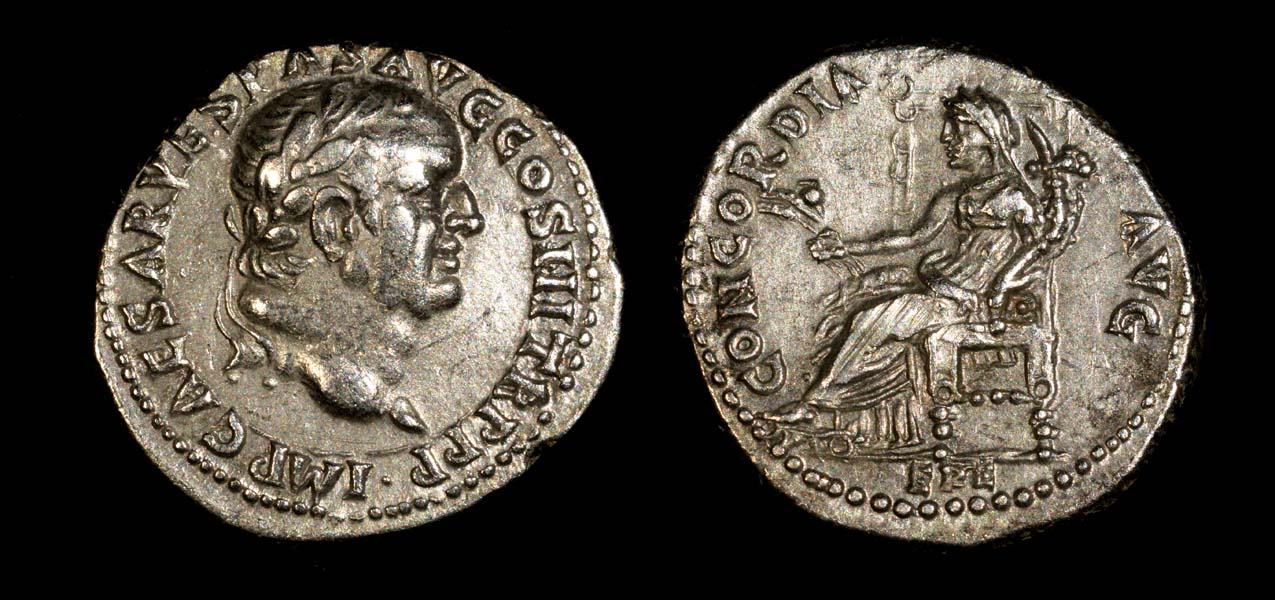
IMP CAESAR VESPAS AVG COS III TR P PP
As a general, Vespasion was often charged to "pacify" disrupted parts of the empire in an after the Civil Wars. In many respects this role continued as emperor, aided by the ministrations of his son, Titus, and so the coinage for Vespasian is considerable, from a number of mints around the empire.
Unlike Tiberius, whose visage on his denarii belie his advanced years (52) when he assumed the purple, busts of Vespasion leave no doubt that he was all of 60 years of age when he was called to the imperial office. Moreover, he held that office for 10 more years, and the coins do not hold back the truth about his appearance. For this reason, distinguishing father and son, despite common naming elements, is generally not a problem.
CONCORDIA AVG
in exergue EPHE (second set ligatured)
Ceres, veiled, draped, seated left on throne, foot on stool, holding two heads of wheat and a poppy extended in right hand, and cornucopia in left.
The detail on the reverse is extraordinary considering that the surface area is 29% smaller than normal. (diameter = 16mm vs 19mm). Nonetheless, I could not help being surprised by how masculine the face of Ceres appears in this rendering. The size of the nose and the strength of the jaw seems unusually large for a woman, in my limited experience. I also found it interesting that the grain represents one of the great necessities of life, but here they are supplemented with a poppy (the round object on a stick). Whatever it takes to keep the people happy, I guess.
Noteworthy too is the use of an abbreviated place name in the exergue to designate the mint. The last two characters are ligatured across the top, and are only similar in appearance to the letters EPE, the middle being more like a Greek letter Phi. There has been some dispute as to whether or not this represents the initial letters of Ephesus.
Titus Flavius Vespasianus (79)
BMCRE 61; RSC 313a; RIC -
Minted at Rome
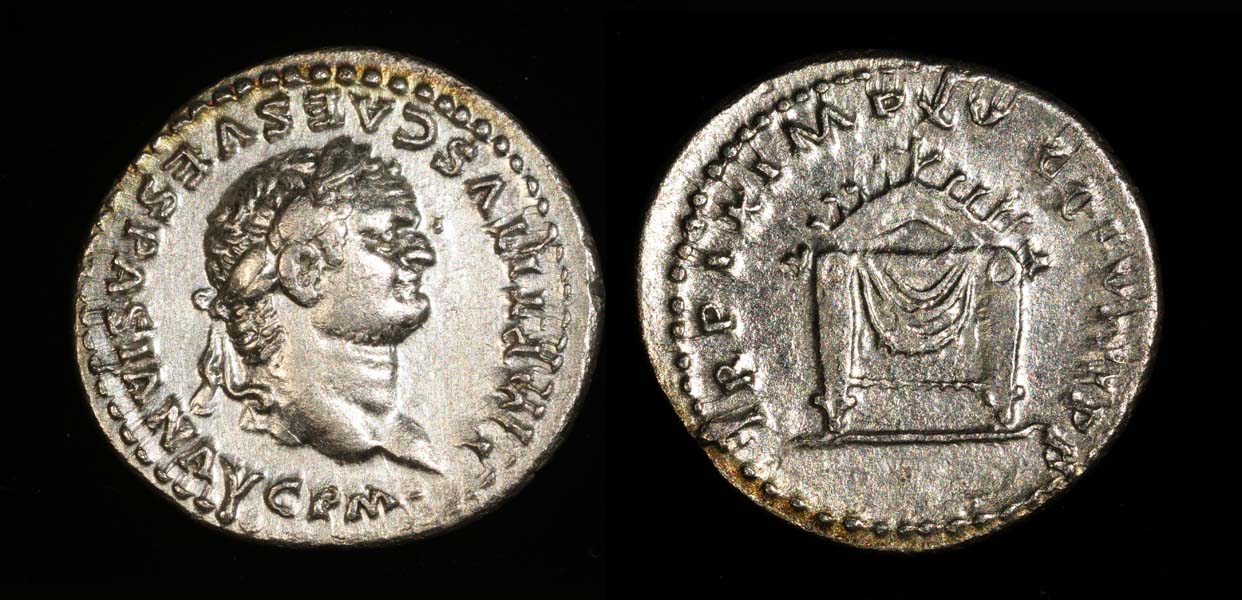
IMP TITVS CAESAR VESPASIAN AVG P M
(reading up from left)
bare, laureate bust facing right
When his father was called to Rome to serve as emperor in 69 AD, Titus was charged to finish the "pacification" from the Jewish war that had begun in 66. With the destruction of the Jewish temple in 70 AD, Titus determined most of that work was done, and headed for Rome to assist he father, leaving the cleanup operations to the 10th legion. For the next nine years he served as Caesar under his father, but was automatically advanced to Augustus in 79 AD after his fathers death, a position he occupied for only two years prior to his own death. As a result, out of 14 different obverse inscriptions on the denarii of Titus, only two bear the AVG title for him as Augustus, this one and a shorter version.
TR P IX IMPXV COS VIII P P
throne with triangular back
Domitian (81-84)
T. Flavius Domitianus
BMCRE -; RSC -; RIC -
Unlisted Mint of Rome?
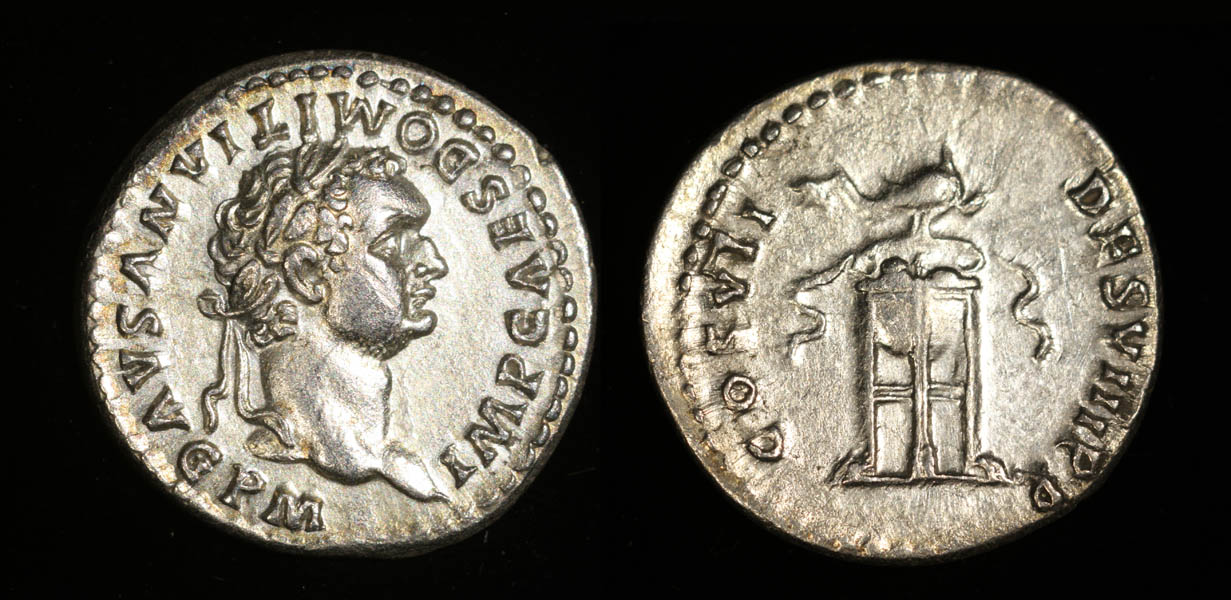
IMP CAES DOMITIANVS AVG P M
(reading up from left)
bare, laureate bust right
Really not sure what to make of this piece, so I thought I would post it here. There is nothing particularly exceptional about the features of the obverse.
COS VII DES VIII P P
This is a variant example from the third issue for Domitian. It has the reverse inscription of #10, but with the reverse type of #22; (tripod with fillets streaming out l and r, on which is a dolphin, as on no. 4) This combination of reverse inscription and reverse type is not listed in any of the standard references. It is a close variant of
BMCRE #10 for Domitian, so I have dated it to the same time frame.
On that last one, tell me what you think from your experience with these. This combination is unknown in
BMC and
RSC, but I do not have the appropriate volume of
RIC to verify anything.






 First Page
 Previous Page


 Posted 08/11/2017 8:16 pm





 pieces.