Coin Community Family of Web Sites Join Thousands of Coin, Bullion, & Money Collectors
Specializing in Modern Numismatics 300,000 items to help build your collection! Join Thousands of Coin, Bullion, & Money Collectors Vancouvers #1 Coin and Paper Money Dealer Royal Estate Auctions - $1 Coin AuctionsCoin, Banknote and Medal Collectors's Online Mall Royal Canadian Mint products, Canadian, Polish, American, and world coins and banknotes.


Username:
Password:
Save Password
Forgot your Password?


This page may contain links that result in small commissions to keep this free site up and running.

Welcome Guest! Registering and/or logging in will remove the anchor (bottom) ads. It's Free!

A Test - 1788 MO Fm 8 Reales

To participate in the forum you must log in or register.
First Page  Showing last 15 replies.
Author Previous TopicReplies: 21 / Views: 4,067Next Topic Page 2 of 2
Pillar of the Community
United States
5362 Posts
 Posted 02/23/2018  11:39 pm  Show Profile   Bookmark this reply Add swamperbob to your friends list
coloneljohn You are correct to indicate the seller may have been defrauded himself. He should be advised so he can pull the auctions - IF HE IS LEGITIMATE.

Lets see if he does.
Pillar of the Community
United States
5362 Posts
 Posted 02/25/2018  02:03 am  Show Profile   Bookmark this reply Add swamperbob to your friends list
coloneljohn He has replied claiming he does not know. Says he would terminate the auction and asked about others he has. I gave him the full list - all are fake - I believe three have incorrect assayer initials but all share the identical problems - edge-denticles-and raised rims.

I also checked his pair of 1806 Mo TH 8Rs. Both auctions use the same pictures.

Nothing is down yet.

Curious on the 1806 are the certificates of authenticity signed by Jimmy or James R. Gerstel. He claims to be a numismatist. Looked up the name and James Gerstal is a principle in the Panda America Co. a subsidiary of a Singapore company that exports Chinese Panda coins. A check of the BBB indicates no rating. Company has operated since 1982. Looked up comments and found claims that they overcharge for bullion. Also one comment that all of their ebay postings are bogus coins. I found the same fellow on Linked-in and his university credits come from "hamburger university". I checked and this is MacDonald's school for managers. I also found he has or had a TV show selling coins.

So with that kind of source can he think the coins are genuine?

I will check and update to see if he pulls the coins.
Pillar of the Community
United States
1757 Posts
 Posted 02/25/2018  3:07 pm  Show Profile   Bookmark this reply Add colonialjohn to your friends list
Its unusual he has them marked so high? If he was scamming mark them like $19.99 or just below spot silver for an ounce. Seems like he was scammed and he is in the process of $$$ recovering his loss since they are still up for sale?

Bob - what I do is look at his HISTORY. He seems to be a simple buillion dealer with Morgans and Eagles being sold in the lst six months. He has sold one bogus 1804 and he probably got stuck with this group for several hundered dollars. He is recouping his losses which may explain these high starting prices? He is a VICTIM making now other people VICTIMS of his unfortunate blunder - IMO. Its the American Way ... today. I venture in COIN TALK occasionally - Bob your book still has a long qway to go to infiltrate the marketplace. Too bad David Bowers never took our advice and put a Whitman sticker on the book. Whatever ...

JPL
Pillar of the Community
United States
1962 Posts
 Posted 02/25/2018  4:41 pm  Show Profile   Bookmark this reply Add realeswatcher to your friends list
There are SOOOO many of these types that have slipped unnoticed into mostly "good" collections, it's not worth wracking your brain over... and it can simply be frustrating to waste your time trying to convince these clueless sellers (obviously, if they list pieces like this in the first place, you're starting the lesson from scratch).

Again, that 1776FF, which is one of this type... was listed in Krause for some years now - so the early incarnations of these have been around for a while. They might not even NEED that fake tonejob... might be natural patina by now.


Quote:
Bob your book still has a long way to go to infiltrate the marketplace.

Honestly, musing aloud here... maybe these "sort of deceptive but easy to recognize if you know what you're doing" fakes aren't so bad. Wheat from chaff? It may soften the underside of the market some, but raise the bar of sophistication overall.
Pillar of the Community
United States
5362 Posts
 Posted 02/25/2018  8:20 pm  Show Profile   Bookmark this reply Add swamperbob to your friends list
I am more fearful that the more novice collectors get burned - the fewer will bother to learn.

John your point about re-couping losses may be the way some people operate, but it is still dishonest.
Valued Member
United States
93 Posts
 Posted 02/25/2018  10:56 pm  Show Profile   Bookmark this reply Add 20021sc to your friends list
swamperbob It's me, 20021sc, the 1866 PCGS poster from a month ago or so (who could forget that?) ..I stepped back some for awhile after that experience. But I was looking on ebay lately and actually put in my save list the coin you mentioned here first that this seller has still active as I write this. I thought this was one of his (or her's) better examples for sale and suspected something about all of the portraits they have for sale, but visually everything looked "right" to me. I should have looked at the edge closer. I now see it's raised rim. What I quickly glanced looking for an overlap on the edge sufficed for me. Boy, do I still have a lot to learn.
I was looking at the features on the coin more as I've spotted several counterfeits that way. Since you said it was copied from a legitimate coin, that made me feel somewhat better. But I think I'm going to be doing a lot more studying before I attempt to collect portrait 8 Reales if I ever do continue in that direction. I'm stopping again after reading this post and will try and learn more first.

I think you have a very valid point about as the newer collectors (like I basically am to this portrait series) get burned, the more likely we are to not learn more and drop out of this area of collecting. I know I've thought about it and calling it good. But I did get better on the cap and rays series from reading some of the posts on the forum here. Since acquiring the binary scope, I've returned an 8 Reales that was almost half the cost of the scope alone. If not for the scope, I would have kept it too. It was genuine passing the weight, SG, rim tests, etc. But under the scope was too harshly cleaned for me. I don't like cleaned coins as most collectors don't also. But this one was a pricey one in the year and condition it was in, and for what I paid thought it was an ok deal. It was obvious it had been cleaned, but still held "eye appeal" to most I would think, myself included. Especially someone that didn't know coins very well would have thought maybe it was a great deal even. But under a 40 x scope, it was horrific.

So basically, thanks for all the info and please keep it coming. Better to learn and improve one's knowledge than to blindly go forth carelessly.

And it's too bad ebay doesn't remove sellers like this or at least do something to try and prevent it. That's a crime too.
Pillar of the Community
United States
5362 Posts
 Posted 02/26/2018  01:58 am  Show Profile   Bookmark this reply Add swamperbob to your friends list
20021sc Thank you for your comments. I write most of what I do in an attempt to make people think.

The idea behind my method is that once you conceptualize how a coin was originally made (all the steps) you have a better shot at knowing when something is just not correct. The raised rim that cuts off part of the dentils is a classic case. The original dies were always cut larger in diameter than the planchets and the dentils were lozenge shaped tapering at both ends. Once that fact is clear, it becomes obvious that if an arc segment cuts off the dentils before the edge of the planchet something is WRONG. That something is that the wrong press and die assembly were used and you can conclude the coin is not genuine. It is also very likely that the image was copied from an already existing coin. Adding those pesky ends of dentils to a forged die is trickier than it seems.

I learned this overall method from a dealer in Boston and it allowed me to use much of what I had learned in school about deductive reasoning and engineering of metals.

One other thing you need to learn is that "cleaning" is not the worst thing that can happen to a coin like an early Mexican 8R. Cleaning of coins was not considered taboo until the Sheldon 70 point grading scale caught on. That (the Sheldon scale), in my opinion, is one of the worst things to happen in collecting in the past 40 years.

Especially when collecting Mexican colonial and early republican issues completetness of the strike, perfect centering and eye appeal are far better criteria than technical grade. MS is often meaningless when discussing some segments of the series. Rarity of 8Rs is simply not a function of state of preservation alone. The ridiculous prices for MS grades from the 1880s and 1890s is a good example. Many of the discolored, weakly struck and off center coins that spent their entire lives in Bank Vaults are not rare. But when these ugly sisters are placed in TPG holders they are treated as rare by technical grade number. That is a marketing ploy. Most collectors outside the US do not have these coins graded by TPGs. So when you get the "best ever graded by XYZ company" example what do you really own? A high price tag but little more. Hoards are still being recovered. Do not fall for that highest number plastic disease that many collectors catch.

High relief coining dies (like the majority of the Hooknecks and many other early dates) are essentially impossible to find 100% fully struck up. There are some die features that you never see. The scales or bands on the snake where it crosses the eagle's breast for instance. Because of large hoards of some of these dates that never circulated there are often many coins exhibiting no wear (technical MS coins) for a specific date and mint. These can be common compared to fully struck up examples. It may be just my personal preference but a fully detailed snake showing across the eagle's chest which looks great and is perfectly centered is far more important than some high point wear or field defects. You can also save some money at the same time because AU or EF coins are "cheaper" than full strikes - unless you run into old timers like myself who still place a premium on eye appeal.

Mexican coins are very much unlike the recently made US coins. These coins have a story to tell. I can spend hours looking at details like die setter's tick marks. I try to visualize how these tiny pin pricks and scrathed arcs were used to manually align die details by proficient craftsmen. These are not sterile clones like a Lincoln Cent. When dies wore or clashed - repairs are made often involving details that got recut or repunched. The varieties are fascinating.

Just looking at a high grade early cap and ray coin for clues as to what each punch added to the die is challanging. For example when did Zacatecas stop using individual punches for each of the eagle's wings? When did Guanajuato cut the eagle's lower jaw line by hand? When did the cactus plant become a single punch? When did the spines appear on the master punches? Can you tell how many hubs Durango used in 1832? Can you list the individual elements that were typically added by hand after hubbing for each mint? How many rays are there on the Cap? Did they vary in number or not? Did the order of the rays vary by die? Do all the rays trace to a single centering point in the cap? How many rays are overcut using two punches to create? Were outline rays with low centers ever used? When did the long tail of the San Louis Potosi coins become broken creating a bob-tailed eagle? How many breaks happened to that tail? How many dentils were on each punch that created the edge of the coin? Did you know that some counterfeits can be detected simply by that number?

The more you look at the Cap and Ray series the more detail you can derive. Of course if you like looking at clones searching for a stray die scratch or chipped letter collect the Standardized dies hubbed at Mexico City after 1886. BORING but high grades available on the foolish Sheldon scale.

There is something for everyone in this complex series and many discoveries are waiting for you to make. Even if you are re-discovering a fact that was published 60 years ago it is new to you, it may have been forgotten by 99% of collectors and it can be very personally rewarding.

Enough philosophy - remember to have fun. Forget the money enjoy.
Valued Member
United States
93 Posts
 Posted 03/02/2018  11:04 am  Show Profile   Bookmark this reply Add 20021sc to your friends list
swamperbob :
OK, I think I get it about the denticles. If they're completely cut off in a segment of the circumference, something is wrong? So if it's struck so far off center that the denticles are not there at all in even a small portion of the peroimeter, it's counterfeit? I'll be looking for that in the future if I understand you right. I can understand wear affecting the denticles and appearing to not go all the way to the edge. Also certainly know about centering issues and planchets smaller than the dies. I would like your opinion on this one coin that ends tomorrow (I'm not bidding on it, just if you think it's genuine with the denticles the way they seem to not go to the edge of the coin? Also appears to be a raised edge from what I can see of the pics provided?) It's

https://www.ebay.com/itm/1789-FM-Me....m1438.l2649


Many coins in my whole collection, not just some 8 Reales, are cleaned. if they still have the all important eye appeal (to me anyway), it is what it is. You either are ok with it, or try and sell it or just keep it. I would rather have an uncleaned one that a cleaned one, all other things considered, just me.
There are many things I don't like about the Sheldon scale. Like one of my pet peeves is there is no numbering between certain numbers. Like ever see an AU-59? how about an XF-43? 42? 41? A VG-13? Weak strikes do not seem to be considered. Different mints have different strike qualities. In the Morgan dollar series, San Francisco and Carson City silver dollars have more sharply struck eagle breast feathers than Philly or certainly New Orleans, but it that considered? Doesn't seem to be in most cases. Other things too that are just not right with that grading system. But ask almost any coin collector what other grading systems they like and you will get a blank stare.

Reading one of your later paragraphs makes me realize the extent of your knowledge on the cap and ray series. I could not answer a single question you ask. All intriguing, but I'd have to spend vast amounts of time I simply do not have now to even begin to research any of those points. All those things do point to some of the fascination of this unique coinage IMHO.

And, yes, the slabbed, higher graded later 8 Reales are ridiculously priced and I cannot afford them. A marketing ploy for sure. But I sure would like to find one of the hoards you mentioned left! That would be something!

Thanks again for all the info. I'll try and not forget and continue to learn hopefully.
Pillar of the Community
United States
5362 Posts
 Posted 03/03/2018  01:16 am  Show Profile   Bookmark this reply Add swamperbob to your friends list
20021sc You start by saying;


Quote:
OK, I think I get it about the denticles. If they're completely cut off in a segment of the circumference, something is wrong? So if it's struck so far off center that the denticles are not there at all in even a small portion of the peroimeter, it's counterfeit?


You have misunderstood what I am referring to.

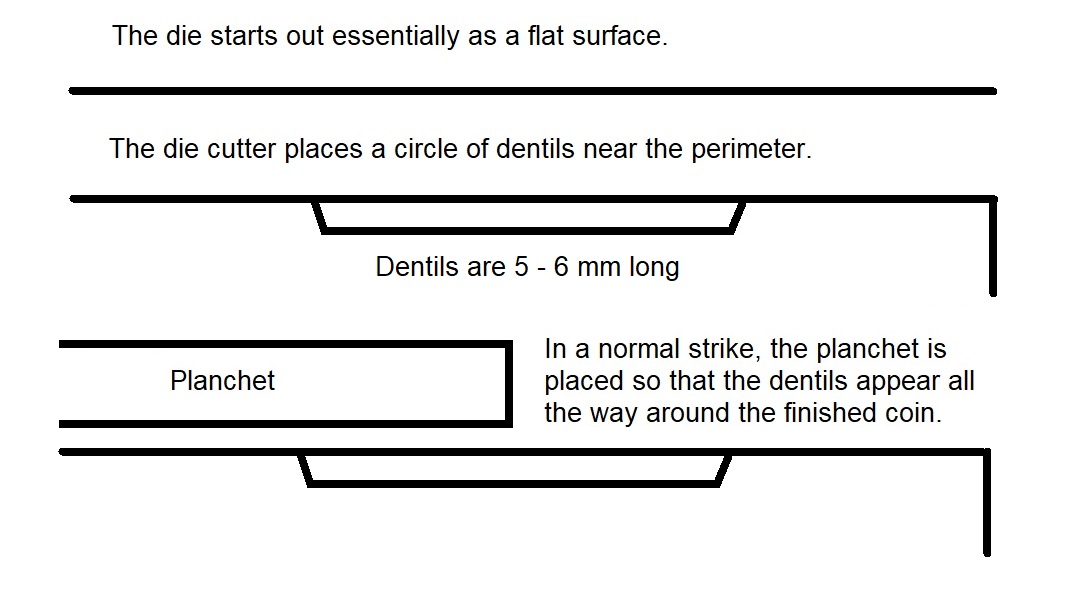
You must start with the fact that the 8 reales working dies were made larger in diameter than the coin they were made to strike. This was because the screw press had no automatic centering device. A person had to place a planchet between the dies while other men spun heavy counterweights attached to the vertical axel.

So on a working die the entire dentil appears - beyond the dentil circle there is a flat surface which is at the same level as the field.

A-Test---1788-MO-Fm--8-Reales

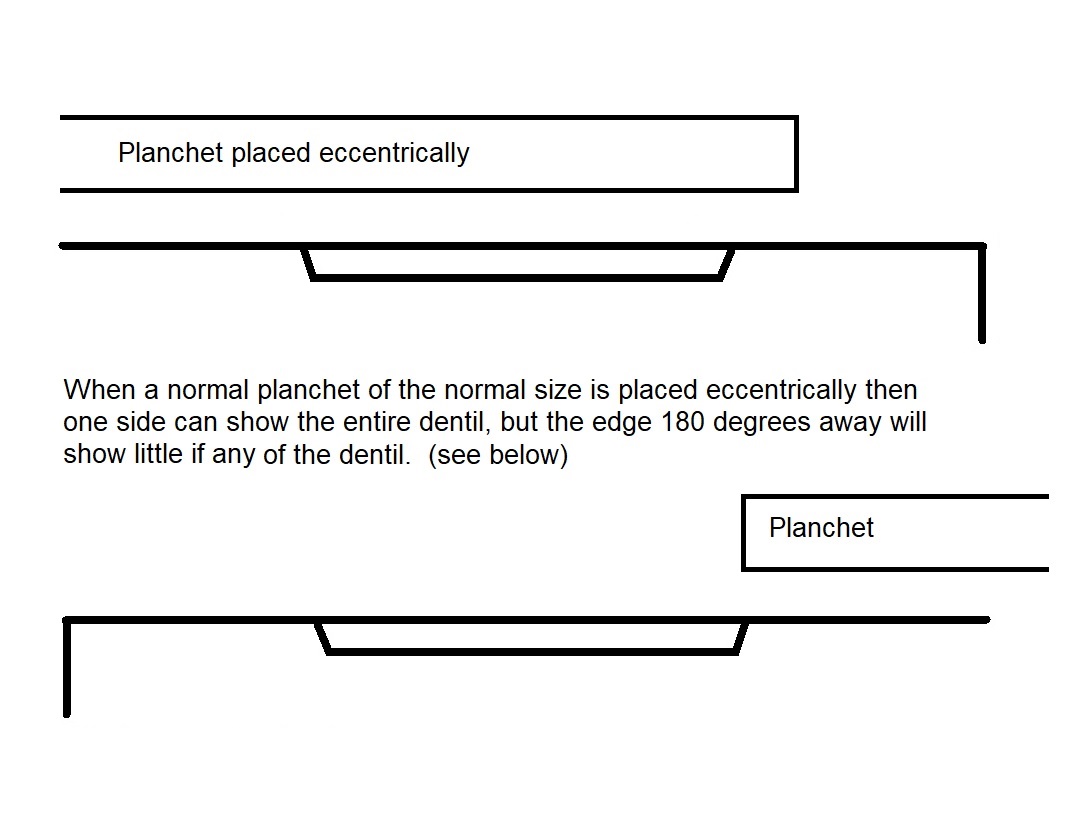
When a planchet is placed on the die eccentrically the dentils may partially disappear along part of the perimeter. This is NOT a sign of a forgery.

A-Test---1788-MO-Fm--8-Reales

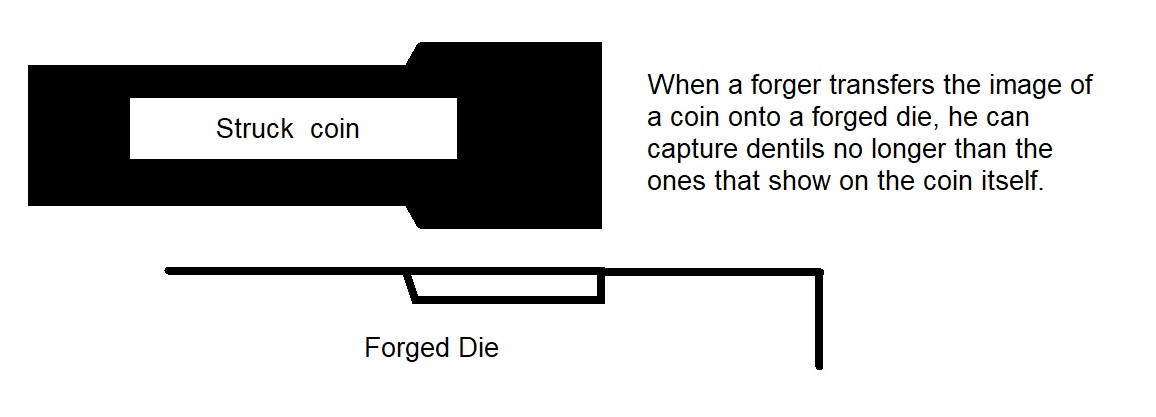
When a forger makes his dies, he often starts with a genuine coin. Using any of a number of different processes he can transfer the image of the coin to a die. The die will be exactly like the coin. This may/will include partial dentils.

A-Test---1788-MO-Fm--8-Reales

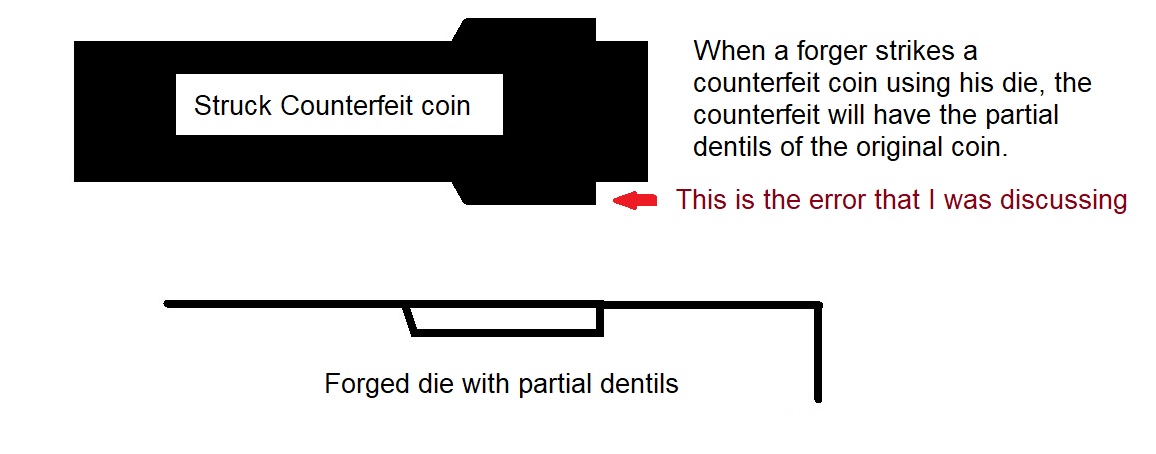
So if the forger does not add the ends to the dentils on his fake die (which usually does not go well), the coins he strikes are exactly the size of the die. This requires perfect centering of the planchet. An off-centered planchet leads to the error I was referring to - Dentils that end BEFORE the edge of the coin.

A-Test---1788-MO-Fm--8-Reales


Quote:
I would like your opinion on this one coin that ends tomorrow


The coin is shown inside a plastic and cardboard container that I am very familiar with. The offering enclosed coins that were purchased in China in bulk. A good percentage are counterfeit and most are polished. Typically they are a poor investment.

I am fairly certain that the coin enclosed is a forgery but I can not be 100% certain because of the plastic, it has a tendency to reflect the edge and can make the edge visible as if those details are at or near face level.

The Sheldon scale is flawed. There is no consensus when it come to the grades that exist. Two graders will grade a coin differently. If the scale worked that would not happen but it does. The MS coins have become foolish. I collect counterfeits so cleaning and other damage is no problem for me.

Hoards are still out there. I know many "pot hunters" and always keep my eyes and ears open for new discoveries.
Valued Member
United States
93 Posts
 Posted 03/03/2018  5:25 pm  Show Profile   Bookmark this reply Add 20021sc to your friends list
swamperbob : OK, I think I've finally got it. The pictures help a lot.

Sorry to be so obtuse. I do understand now about the dentils. I also bookmarked this page for future use.
Thank you again!
Pillar of the Community
United States
5362 Posts
 Posted 03/03/2018  6:29 pm  Show Profile   Bookmark this reply Add swamperbob to your friends list
I am very glad it helped.
Valued Member
United States
93 Posts
 Posted 03/11/2018  10:59 pm  Show Profile   Bookmark this reply Add 20021sc to your friends list
This one certainly seems like the dentils don't make it! Now here's a raised rim:

https://www.ebay.com/itm/Mexico-8-R...AOSwwlZapVCd

Pillar of the Community
United States
5362 Posts
 Posted 03/12/2018  01:10 am  Show Profile   Bookmark this reply Add swamperbob to your friends list
20021sc The coin is a modern Numismatic Forgery that was made on a closed collar press by the Chinese. It was very common on ebay at one time, but has largely been replaced by a new generation of improved forgeries like the one that started this thread.

The 1801 actually has a reeded edge applied by a modern collar die. These non-silver copies are worthless. The design is a total fabrication with details that are not original. The edge has a raised flat rim like you see on modern struck coins and the perimeter design is like the beading employed in the mid-1800's and after by most world countries. So it is technically a different type from what I was describing, but has the same outcome.

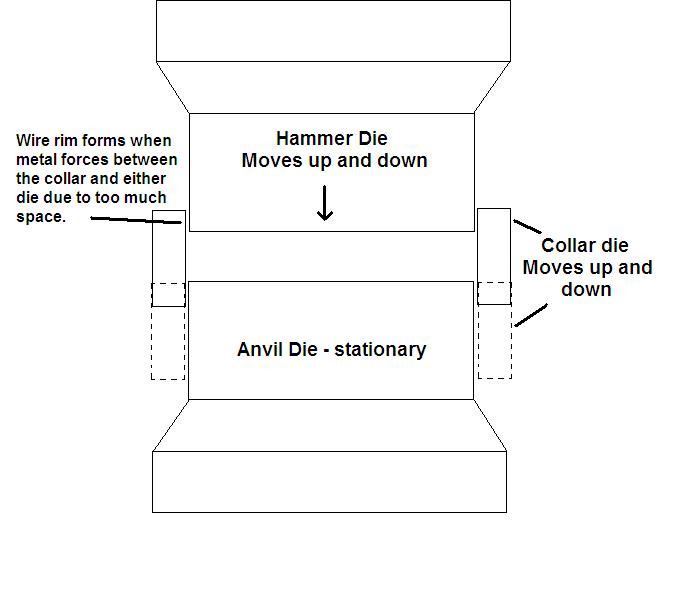
Here is a picture I posted earlier showing a closed collar press with a rising and falling collar.

A-Test---1788-MO-Fm--8-Reales

A closed collar press has a moving collar that rises for the strike and then falls when the complete coin is removed. The collar contains the edge design often reeds. The edge design is imparted to the coin by the force of the strike. The three dies form a closed space referred to as the coining chamber. The pressure of the strike causes metal flow in three dimensions fill all three die. The retraction of the collar causes stria to develop on the edge. A second type of closed collar may be used as well. Developed in France the split collar is composed of segments that join to form a circle. This collar usually moves sideways to form the coining chamber. The benefit is that a spilt collar can impart raised or incuse edge features impossible on a sold collar that can only rise up and down.

The rim that appears on the coin is usually a die feature. The perimeter of the die is cut down slightly below the die face. Expansion of the rim is limited by the collar. If the collar and die do not form a tight fit a small sharp fin extrudes into the space.
Valued Member
United States
93 Posts
 Posted 03/16/2018  11:35 am  Show Profile   Bookmark this reply Add 20021sc to your friends list
swamperbob : OK, interesting about the closed collar press. A lot I do not know about minting, I must admit. While we're still somewhat on the subject of dentrils and edges, what do you think of this 1828 Durango coin? The dentrils seem very uneven in places, even for sometimes crude, early Republic issues they seem very odd. Not very concentric either. I can see maybe why the dentrils do not go all the way to the edge in places, maybe the planchet was placed off center and the entire dentril is seen and then some of the blank planchet. But why the irregularity in the dentrils themselves? And under the Do and date on the cap side, there seems to be a raised edge. Do you think this coin is genuine? As a last side note, I noticed the eagle's claw does not appear to touch the cactus and I think I remember you saying that's not a good sign in an earlier thread.

https://www.ebay.com/itm/Mexico-182...352305401754


Pillar of the Community
United States
5362 Posts
 Posted 03/16/2018  5:07 pm  Show Profile   Bookmark this reply Add swamperbob to your friends list
20021sc Regarding the eagle's feet and the cactus pads - that depends on the date and mint. Some mints used numerous die punches to create the dies while others used King punches, partial hubs or full hubs. There is no text that covers this subject completely. The closest is Resplandores by Mike Dunigan. You need this book before you buy Cap and Ray coins. There you will find a picture of 1400 mint & assayer combinations. He includes notes on design types that can be clues to how dies were created. He also often indicates when hubs are first used at each mint.

Starting with his book you can get to know when most major technological shifts took place. Using the pictures you can see some of the variation. Next go to a website like Heritage where you can see high grade pictures of each coin. Focus on the transitional periods first so you understand what changed.

You really need to become familiar with each period to be sure. For early coins that means each date individually. It is a lot of study but without it you will always need to ask questions like the eagle's foot. The best way to determine the ways dies were made is to start with pictures of say 10 examples of a specific date and mint. Then check Resplandores to try to pick up clues there. Then study the details of each coin to see what varies. If a detail is EXACTLY the same on all 10 that detail is likely on a single punch.

Some mints used one punch for the eagle (it was referred to as a King Punch). It was set first and the rest was added around it. To set a king punch requires more power than a smaller punch. The king punch was set normally on a screw press of the same type that was used for coining. The operation was done more slowly and usually needed several presses to complete. Then the partial die went to die setters to add smaller punches and details. Zacatecas was one mint where they went from full eagle punch to partial and back to full a couple times. Guanajuato did the same. It depended on who ran the mint. At times a mine owner leased a mint to make coins at other times the State government or the central government controlled the mints. Dunigan provides a very helpful list of these contracts.

On early Durangos - 1825-1832 the dies vary considerably. This could be a decades long study by itself. Dunigan notes three "Die Styles" 1825-1827, 1827-1929 and 1830-1832. In 1832 Dunigan discusses the introduction of hubs. The early Die Styles contain variations. The 1825-1827 Style contains a significant number of variations which some people list as varieties. Some of these variations Dunigan notes but not all. Dunigan lists only two varieties for 1825 the examples with a period between REPUBLICA and MEXICANA and the eons that have no period. He does indicate more than one eagle punch is used for 1825 and that there are variations in the cactus pads that need to be studied, but in these cases he does not refer to the differences as varieties.

What Dunigan does not list can be very surprising. One example is that there are variations in the number of rays on the Cap from 27 to 31. In addition to number of rays, the ray arrangements vary wildly. On the eagle die the laurel and oak leaf arrangements differ die to die significantly, including one die that has a branch with three leaves across. The only example I am aware of from any mint.

In 1826 Dunigan indicates there are still multiple eagle punches used, but lists only one variety the over date.

Dunigan reports overdates in 1826 and 1827 but does not report other recut elements - he rarely mentions a repunch unless it is very wide and he misses some letters placed over inverted letters.

These minor varieties you get to know only with time. These varieties can be common, rare or very rare but there is not yet an existing market differential in price. Most collectors keep the variations to themselves.

So you need to look at and retain photos of all the different dies you encounter. Watch ebay and other auction sources and compare them with your library of pictures. No one even Mike Dunigan can afford to buy every different variety because there are simply too many.

The earliest dates are the most interesting.

In 1832 Durango began using nearly full hubs. The working dies were prepared by pressing the hub dies into master dies several times. So after 1832 you can look for multiple hub impressions. You can also look for die repairs which create variations. The only variation seen on hubbed dies will normally be very minor details. The original hubs sent from France were Dated 1831 RL. So all dies beginning with 1832 are hub over date and over assayer types. The 2 covered the 1 and the M covered the L. The over punches were done die by die so positions vary and the amount of the under letter varies as well. At some point the hubs themselves were modified. When?

Even though these are hubbed dies there is one item that always varies. The crest on the eagle. The original hubs (believed to be at least two pair) had one eagle with no crest and one with a small crest. The mint officials knew the eagle (actually a Caracara) was illustrated with a prominent crest feather (see Durango Hookneck issues). So as a result you see the feather was added to most dies. Some of the crest feathers are short, long, heavy or thin. I think of them as sub-varieties because hubbed coins have no varieties theoretically. There are also some dies where cactus spines were added or strengthened.

For 1834 Dunigan illustrates a coin with a different eagle. The head is completely unlike the hub. I have yet to find one - but I wonder if a counterfeit slipped in accidentally or if a hubbed die was repaired. Either way a different die pair.

When John Riddell wrote his book in 1845 about circulating counterfeits he also noted the 1832 Do coins with and without the crest feather. He went so far as to indicate the missing crest was enough to diagnose a counterfeit. He was actually incorrect on that point. The situation was more complex. In 1832 there are two counterfeit varieties made of Sheffield plate where one has a crest and one does not. There are also genuine issues with and without a crest. So it was not quite as easy as Riddell thought. The same thing happened in 1834. So crest feathers are very interesting on the French hubbed coins from Durango.

Regarding the 1828 Durango 8R you asked about the coin is a fake. Notice the assayer initials are JM - in 1828 Durango used assayer initals RM. The eagle is incorrect, the Cap is too large and most details show a lack of understanding of the coin itself.

The engraving (in particular the head of the eagle) is linked to other fakes that I classify as most likely modern or at best completely uncertain. I am extremely suspicious of the age of this coin but would like to see it in hand to make a final decision. This could be a modern numismatic forgery or a new variety of a ccc that I have never seen.

Page 2 of 2   Previous TopicReplies: 21 / Views: 4,067Next Topic Page 2 of 2
First Page  Showing last 15 replies.
To participate in the forum you must log in or register.


Disclaimer: While a tremendous amount of effort goes into ensuring the accuracy of the information contained in this site, Coin Community assumes no liability for errors. Copyright 2005 - 2026 Coin Community Family- all rights reserved worldwide. Use of any images or content on this website without prior written permission of Coin Community or the original lender is strictly prohibited.
Contact Us  |  Advertise Here  |  Privacy Policy / Terms of Use

Coin Community Forum © 2005 - 2026 Coin Community Forums
It took 0.49 seconds to rattle this change. Forums