| Author |
 Replies: 51 / Views: 6,248 Replies: 51 / Views: 6,248 |
|
|
|
|
Valued Member
United States
85 Posts |
Greetings all and Happy Easter. This coin is currently listed on ebay and looks somewhat off to me. The sharp details in the cap are what I noticed first. What do yall think, real, ccc, modern fake? 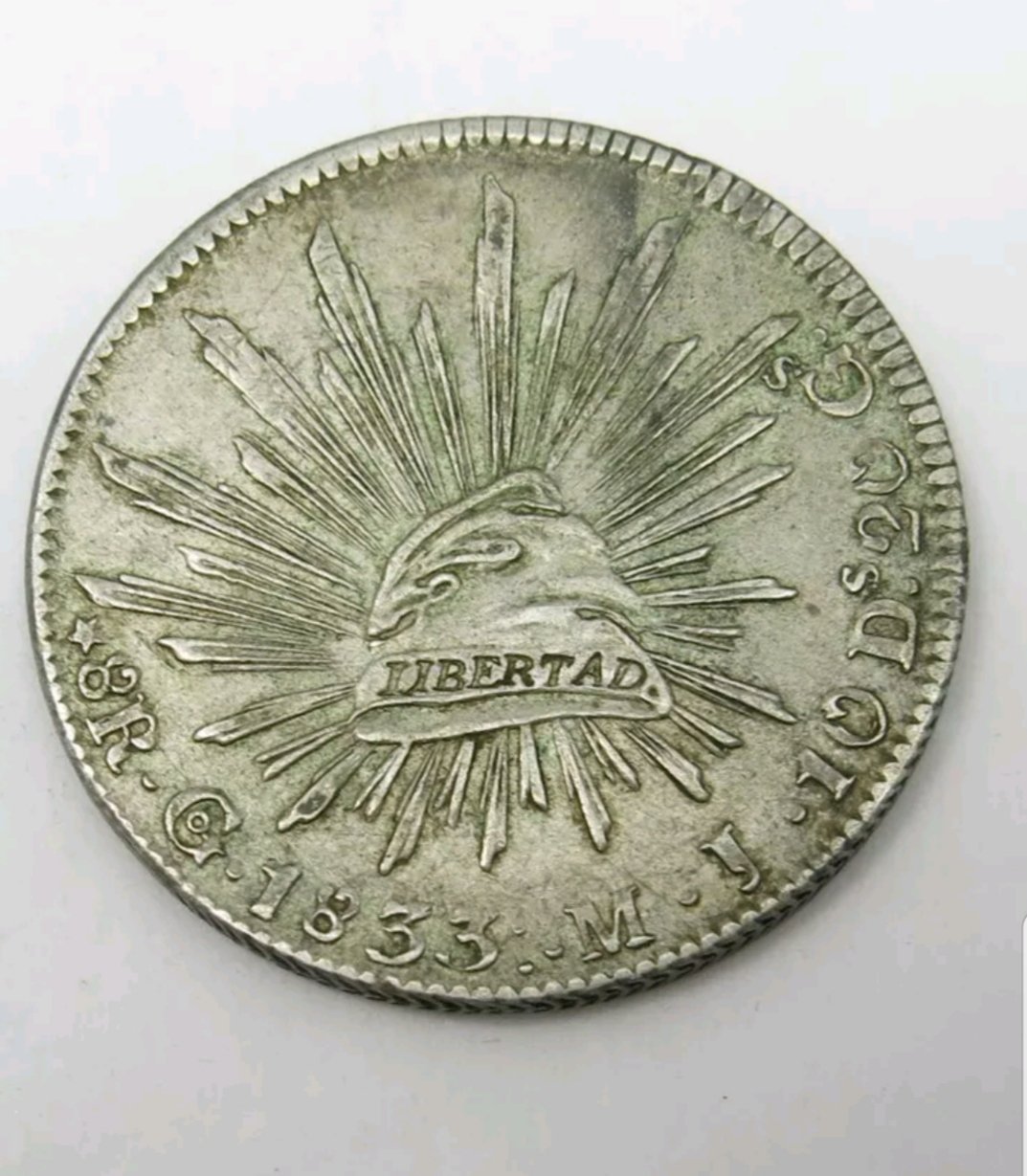 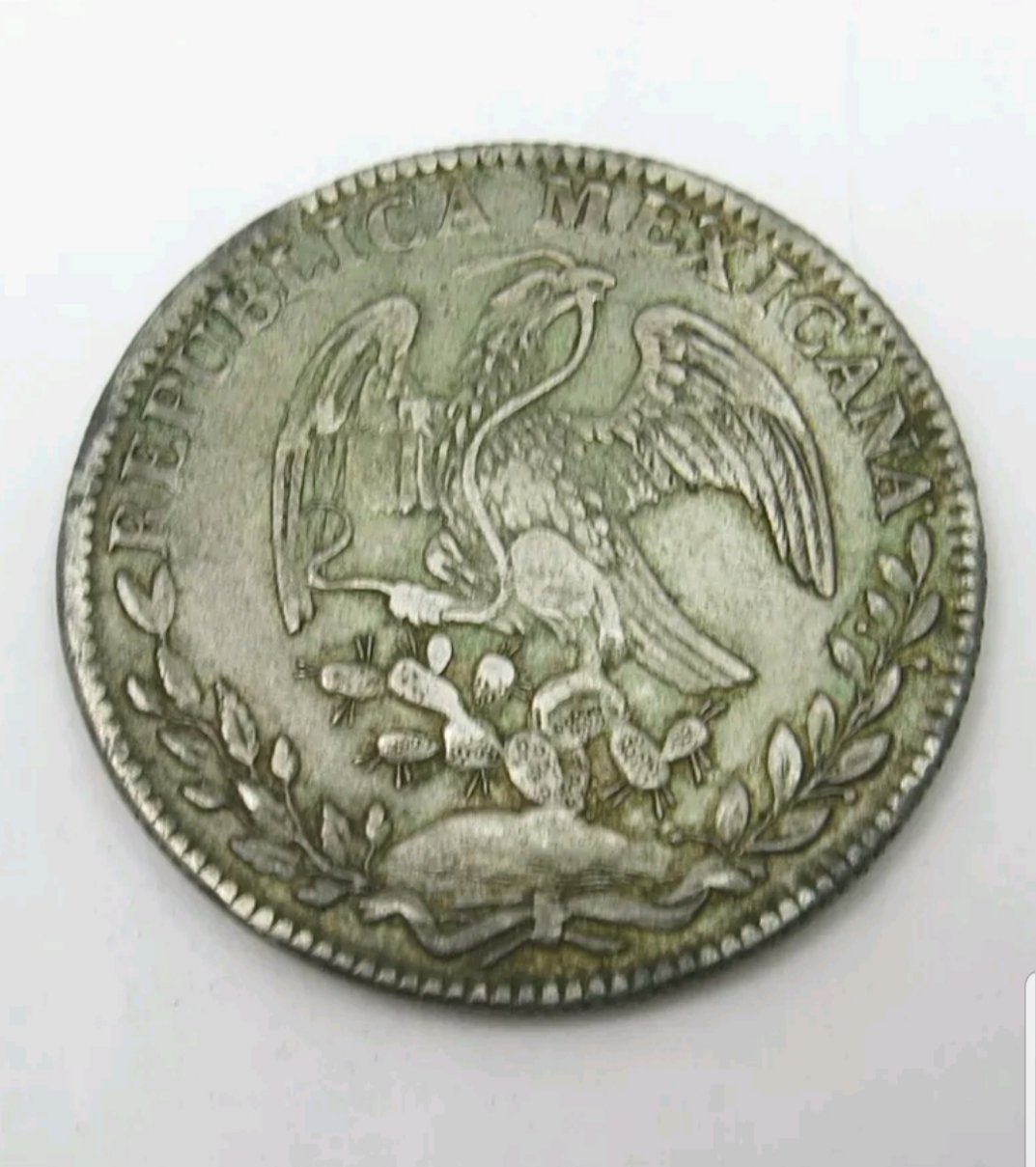 |
|
Pillar of the Community
 United States
5362 Posts |
MaximillianMike The 1833 Go MJ was struck from hubbed dies - the coin pictured here matches the hub although just slightly weakly set into the die face. This is typical of the issue. I own several coins struck from dies that were so weakly hubbed that remedial work was required to strengthen weak or missing elements. This die was clearly set better.
There is a well know problem with these hubbed coins from the Guanajuato mint in the mid 1830s. Riddell points it out in his book but in very few details. Some of the dies, die tools and even hubs were sold as scrap metal to junk dealers after they were worn out. These were used to create debased coins that circulated well - the only way to detect such fraudulent coins is to perform an XRF or even better an accurate SG measurement. The coin assayed by Riddell tested 466 fine silver so the SG was about 9.6.
I would suggest that test and if it comes out 10.3 it is genuine and if 9.6 it is a VERY RARE Contemporary Counterfeit.
|
|
Valued Member
United States
85 Posts |
Thank you Swamperbob,
Either way it sounds like a win to me. Happy Easter!
|
|
Valued Member
United States
425 Posts |
Swamperbob, to answer your original question, "I am wondering if there is enough interest on the forum for a thread that would post the item numbers of active ebay auctions involving Counterfeit/Forgery types" YES! I would very much like to see auctions with the number. As you may remember I collect copy/counterfeit Spanish 8 Reales and would check in with this forum much more often if there was such a thread. Thank you Sir for all your help. P.s. Got anymore copies for sale? |
|
Pillar of the Community
United States
5362 Posts |
odentheviking Since I first wrote this post I have identified 96 different Counterfeit, Forged or Improperly described Mexican 8R coins posted on ebay. These break down into 57 Cap and ray types and 39 Portrait types. I did not count some duplication of common counterfeit types (which I probably should have). Of the Cap and Ray types 34 were CCC types and 22 were Numismatic forgeries one coin called a counterfeit was not. The portraits broke down to 19 CCC and 20 NF. All but one of the incorrectly described Portraits were forgeries described as contemporary counterfeits. This seems to be a new trend since Portrait counterfeits are starting to be recognized as valuable. To have posted every auction would have been too time consuming for me at present (my wife is very ill and I am caring for two of our grand children). I also discovered that over half of the examples that I identified were very common types that appeared more than once (not the same coin but different ones) in the study interval. I also discovered that there were 5 Cap and Ray coins that I was interested in bidding on because they were Riddell examples I have never previously seen. I can not recall that happening any time in the past 5 years or so. That last category is the most problematic for me since I would prefer not to identify that kind of example to prospective competitors and because most were not identified as fakes of any type. I was also surprised that so few of the coins I saw were posted by other members. Were nearly all of the bad coins missed or was it just that no one had questions? I have decided that it would be better for me if I posted mostly completed auctions. I would however reply to any posts by members whether the auction is active or not.
|
|
New Member
United States
28 Posts |
Here is one currently on ebay with a low opening bid of $346.38. No takers so far. I have its identical twin, which I acquired in a lot of 30 contemporary counterfeits purchased at auction. Its clearly a numismatic forgery. Luckily there was only one other forgery in the lot. 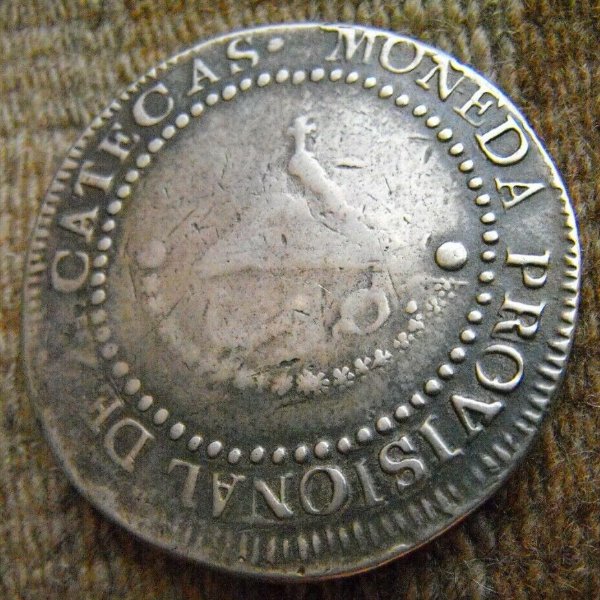 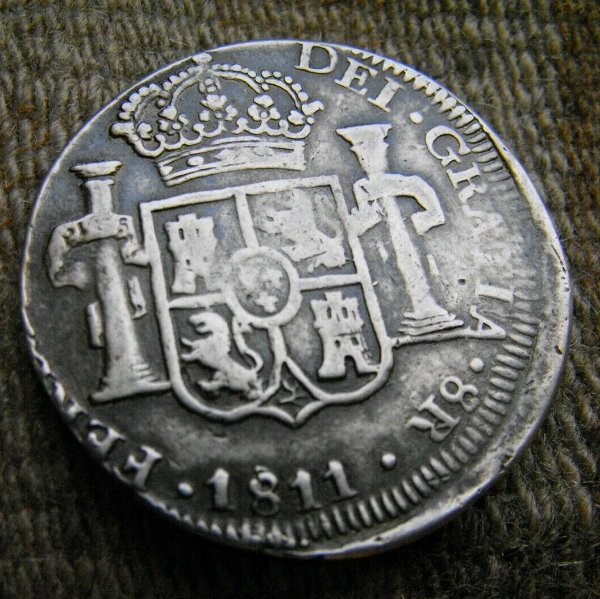 |
|
Valued Member
United States
425 Posts |
Swamperbob, WOW! I had no idea there could be so many up for auction in such a short time. The last thing I want to do is to bid against someone here on the forum, or anyone that wants or needs a coin for their collection. I only have an interest in the Counterfeits of the 1733&1734 8R Klippe's, and 8R Pillar Dollars.
But thank you for starting this thread and your willingness to pipe in on any coins we find.
|
|
New Member
United States
28 Posts |
Here is another ebay auction that caught my eye. Bid is up to $530, which is a very good price if authentic. It looks cast to me. 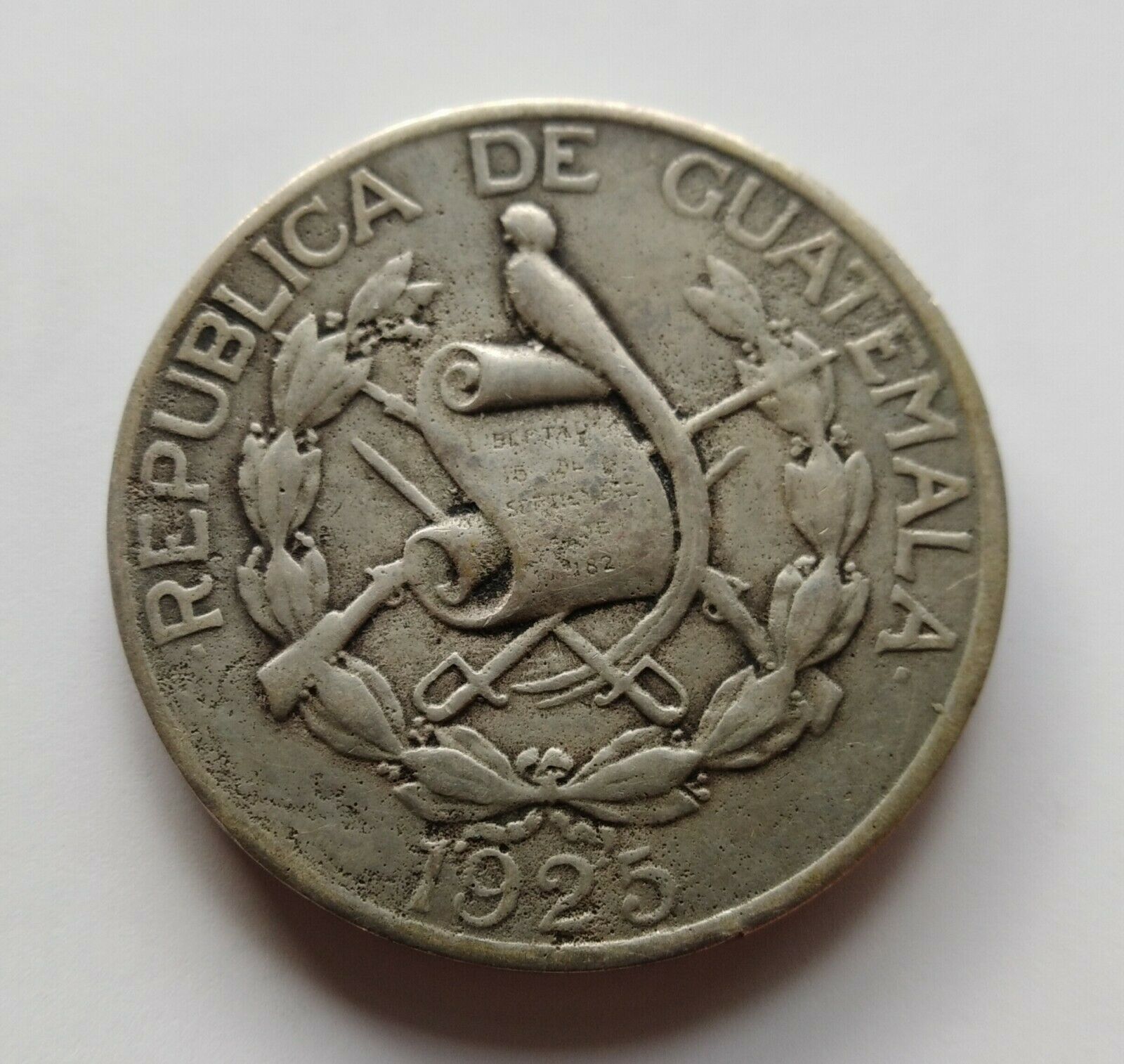 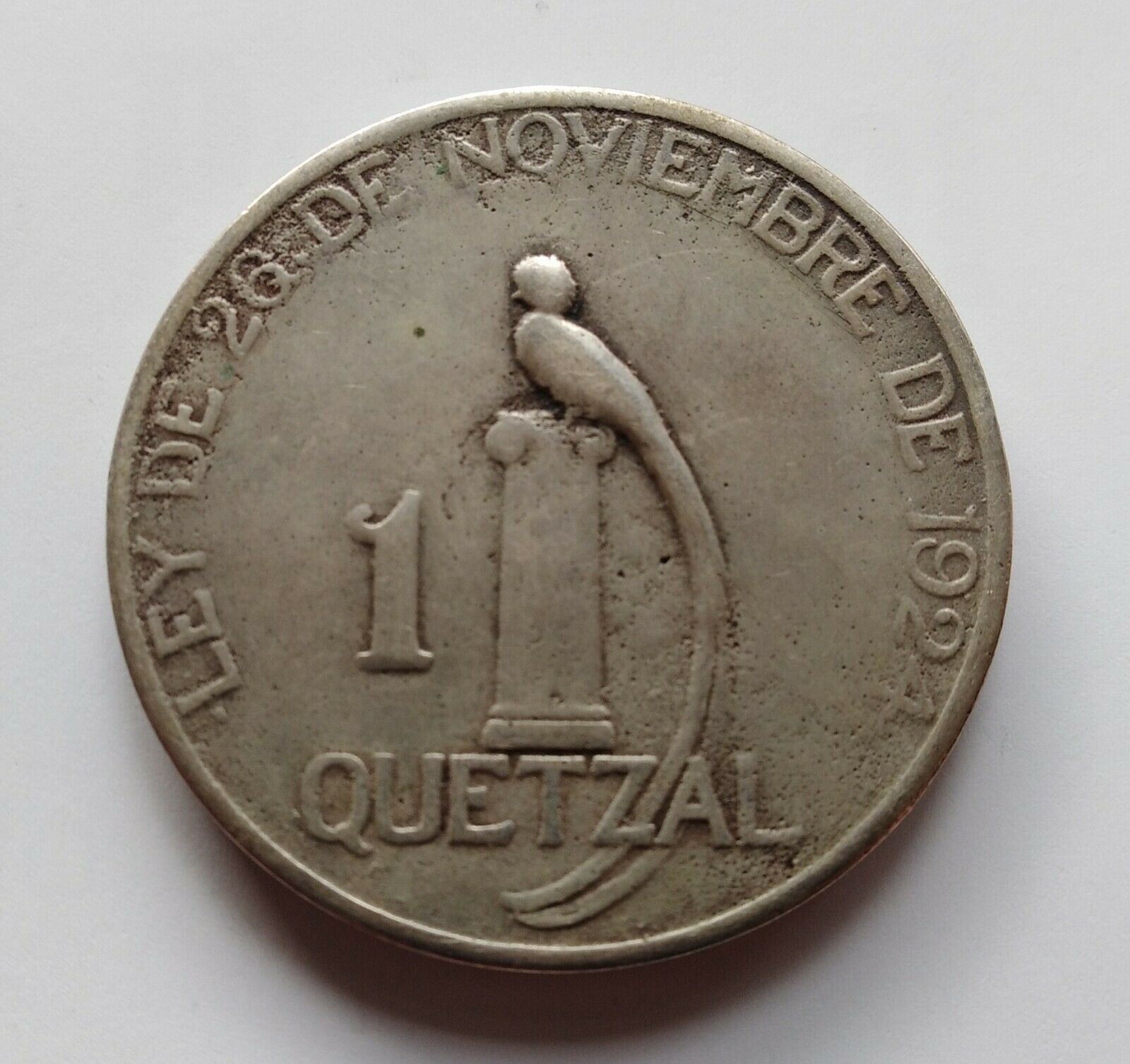 |
|
Pillar of the Community
United States
5362 Posts |
ChipDehart I agree that the coin is a cast copy. Looks like a fairly early (or novice made) plaster mold. Possibly used as an injection mold but that is difficult to prove. The mold surface even has a clear repair to the left of the date. So the mold could be re-used. I wonder who looking at this coin could ever believe it was genuine? no mint in 1925 would make a crown sized coin this poorly because it would invite forgery. Even if it was actually made in 1925 and is therefore technically a "circulating" counterfeit - fewer than 3,000 examples of this coin survived. I would question if this was ever a circulating coin so how could there be CCC copies? I would refer to this as a numismatic forgery because it copied a rare issue that was produced for only one year and must have had immediate numismatic interest.
|
|
Pillar of the Community
United States
5362 Posts |
odentheviking Good luck hunting for anything other than numismatic forgeries in your limited target group of 8 reales. In my 60 years of searching, I have only managed to locate fewer than 10 contemporary circulating counterfeit pillar dollars that I believe to be "genuine". (I get the pun there.) I own only 4 that I believe to be CCC varieties - all from Mexico. In the same time, I have seen at least 2,000 Portrait CCC 8Rs and perhaps 20,000 C&R CCC 8Rs. CCC Pillar dollars are in the same class as CCC Iturbide 8Rs (perhaps a dozen total exist) and are less common than Hookneck CCC 8Rs (perhaps 200 exist).
Have you found any you believe to be CCC?
|
|
Valued Member
United States
104 Posts |
I think it would be a great educational resource as well for those looking for the information either way.
I have one coin that I guess falls into the CCC category and I've actually never been able to find much out about it's a cap bust quarter (I believe) and is silver, but is marked with copy on the back.
If it's beneficial for anyone for learning/data purposes I'm happy to share.
|
|
Pillar of the Community
United States
5362 Posts |
CoinMom4 I would like to see your coin.
If it is marked COPY it really should not be a CCC type.
The word COPY was first mandated in 1973 by the Hobby Protection Act and that requirement does not apply to items made before that date.
I have seen quite a few older counterfeits with recently added "cancellations" and I always get upset at the needless destruction of an historical artifact and of course the drastic reduction in value this produces.
|
|
Valued Member
United States
104 Posts |
SwamperBob Here you go. Looking forward to hearing your expert opinion. I know zero about this. Other than where it came from, and that it metal was tested by a jeweler friend Who said it was silver. I have actually wondered if the copy was not added later on because of the fact that it looks so much different. But idk. 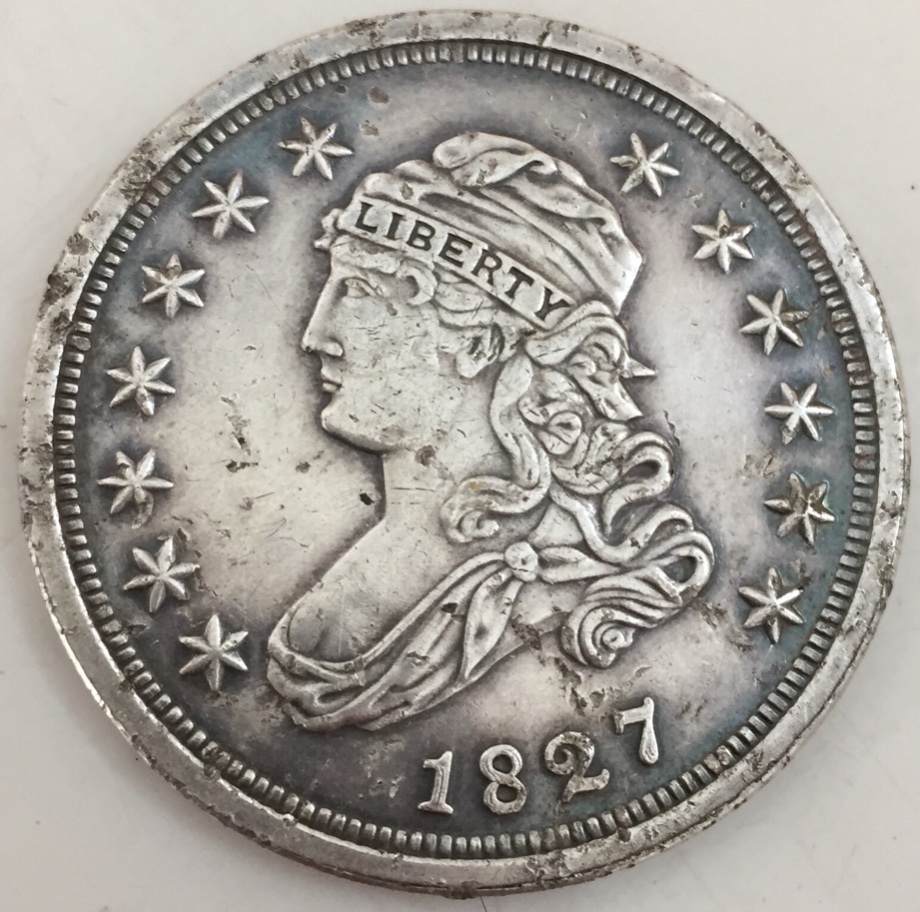 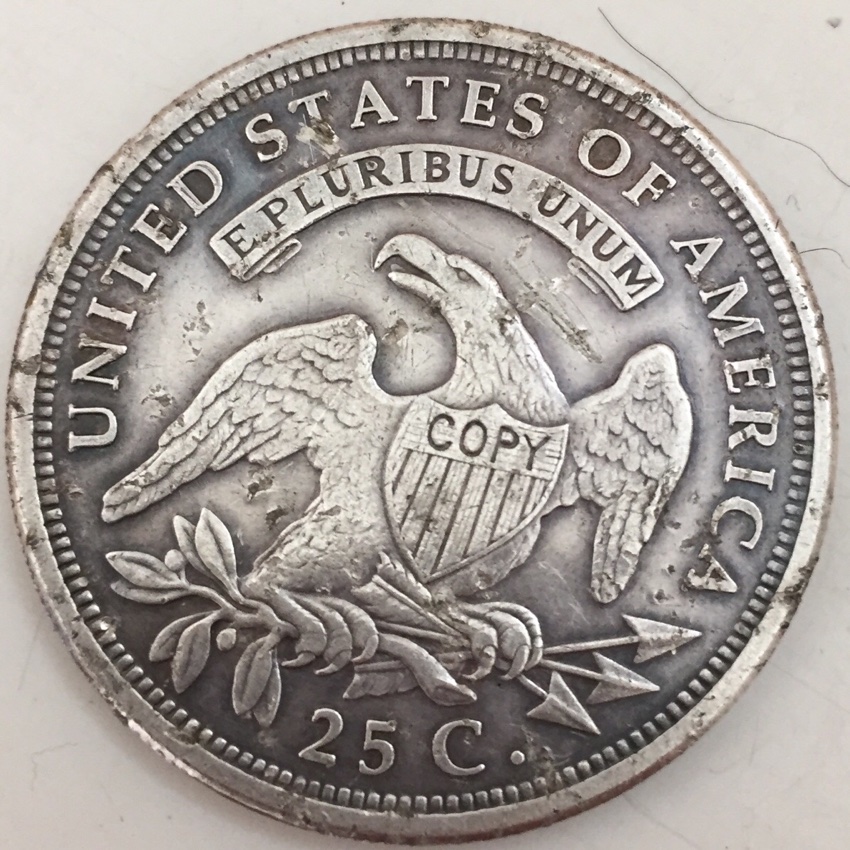 |
|
Pillar of the Community
United States
5362 Posts |
The 1827 US 25 Cent "coin" is a modern replica post 1973.
It appears to be silver electro-plated base metal of some sort. COPY was likely added post creation.
The coining dies (or molds - difficult to tell which for sure) appear to have been engraved with some sort of CAD assisted device. See in particular the numbers 1 and 8 for what look like "strokes" of a laser cutter or possibly an engraving tool that was free to follow a non-linear path instead of a rectangular grid pattern. The high points of the number 1 have non-linear line segments that are in the most recessed part of the die/mold. There are some other areas where similar type features appear.
Regarding the word COPY. The HPA requires the text to be incuse and to use a sans serif script. The reason the word COPY looks different is because it was supposed to be different. The presence of the word COPY in a form that happens to comply with HPA is essentially all the proof needed to place the origin of the piece after 1973. I have never seen an earlier marking that is similar. The word copy seems to have been stamped into the completed coin as HPA originally meant to require.
The wide flat rim on the item looks a lot like a mounting rim that was placed on replicas so that they could be built into items like cup bottoms or ashtray bottoms. It was a fad at one time.
|
|
Valued Member
United States
104 Posts |
Quote:
The 1827 US 25 Cent "coin" is a modern replica post 1973.
It appears to be silver electro-plated base metal of some sort. COPY was likely added post creation.
The coining dies (or molds - difficult to tell which for sure) appear to have been engraved with some sort of CAD assisted device. See in particular the numbers 1 and 8 for what look like "strokes" of a laser cutter or possibly an engraving tool that was free to follow a non-linear path instead of a rectangular grid pattern. The high points of the number 1 have non-linear line segments that are in the most recessed part of the die/mold. There are some other areas where similar type features appear.
All though in my brain when I'm reading that all it translates too is speech similar to the teachings in peanuts. HOWEVER I'm now inclined to to read and study the coin to learn and comprehend what you said. Thank you very much for the detailed Analysis and taking the time. Is greatly appreciated |
|
|
Replies: 51 / Views: 6,248 |
|








 First Page
 Previous Page

 Posted 04/21/2019 8:00 pm


