| Author |
 Replies: 114 / Views: 12,605 Replies: 114 / Views: 12,605 |
|
|
|
|
CCF Master Historian of Commemorative Coins
  United States
12558 Posts |
In 1998, the US Mint launched a five-year program for the proof American Platinum Eagle (APE) coins - it was called the "Vistas of Liberty" series. Each year, the reverse of the coin featured a bald eagle in a different region of the US. At the time of the first coin's release, Mint Director Philip N. Diehl stated: "The Vistas of Liberty" designs will profile the unique character and charisma of our Nation's diverse landscapes, capturing the spirit and strength of America and its people." For the 1998 coin, an eagle is depicted flying - with wings up - off the coast of New England (at right), with a lighthouse rising up on the cliff (at left) and the moon rising in the evening sky in the background. John Mercanti designed/engraved the new reverse; it was paired with his "Portrait of Liberty" obverse design from 1997. In an interesting twist, three of the coin's inscriptions are presented as incuse elements - i.e., sunk below the surface of the coin vs. raised in relief. This can be seen on the obverse via "E PLURIBUS UNUM' which is sunk into the gown of Liberty on her raised arm (at the rim), and on the reverse with the coin's fineness and weight sunk into the cliff and its denomination sunk below the surface of the sea. Mercanti's "JM" initials can be seen on the obverse just above Liberty's shoulder at roughly the nine o'clock position. The proof coins were launched on June 5 and only available until December 31, 1998 (or until sold out). The fractional weights all sold out prior to December 31, 1998, with the one-ounce coin coming very close with about 4,900 of its authorized 5,000 sold. 1998 American Platinum Eagle (APE) - Proof: Vistas of Liberty - New England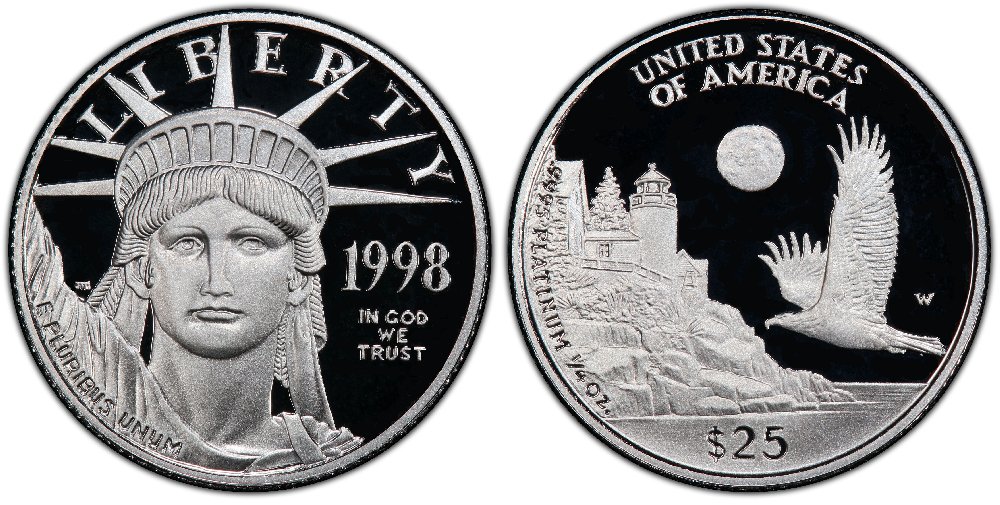 Image Credit: PCGS CoinFacts, http://www.PCGS.com Image Credit: PCGS CoinFacts, http://www.PCGS.comAs nice as the coin looks here via images, in hand (IMO) it looks even better! Collecting history one coin or medal at a time! (c) commems. All rights reserved.
|
|
CCF Master Historian of Commemorative Coins
United States
12558 Posts |
The "Vistas of Liberty" series continued on the proof American Platinum Eagle (APE) coins in 1999, with a reverse scene from the wetlands of the southeastern US. John Mercanti once again was the designer of the obverse and reverse sides of the coin. The reverse scene presents a bald eagle at its center, flying through a swamp scene. Moss is shown hanging from trees (bald cypress or Taxodium distichum for those with a more scientific bent) at right, swamp black-gum tupelo (Nyssa biflora) at left, bushes and duckweed are seen along the water line and an American alligator (Alligator mississippiensis), is seen coming out of the water at the lower left. (Per the US Mint, it is definitely an American alligator vs. a crocodile.) The fineness, weight and denomination inscriptions that were presented in incuse style on the 1998 proof APE coin returned to being presented in relief in 1999. "UNITED" (part of the "UNITED STATES OF AMERICA" inscription is sunk into the branches of the tupelo tree, however. Mercanti's "Portrait of Liberty" is once again seen on the obverse. His "JM" initials are found on the obverse just above Liberty's shoulder at roughly the nine o'clock position. The 1999 proof APE was the last of the series to include a new reverse design by Mercanti; his "Portrait of Liberty" design would continue on the obverse of the proof coins through 2017. 1999 American Platinum Eagle (APE) - Proof: Vistas of Liberty - Southeast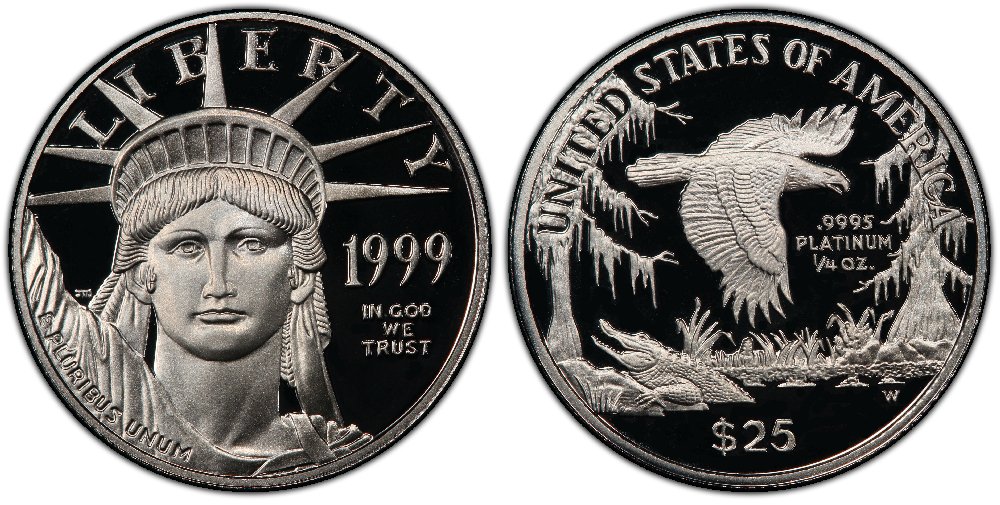 (Image Credit: Image courtesy of PCGA CoinFacts, http://www.PCGS.com.) (Image Credit: Image courtesy of PCGA CoinFacts, http://www.PCGS.com.)Collecting history one coin or medal at a time! (c) commems. All rights reserved.
Edited by commems
08/08/2021 09:04 am
|
|
CCF Master Historian of Commemorative Coins
United States
12558 Posts |
I'm surprised that an American Silver Eagle ( ASE) has not yet been posted in this thread as it features what is likely the most famous John Mercanti design. So... John Mercanti is responsible for the reverse of the 1986-2021 ASEs (Type I) - bullion, proof and burnished/uncirculated strikes. The design presents a heraldic eagle with a ribbon bearing "E PLURIBUS UNUM" being held in its beak. On the eagle's breast is a starless US Shield, while a constellation of 13 stars representing the 13 original states is depicted in the field above the eagle. The design is a modern reinterpretation of the Great Seal of the United States. US Great Seal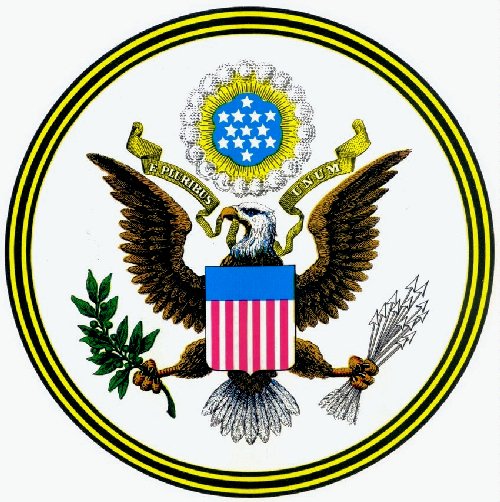 (Image Credit: Image courtesy National Museum of American Diplomacy, https://diplomacy.state.gov/, Public Domain.) (Image Credit: Image courtesy National Museum of American Diplomacy, https://diplomacy.state.gov/, Public Domain.)Mercanti's "JM" initials on the reverse of the ASE are found just below the eagle's left talon (holding the arrows). The coin's obverse is a re-use of Adolph A. Weinman's Walking Liberty design that adorned the obverse of the US half dollar coin from 1916 though 1947. The classic design is regularly listed as one of the US' most beautiful coin designs and is a very popular coin among collectors. The ASE has certainly followed suit in popularity! 2019 American Silver Eagle ( ASE) - Bullion Strike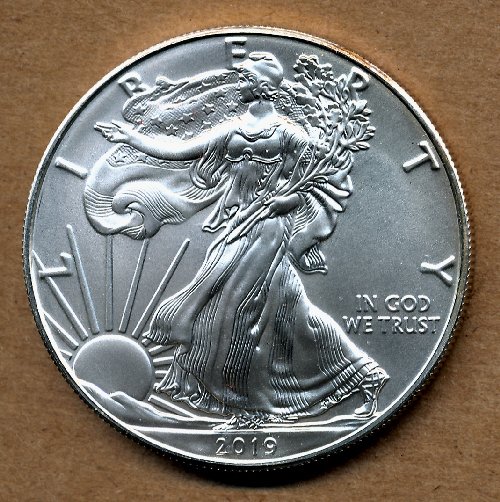 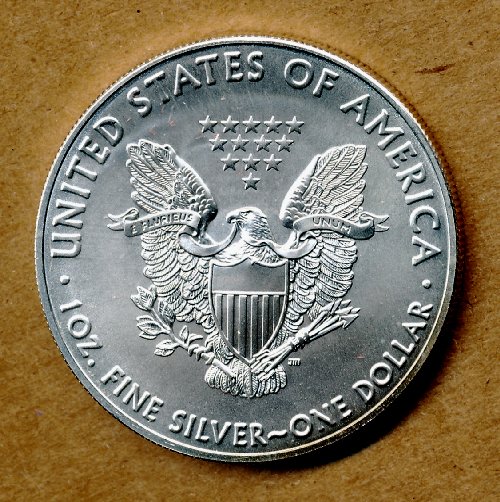 Collecting history one coin or medal at a time! (c) commems. All rights reserved.
|
|
Moderator
United States
195821 Posts |
Fantastic trio!  I had forgotten about the "Vistas of Liberty" series. Not surprising as platinum, like gold, pretty much stays off my radar. |
|
CCF Master Historian of Commemorative Coins
United States
12558 Posts |
Found another one! In 1994, the US Mint struck a three-coin program in support of World Cup USA 1994, Inc. and its hosting of the 1994 World Cup. The 15th Federation Internationale de Football Association (FIFA) World Cup championship was hosted in the United States for the first time in 1994; it is the only time the event has thus far been hosted in the US. John Mercanti served as the modeler for the obverse of the coin; it was designed by Richard T. LaRoche. The design presents a male soccer player in motion, about to kick the ball further down the pitch/field. He is flanked by large "19" and "94" figures representing the tournament's and coin's date. LaRoche's "RTL" and Mercanti's "JM" initials are both found at the rim, just below the player's planted left foot. 1994 World Cup Half Dollar - Obverse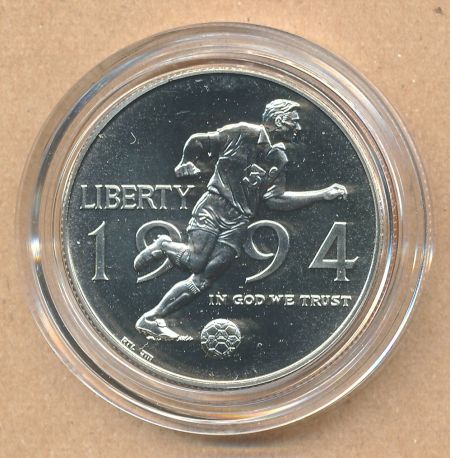 1994 World Cup Coins - Common Reverse (Illustrated with Silver Dollar) 1994 World Cup Coins - Common Reverse (Illustrated with Silver Dollar)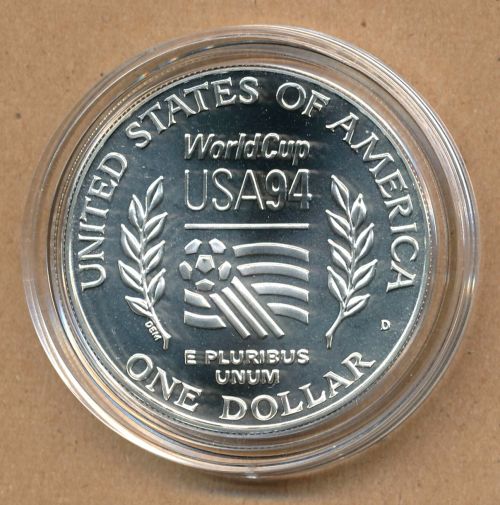 The coin's reverse, common to all three coins of the program, presents the official logo of the 1994 World Cup framed by laurel branches. The design for the coin was prepared by Dean McMullen; the core logo was created by Michael Geircke and James Anderson of Pentagram, a design firm with offices in London (England), New York City, Austin (Texas), and Berlin (Germany). 1994 World Cup Logo in Color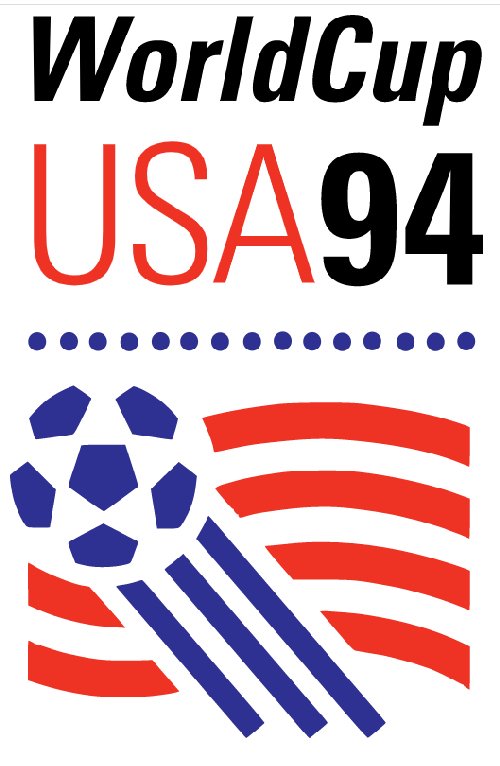 (Image Credit: World Cup USA 1994, Inc. / Pantagram. Fair use.) (Image Credit: World Cup USA 1994, Inc. / Pantagram. Fair use.)The logo is strongly influenced by the US Flag. It consists of waving white and red stripes with a blue-paneled soccer ball in the upper left; diagonal blue lines trail behind the ball and give it a sense of motion. The half dollar was packaged by the Mint in multiple ways, including as part of sets themed for each of the nine host cities in the US, in a Young Collectors Set, in a Striker (the official mascot) Set and a special Collectors Set; See below for posts I've made about some of these options, plus the official philatelic-numismatic covers (PNCs). For more on the 1994 World Cup Coins, check out: - 1994 World Cup Coins - Part I - Official World Cup USA 94 PNCs - 1994 World Cup Coins - Part II - Host City Sets - 1994 World Cup Coins - Part III - UK PNC - 1994 World Cup Coins - Striker SetFor other of my posts on commemorative coins and medals, see: Read More: Commems Collection. Collecting history one coin or medal at a time! (c) commems. All rights reserved.
Edited by commems
08/23/2021 08:03 am
|
|
Moderator
United States
195821 Posts |
Excellent! |
|
CCF Master Historian of Commemorative Coins
United States
12558 Posts |
John Mercanti's involvement with the Perth Mint of Australia ince 2014 is well-known via his ongoing design work on Australia's precious metal Wedge-Tailed Eagle coin series. He has also been engaged with the Royal Canadian Mint, working on a 2019 collaborative medal project with Susan Taylor, the former Royal Canadian Mint Senior Engraver. The obverse of the medal, the side that depicts a left-facing portrait of Lady Peace was designed by Ms. Taylor. The allegorical figure presents a young woman portraying "quiet strength and radiant hope." (Per Mint web site description.) Peace is depicted wearing a crown comprised of olive branches (an international symbol of peace) and maple leaves (symbolic of Canada). The inscription "A Mari Usque Ad Mare" (translates from Latin to English as "From Sea to Sea") is Canada's official motto; "Pax" translates as "Peace." John Mercanti, the former US Mint Chief Engraver, designed the medal's reverse. It presents a forward-striding figure of Liberty (somewhat reminiscent of the US' St. Gaudens gold Double Eagle coins). In her upraised left hand is held the torch of freedom, with laurel branches wrapped about it. In her right hand is seen a sword with which she is warding off a pair of snakes meant to represent evil and oppression. The inscription "E Pluribus Unum" translates to English as "Out of Many, One" and "Libertas" translates to "Liberty." Mercanti's "JM" initials are seen directly below the figure of Liberty. The "Peace" side of the medal was clearly struck in ultra-high relief. To my eyes, the reverse "Liberty" side was struck in standard relief. Both sides feature a reverse-proof finish. I purchased the one-ounce 0.9999 fine silver version for my collection; 10-ounce and kilogram silver versions were also produced. A one-ounce 0.99999 fine gold verion was also struck. Susan Taylor's "Peace" design has been reissued on a Canadian silver dollar and a gold $200 coin (so far, in 2020 and 2021); the Mint might be starting two new coin series. 2019 Canada Peace & Liberty Medal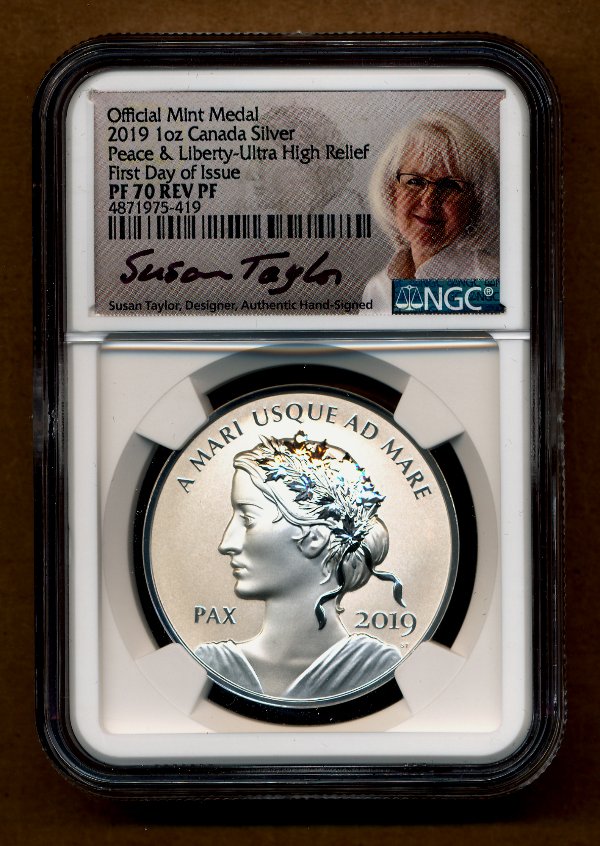 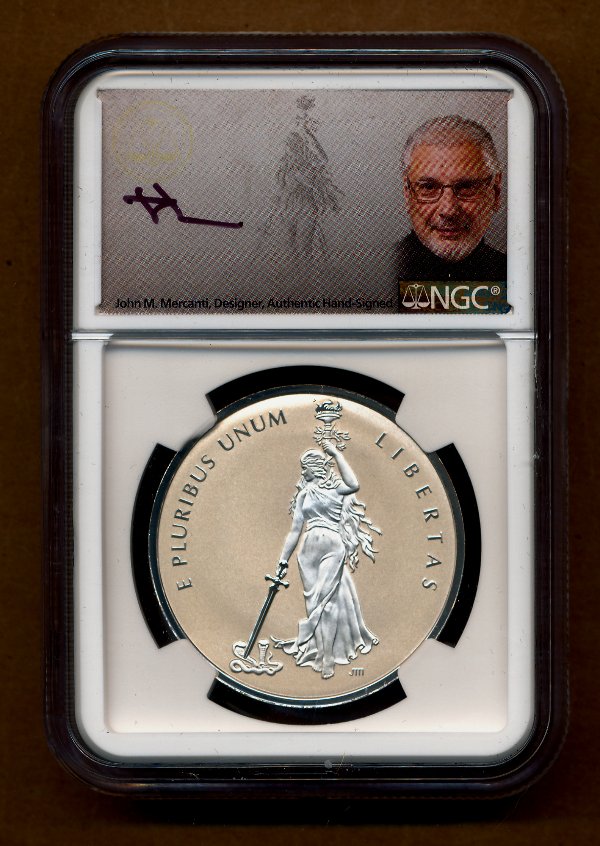 Collecting history one coin or medal at a time! (c) commems. All rights reserved.
Edited by commems
08/25/2021 11:17 am
|
|
Moderator
United States
195821 Posts |
Quote:
2019 Canada Peace & Liberty Medal That is very beautiful! |
|
CCF Master Historian of Commemorative Coins
United States
12558 Posts |
It's been a few months since I last posted a Mercanti coin, but I'm back with another - the 1996 High Jump silver dollar for the 1996 Atlanta Olympics. The coin is another example of Mercanti serving as the sculptor/modeler for a design created by another artist vs. being the originator of the design. The obverse of the High Jump silver dollar was created by Calvin Massey, an independent professional artist; Mercanti modeled Massey's designs and thus enabled the coin's dies to be created. Mercanti's "JM" initials are seen at the rim at approximately the 4:30 clock position; they follow the "CM" of Massey. The Massey-Mercanti design features a female high jumper in mid-jump - shown at the moment she is clearing the bar. She is jumping with her back to the bar (i.e., the "back-first technique), a style developed and popularized by Dick Fosbury - it became famous internationally after he used it to win the Gold Medal at the 1968 Olympic Games in Mexico City. Fosbury began developing the new jumping style while still in High School in 1963/64. It went on to become known as the "Fosbury Flop." Far from being a "flop," it proved to be a very effective high jump technique and has been adopted by essentially all high jumpers around the world. At the Games in Mexico City, Fosbury used the technique to establish an Olympic record with a jump of 7' 4-1/4". (Just FYI, the current World record (men's) for the high jump was set by Javier Sotomayor in 1993; he completed a jump of 8' 1/4" (2.45 meters). 1996 Atlanta Olympics High Jump Silver Dollar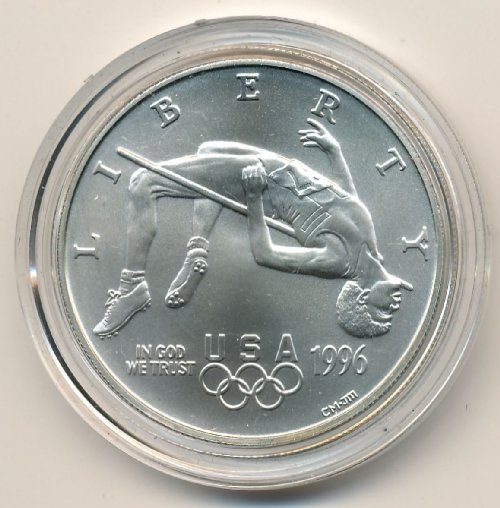 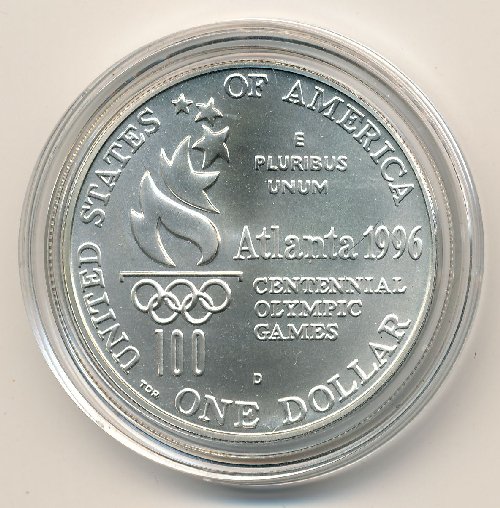 For a discussion of the coin's reverse, see: - 1996 High Jump Silver Dollar - Post Your Coins with Stars ThreadCollecting history one coin or medal at a time! (c) commems. All rights reserved.
Edited by commems
11/21/2021 1:07 pm
|
|
Moderator
United States
195821 Posts |
Nice example! |
|
CCF Master Historian of Commemorative Coins
United States
12558 Posts |
The 1996 Flag Bearer Gold Half Eagle of the 1995-1996 US Atlanta Olympics coin program is another coin for which John Mercanti served as the modeler for a design from an outside, freelance artist. The Flag Bearer Half Eagle's obverse design was the work of freelance artist Patricia L. Verani The design presents the flag bearer of the US Olympic team leading the US team into Olympic Stadium as part of the Games' Opening Ceremony. Also seen, to the right of the flag bearer, are the Olympic Rings surmounted by "USA" to further signal the US Olympic Team connection. The initials of Verani and Mercanti are found on the lower torso of the athlete directly behind the flag bearer. A flag bearer is the Olympic Team member who is selected to carry the national flag of his/her team and lead the parade of his/her country's athletes during the Opening and Closing ceremonies. The Flag Bearer has officially been part of the Olympic Games since 1908 via the Summer Games held in London that year. The first US Olympian to hold the honor of being the US flag bearer was track and field athlete Ralph Ross. The coin's reverse design - shared with the 1996 Atlanta Olympics Gold Half Eagle - was created by William Krawczewicz; US Mint Sculptor-Engraver Thomas D. Rogers, Sr. modeled the design for coinage. The design presents the official logo of the Atlanta Committee for the Olympic Games (ACOG) as its center device; the logo is flanked by olive branches that curve around it. Atlanta Committee for the Olympic Games Logo From http://www.olympics.com/en/olympic-...logo-design, the logo/emblem is described as follows: "The base of the torch mark logo, made of the five Rings and the number 100, resembles a classical Greek column and recognizes the centennial of the Games. The torch mark's flames gradually evolve into a perfect star symbolizing each athlete's pursuit of excellence."1996 Atlanta Olympics - Flag Bearer - Gold Half Eagle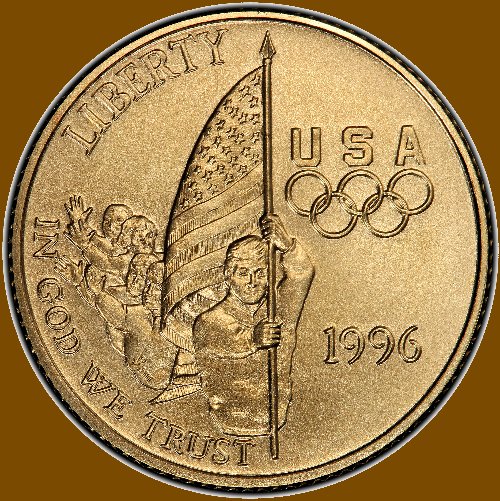 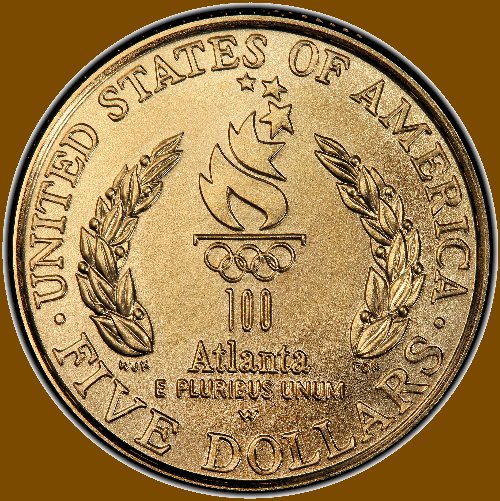 Collecting history one coin or medal at a time! (c) commems. All rights reserved.
Edited by commems
12/07/2021 06:55 am
|
|
Moderator
United States
195821 Posts |
Very nice! |
|
Moderator
United States
195821 Posts |
|
|
CCF Master Historian of Commemorative Coins
United States
12558 Posts |
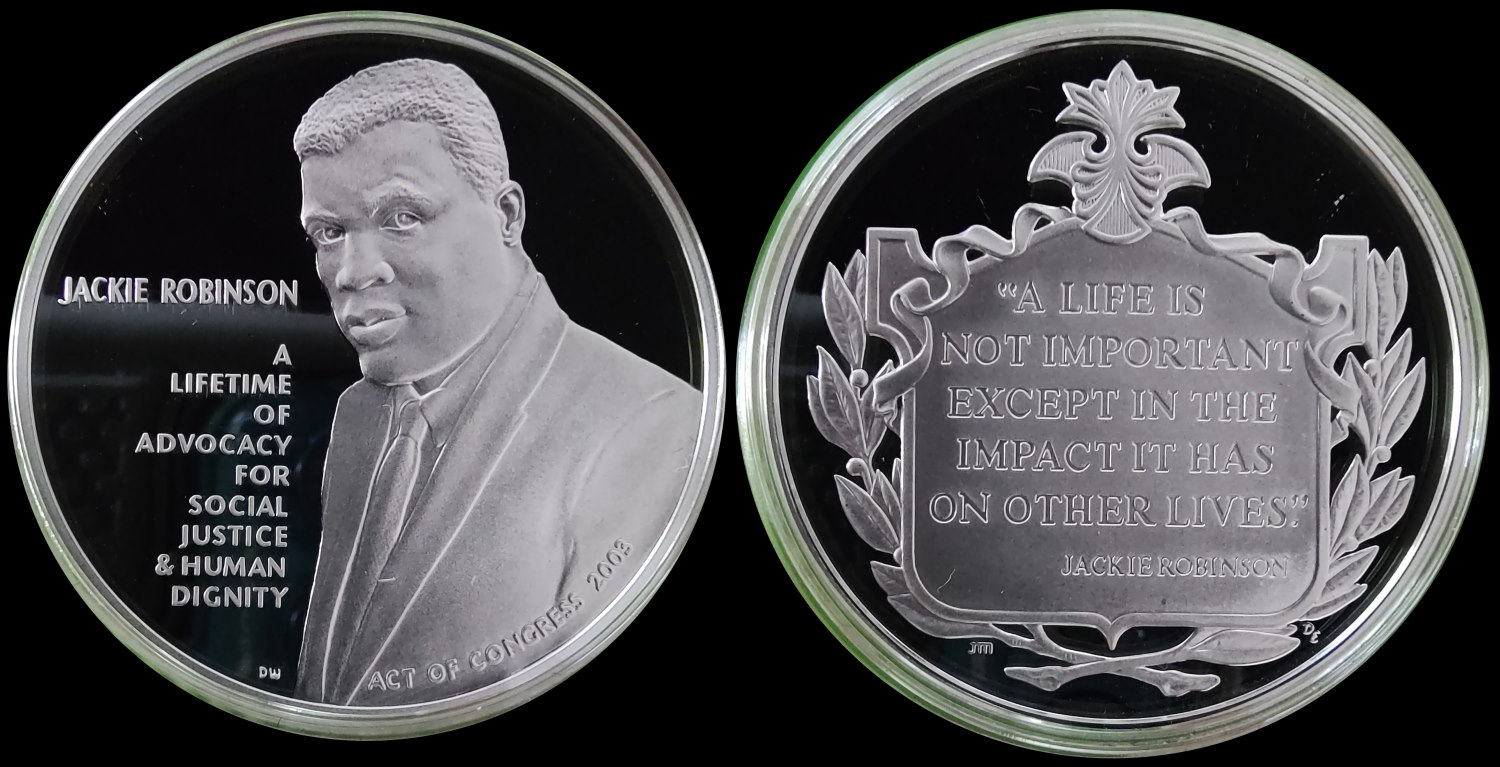
@jbuck: Very nice! The medal looks great as a proof piece struck in silver!
It's been 17 years since the bronze version of this medal was first made available (2005) by the Mint.
To illustrate how it's a different time for US Mint medal pricing: the 3" bronze medal was issued in 2005 at $38.00 and the small bronze piece was $3.00. Compare that to today's prices of $160.00 and $20.00, respectively! (FYI: If average inflation was applied, the prices would be raised to ~$56.00 and ~$4.50, respectively.)
Collecting history one coin or medal at a time! (c) commems. All rights reserved.
Edited by commems
05/02/2022 11:24 am
|
|
Moderator
United States
195821 Posts |
Very interesting! Thank you for the additional information. I assumed the medal existed previously as bronze offering by the mint a while back (given the "Act of Congress" date) and had to look for some examples online. I agree, the silver proof looks really great; better than the bronze, in my opinion, especially the reverse. |
|
|
Replies: 114 / Views: 12,605 |
|








 First Page
 Previous Page

 Posted 08/08/2021 09:00 am