First Page


 Posted 11/08/2021 5:16 pm


Thanks 'jbuck,' 'commems' & 'Orac' for following this thread & providing some feedback or insight into your experiences. If there are any World currency collectors, or collectors from the region, & you would like to add, please feel free to do so. 'Orac' I actually did receive some decent banknotes from an ATM one time while living near Castries (they were $10 or $20 I believe). But, unfortunately, I just didn't have enough spare money to tuck away either (& at the time I had made a commitment to collect BoC (Canadian) currency exclusively.
Anyway, I'd just like to close up by summarizing what occurred to the various series up to the recent VERTICAL designs.
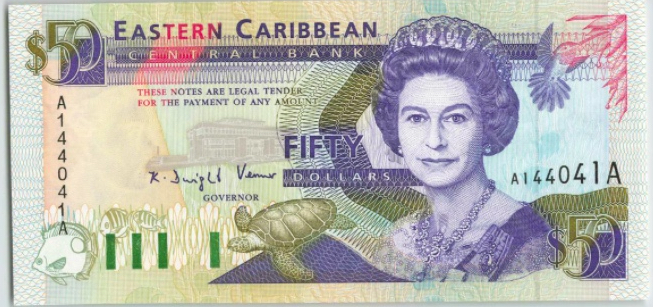
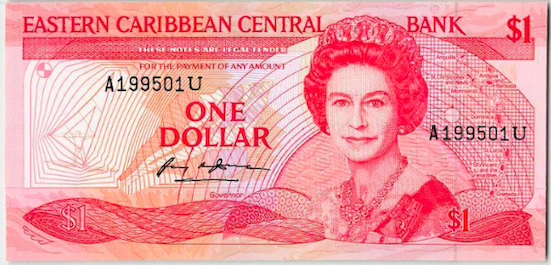
Allow me to back up a little once again. The 1994 series was unremarkable other than the fact that the square box obscuring the denomination MARKER was removed & that P-34 FIFTY DOLLARS had a significant colour overhaul (aqua-marine blue tint added to avoid confusion with the $100 P-35). This was a problem that often occurred between the 1993 $50 & $100 (as the colour schemes were similar -esp in poor light). I have also found it quite ironic that 1993 series was the 1st year the bar codes were added to aid the visually impaired to ID each denomination (& yet the 1993 series failed so miserably to be easily identified). The revised 1994 series got rid of the squares (& the funky fonts) so that the MARKER numerals were much clearer to distinguish.
In 1998, the $100 had a gold foil orchid shaped security device added to the FRONT (Obverse) for additional suggesting it may have been subject to counterfeiting.
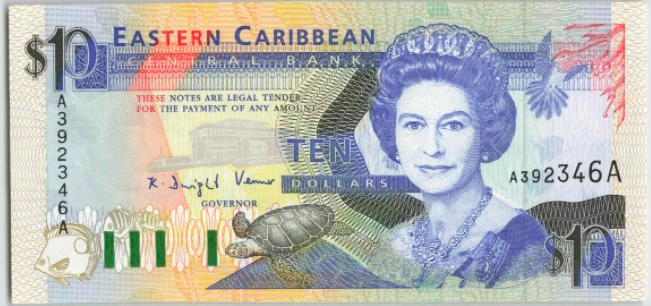
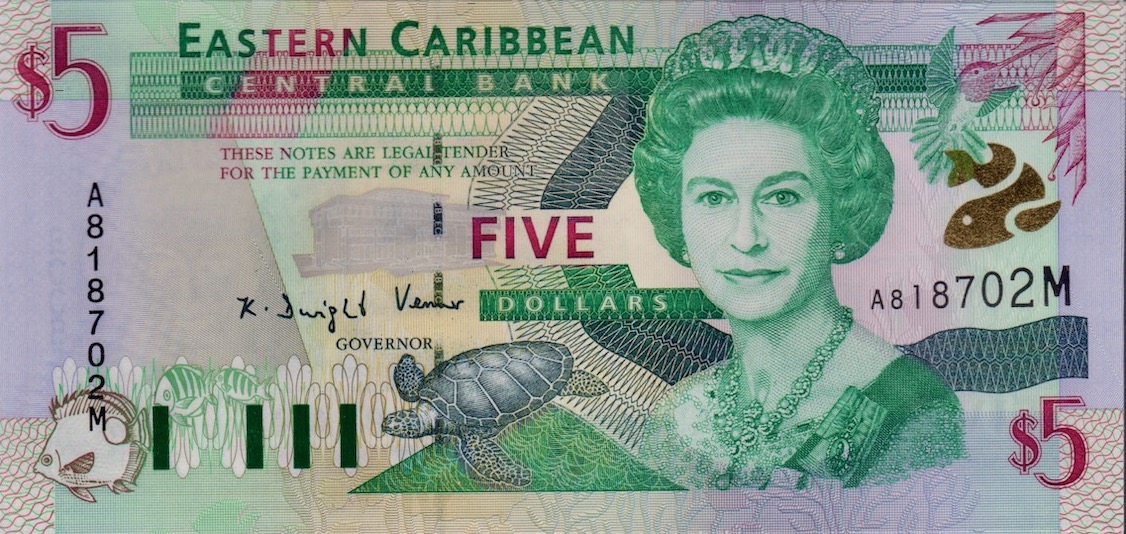
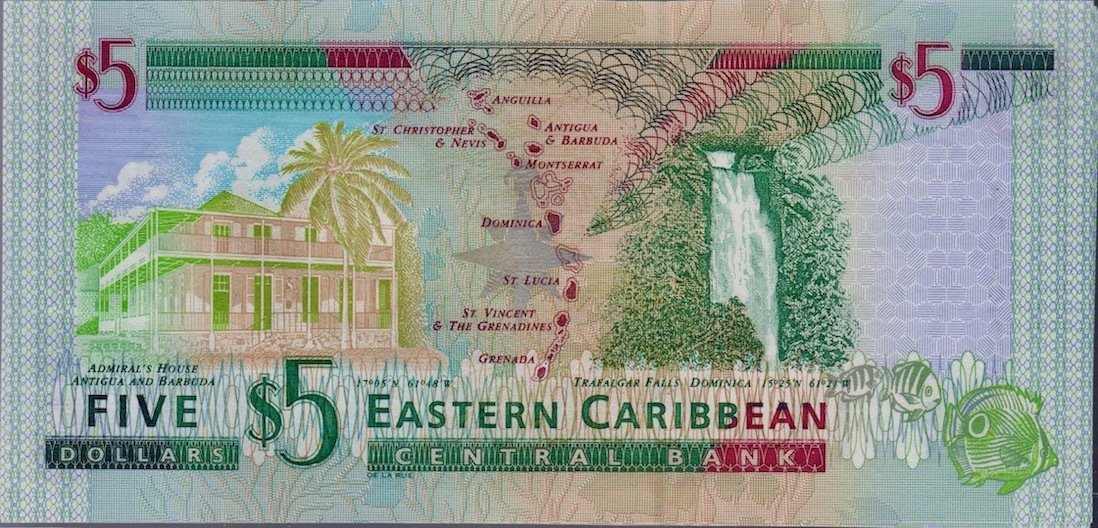
In the 2000 Series, 2 unique gold foiled fish were added to the $5 & $10, a butterfly graced the $10 & two types of flowers were added to the $50 & $100. Foiled security devices would be a feature of the next design upgrades. I added an example of the $10 on my initial post & below is a $5 from Montserrat (P-37m):
In 2003 P-42 to P-46 have squared off silver foiled security devices (of the same themes) replacing the gold foil optical devices. This also happens to be the last series to employ suffix association to island member states.
In 2008, P-47 to P-51, suffix designation designation is replaced by 2 letter prefixes. All islands received similar notes (no member state signified). Here's an example of P-47 ($5):
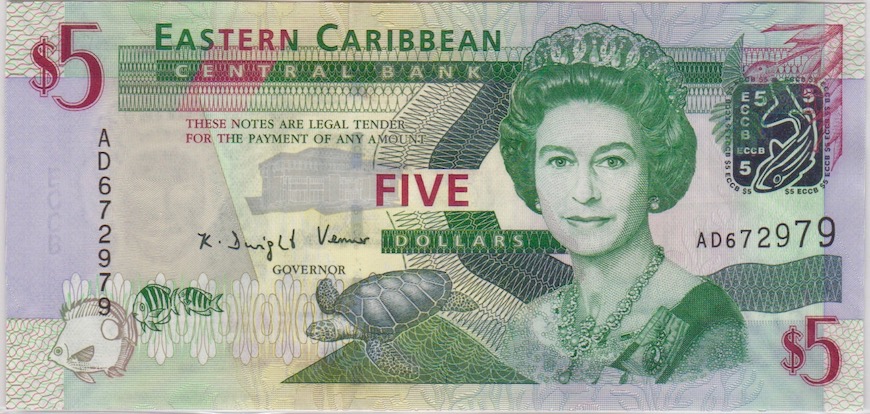
-this note has the AD prefix. It would be interesting to know what the last prefix of this series was for each denomination.
In 2012 & 2015 the ECCB notes P-52 to P-55 have one more significant design modification. The first series (2012) indicated by an (a), so that P-52a has a QEII watermark on the $10, while P-52b has no watermark, but an extra thick segmented security strip. Also note that in 2012, the $5 has been retired. See the link below for examples of the two different TEN DOLLAR denominations:
http://www.banknote.ws/COLLECTION/c.../XCD0052.htm
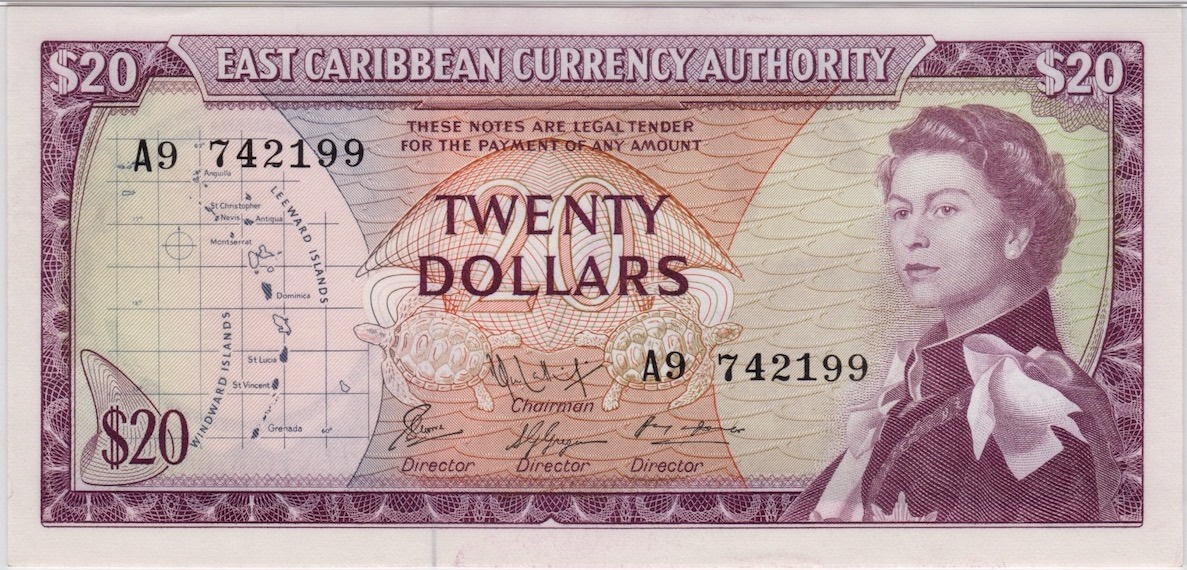
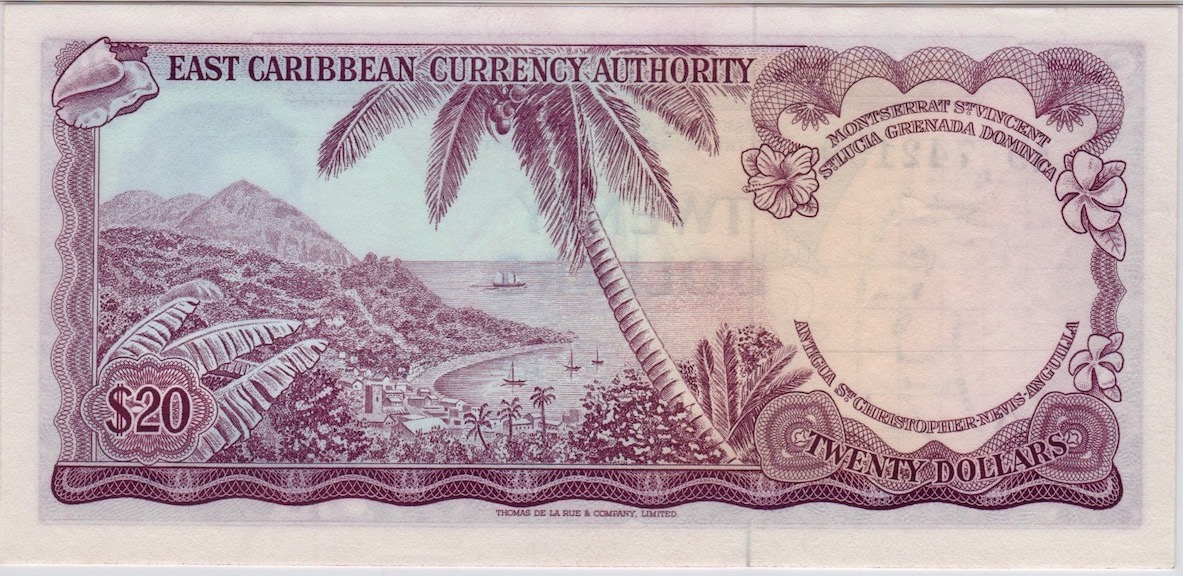
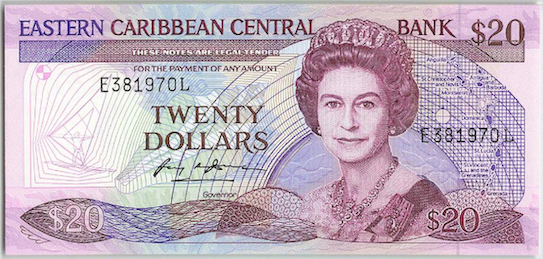
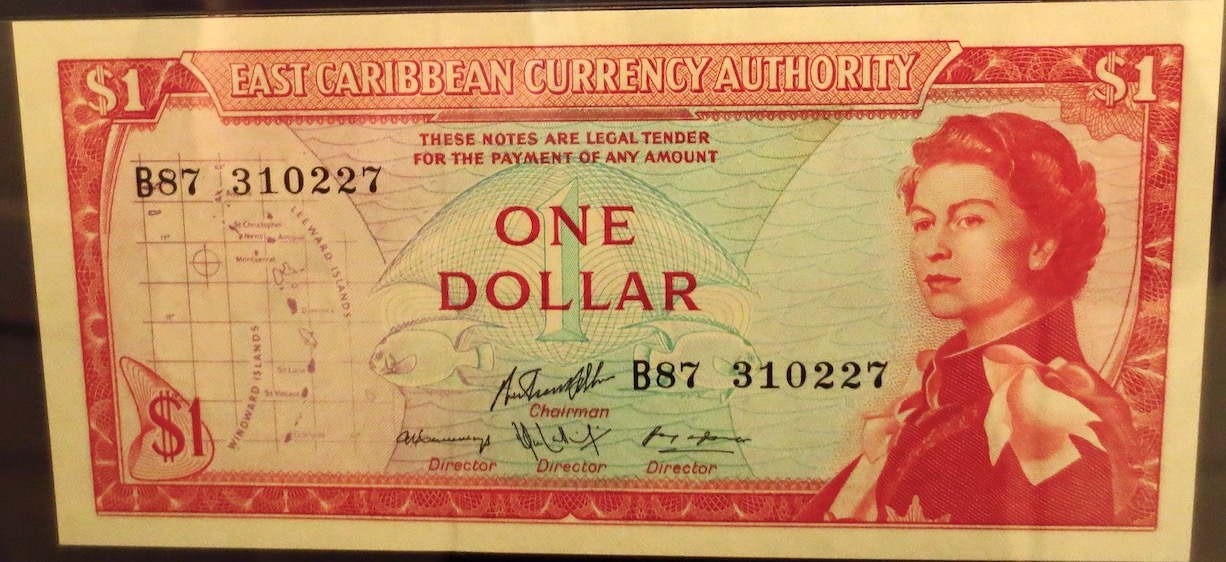
I have found almost all of the variations (suffixes) from 1994 until today to be fairly easy to acquire if one wants to obtain these. The only challenging notes are typically the higher denominations from 1993 back to 1965.
Anyway, I'd just like to close up by summarizing what occurred to the various series up to the recent VERTICAL designs.
Allow me to back up a little once again. The 1994 series was unremarkable other than the fact that the square box obscuring the denomination MARKER was removed & that P-34 FIFTY DOLLARS had a significant colour overhaul (aqua-marine blue tint added to avoid confusion with the $100 P-35). This was a problem that often occurred between the 1993 $50 & $100 (as the colour schemes were similar -esp in poor light). I have also found it quite ironic that 1993 series was the 1st year the bar codes were added to aid the visually impaired to ID each denomination (& yet the 1993 series failed so miserably to be easily identified). The revised 1994 series got rid of the squares (& the funky fonts) so that the MARKER numerals were much clearer to distinguish.
In 1998, the $100 had a gold foil orchid shaped security device added to the FRONT (Obverse) for additional suggesting it may have been subject to counterfeiting.
In the 2000 Series, 2 unique gold foiled fish were added to the $5 & $10, a butterfly graced the $10 & two types of flowers were added to the $50 & $100. Foiled security devices would be a feature of the next design upgrades. I added an example of the $10 on my initial post & below is a $5 from Montserrat (P-37m):
In 2003 P-42 to P-46 have squared off silver foiled security devices (of the same themes) replacing the gold foil optical devices. This also happens to be the last series to employ suffix association to island member states.
In 2008, P-47 to P-51, suffix designation designation is replaced by 2 letter prefixes. All islands received similar notes (no member state signified). Here's an example of P-47 ($5):
-this note has the AD prefix. It would be interesting to know what the last prefix of this series was for each denomination.
In 2012 & 2015 the ECCB notes P-52 to P-55 have one more significant design modification. The first series (2012) indicated by an (a), so that P-52a has a QEII watermark on the $10, while P-52b has no watermark, but an extra thick segmented security strip. Also note that in 2012, the $5 has been retired. See the link below for examples of the two different TEN DOLLAR denominations:
http://www.banknote.ws/COLLECTION/c.../XCD0052.htm
I have found almost all of the variations (suffixes) from 1994 until today to be fairly easy to acquire if one wants to obtain these. The only challenging notes are typically the higher denominations from 1993 back to 1965.