| Author |
 Replies: 16 / Views: 2,396 Replies: 16 / Views: 2,396 |
Page 2 of 2
|
|
|
|
Valued Member
United States
95 Posts |
 There isn't likely a one size fits all solution. I would start with excel and capture any key info such as year, type, country, etc and go from there. |
|
Bedrock of the Community
United States
19496 Posts |
Agree with the above. Begin with a basic excel solution--can always add additional columns and rows as needed--country, year, mint, denomination, composition, KM number (when appropriate), condition, variety, error, other interesting characteristics.
|
|
Bedrock of the Community
United States
20753 Posts |
Send them all to me and I'll do it.   No simple method. Just sit down and separate them the best you can. Edited by just carl
08/21/2022 08:21 am
|
|
Bedrock of the Community
Australia
21789 Posts |
Eekbubbie: to the CCF !First of all, put each individual coin in a 2x2, so that any information relating to the coin can be written on the holder. If the collection need to be re arranged, the information relating to the coin moves with it. With this approach, a spreadsheet in support is favored by some collectors, but is not essential. Valuable coins should be photographed. A mobile 'phone camera is OK for this purpose. Slabs are highly favored by some collectors, but they can severely interfere with the abovementioned storage and display approach. When it comes to arranging the collection For modern coins categorize by -Country -denomination -date. Ancient and Medieval coins will require a different arrangement of the collection, but are most probably outside the scope of this post. |
|
Pillar of the Community
United States
665 Posts |
I recommend joining/using NUMISTA.COM (it's free) to research and create a database for your collection. After creating, you can download all the below listed information to an Excel spreadsheet automatically, with the click of a button. Quote:
Begin with a basic excel solution--can always add additional columns and rows as needed--country, year, mint, denomination, composition, KM number (when appropriate), condition, variety, error, other interesting characteristics. The below is a snippet from my collection downloaded from Numista and modified to my needs. 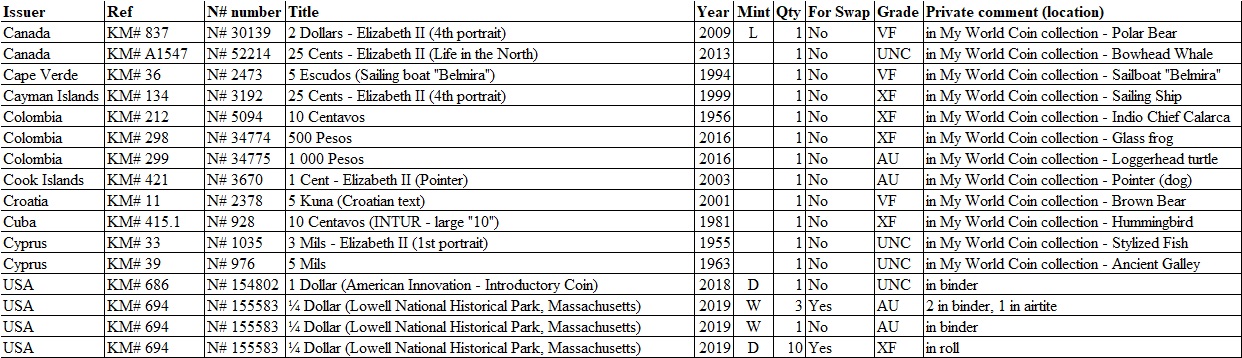 |
|
New Member
 United Kingdom
2 Posts |
Thanks for all the advice! Much appreciated.
|
|
Rest in Peace
United States
18456 Posts |
I'm still old school ,I did my inventory in two different books with 6 columns each : Denomination & type , Date & Mint , Inventory # , Comments , Raw Grade , and price paid & when . |
|
Valued Member
United States
65 Posts |
I use Exact Change. Global coin & currency capable or can limit to your specific needs. Very easy to use. Pricing, Image catalogs and other tools. https://www.exactchange.info/ |
|
Bedrock of the Community
United Kingdom
18488 Posts |
I keep mine on an Excel worksheet but I also have a pocket-size notebook that I can carry around to coin fairs and coin shops.
|
|
Pillar of the Community
 United States
6514 Posts |
I have it all in my head.   God help me.  Check out my counterstamped Lincoln Cent collection: http://goccf.com/t/303507 |
|
Moderator
 United States
194256 Posts |
I am in the spreadsheet camp.  (Microsoft Excel, LibreOffice Calc, Google Sheets, etc.) to the Community! |
|
Pillar of the Community
Russian Federation
1557 Posts |
This summer I systematized my entire collection. I used the ucoin website and also created an Excel table. For myself, I created the following columns: country, denomination, year, mint, description (for example, commemorative coin), condition of the coin (I limited myself to letters), KM# number, date of purchase, purchase price in rubles and dollars. Quote:
I have it all in my head. This is a good solution when you have a small collection, but over time I look into my phone more and more often to make sure that I don't have this coin year/type. Edited by Slerk
08/24/2022 10:35 pm
|
|
Pillar of the Community
United States
755 Posts |
I agree with fplagge! I use Numista to inventory my collection. It's easy to use and has a huge database of coins and gives you lots of information. As fplagge showed, it's easy to export a spreadsheet at any time.
|
|
Pillar of the Community
United States
3765 Posts |
Over the years, I've built a fairly extensive set of Excel spreadsheets cataloging all the different parts of my collection. It's easy to sort, arrange and summarize the information across my full collection in any way I want. It's easily expandable and adaptable when, for example, I add or remove an area of collecting interest.
It took a good bit of time to get them set up as I wanted, but I felt it has been very worth it in the long run.
Member of SPMC, FCCB, ANA and ANS. My U.S. Classic Commemorative Complete Set: https://www.NGCcoin.com/registry/co...sets/278741/ |
|
Bedrock of the Community
United Kingdom
18488 Posts |
I have made grids like this for certain series of coins. On this example. a black square means that a coin does not exist and a blue square means that I have it. A diagonal red line indicates a coin that was only issued in sets (NIFC). You can use different colors of shading to indicate, for example, if your coin is in poor condition and needs to be upgraded. You can do these very easily on Excel, or the old-fashioned way with graph paper and fibre-tip pens! 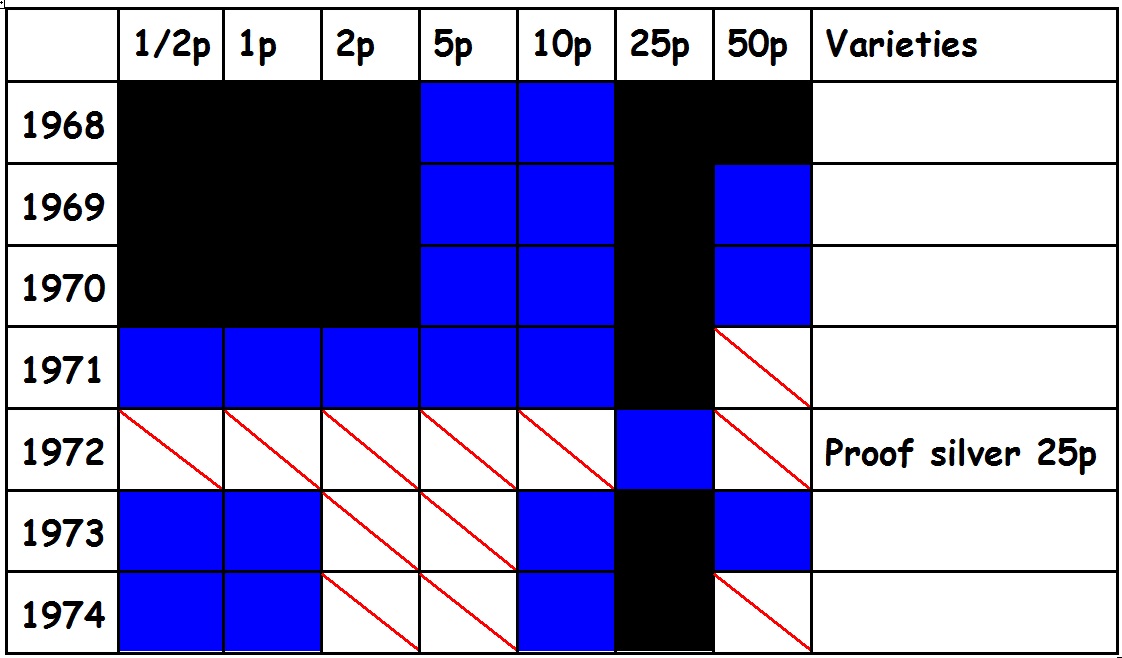 |
|
Page 2 of 2
|
Replies: 16 / Views: 2,396 |
Page 2 of 2
|








 First Page


 Posted 08/21/2022 08:16 am


