| Author |
 Replies: 22 / Views: 6,779 Replies: 22 / Views: 6,779 |
Page 2 of 2
|
|
|
|
Pillar of the Community
United States
3848 Posts |
Depend what you will use it for. For a bullion dealer, some type of X-Ray machine is almost necessary to confirm authenticity of high dollar metals. If you collect classic United States coins, I do not think it would be worth the high price. You can likely conduct you own experiments to see if a piece is genuine without a metalytics, but you would need a lot of practice with good methods. Suffering from bust half fever. Want to learn how to attribute early half dollars by die variety? Click Here: http://goccf.com/t/434955Shoot me a PM if you are looking to sell bust halves. |
|
Valued Member
Australia
144 Posts |
There are times where it's not possible to test the weight and dimensions of a coin. I often encounter this at estate auctions, where people have slabbed coins or put them into flips I can't rip open because the staff would get mad.
An XRF is the gold standard in testing, but even that is not fool proof.
I use my Sigma as an additional tool to help me find dodgy coins. Whether it's worth spending so much money on one is up to the individual. One good thing however is they hold their value, and second hand units are very rare. You're likely to get back most of the unit's purchase price in a few years if you choose to sell.
|
|
Moderator
 United States
34542 Posts |
@clus, I'm quite sure that mine works through a slab. Maybe that is just my specific model?
"If you climb a good tree, you get a push."
-----Ghanaian proverb
"The danger we all now face is distinguishing between what is authentic and what is performed."
-----King Adz
|
|
Valued Member
Australia
144 Posts |
@Spence, depends on the model and the probe. Sigma publishes how deep their device can test metal. Burying a tungsten bar more than a few mm below the surface is probably going to fool the Sigma, but if you're buying gold bars that large then I would be buying from a trusted source anyway.
|
|
Bedrock of the Community
Canada
24885 Posts |
To Spence . Can I have your opinion about this : It is a convenient tool, very fast, non-destructive, reads through plastic and easily detects many fakes...** but cannot detect all fakes,** and is very expensive. http://about.ag/SigmaMetalytics.htmThanks in advance! |
|
Valued Member
Australia
144 Posts |
@Dorado, I know your post wasn't aimed at me, but I thought I'd respond as you touched on an important topic.
First of all, that page with the fake coins and resistivity readings is a helpful resource. Do you know of any pages like it for genuine coins?
While the Sigma is a very handy tool, it is possible to fool it by playing around with the plating and alloy to make the fake bullion. Remember that counterfeiters can buy the Sigma too, and experiment with it to make a better fake product.
But to make a coin/bar with the right weight, size, and resistivity would require considerable skill and may be beyond most counterfeiter's abilities.
Another problem area with the Sigma is false negatives. I have 2 Australian $200 22K 1981 gold coins, but they both test outside the brackets on the 91.6% setting. My coins are genuine (testing by look, weight and size), so it's possible the maker didn't solely use copper when alloying to make 22K.
|
|
Valued Member
United States
59 Posts |
I bought last year on ebay for 800 dollars. I tested all my Morgan's and 3 New Orlean mints were fake. I also,got a fake ASE on ebay last month. It just makes it easier for me to check coins and a peace of mind. I don't buy a lot of slabbed coins other than key dates. |
|
Valued Member
Australia
144 Posts |
I have a Sigma and have previously praised the device, with some caveats, but yesterday I came across an interesting example where the device gave erroneous readings.
I purchased three Napoleon 40 Francs gold coins from a reputable auction house that guaranteed authenticity. 1808, 1810, and 1812. After receiving my coins I tested them all using the wands and the 22K gold setting. 1808 and 1810 tested perfect, but the 1812 coin was off to the far right. Oh no, did I get a fake coin? It looked real...
The measurement mode gave 9.08 and 9.7 for the genuine coins, but 14.8 for the suspect coin. Thinking I might have been ripped off, I took the coins to my trusted bullion dealer that does XRF testing for free (don't know if I can mention them here however...)
All the coins tested between 21.3 and 21.5K gold, with copper and impurities of silver and lead. Tested on both sides of the coins. I didn't press the staff member for the exact composition of the 1812 coin, but it appears the impurities completely threw the Sigma off.
So, the Sigma is a wonderful tool, but use it with caution.
|
|
Valued Member
United States
345 Posts |
I spent the money with the plan for a "brick and mortar" location ... never happened. Now the opportunity to use is limited ... I need to reacquaint myself with it when I take it out. :) I like having it around for appraisals ... comes in handy.
|
|
New Member
United States
1 Posts |
Dealing mainly with sovereign gold and silver coins, I always weigh and measure diameter and width of loose coins and occasionally test gravity. Since I started buying slabbed (NGC & PCGS) coins, I did invest in a Sigma. Ive seen enough fake slabbed coins out there. This is where the Sigma shines as it can see right through the slab. I also like the large bullion wand to test larger bars for anomalies within the bar. All in all, I think it was a great investment and I use it daily. I like that its portable and I can carry along with me to new shops, estate and private sales to quickly determine authenticity.
|
|
Moderator
United States
195203 Posts |
 to the Community, BillMoffatt! |
|
Valued Member
Australia
144 Posts |
At auction today I tested a US 1867 silver dollar with my Sigma on the pre1900 90% setting. The coin was perfectly within the brackets, despite it being an obvious fake. The coin had that weird grey finish you see on Chinese Morgans, and the '1867' date on the coin looked a bit mangled. 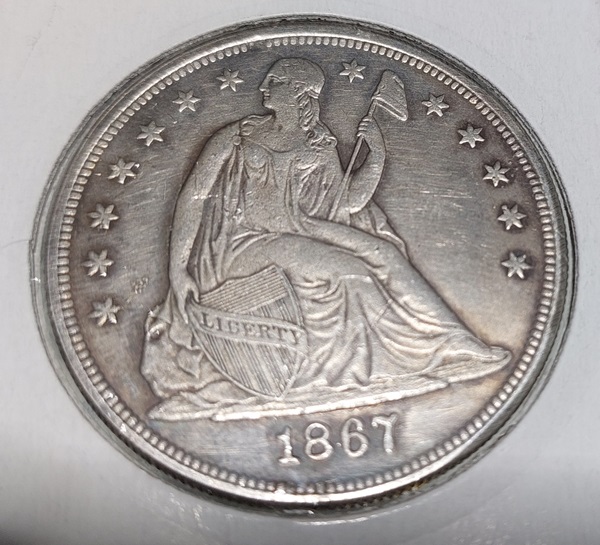 It was paired with an 1885CC Morgan that tested just outside the brackets on the pre1900 setting, and way outside on the pre1945. It's possible the 1867 dollar just had a modified date, but the fact that it was alongside an 1885CC and the two coins had perfectly matching looks and wear made me suspicious. Both coins were in flips so can't really be verified by weight or ping, but the fact that the Sigma said the 1867 is all good is a bit scary. Always use multiple ways to verify your coin. |
|
New Member
Australia
3 Posts |
Hi  New here I have a sigma unit but no wands Hey Cluster coins did you send the faulty unit back to sigma or have you still got the spare wands , if so could you contact me and I would like to see if they work in my unit . |
|
New Member
Australia
3 Posts |
Does any one have any spare wands for the sigma origional as mine did not come with any , so I've been using the measure feature for 1.10 and 1/20 to determine authenticity of the small .9999 gold coins
|
|
Moderator
United States
195203 Posts |
to the Community, Aussiebloke! |
|
Page 2 of 2
|
Replies: 22 / Views: 6,779 |
Page 2 of 2
|







 First Page

 Posted 03/21/2023 09:16 am


