|
This page may contain links that result in small commissions to keep this free site up and running.

Welcome Guest! Registering and/or logging in will remove the anchor (bottom) ads and the security checks. It's Free!
To participate in the forum you must log in or register.| Author |
 Replies: 21 / Views: 2,589 Replies: 21 / Views: 2,589 |
Page 2 of 2
|
|
|
|
Moderator
 United States
15948 Posts |
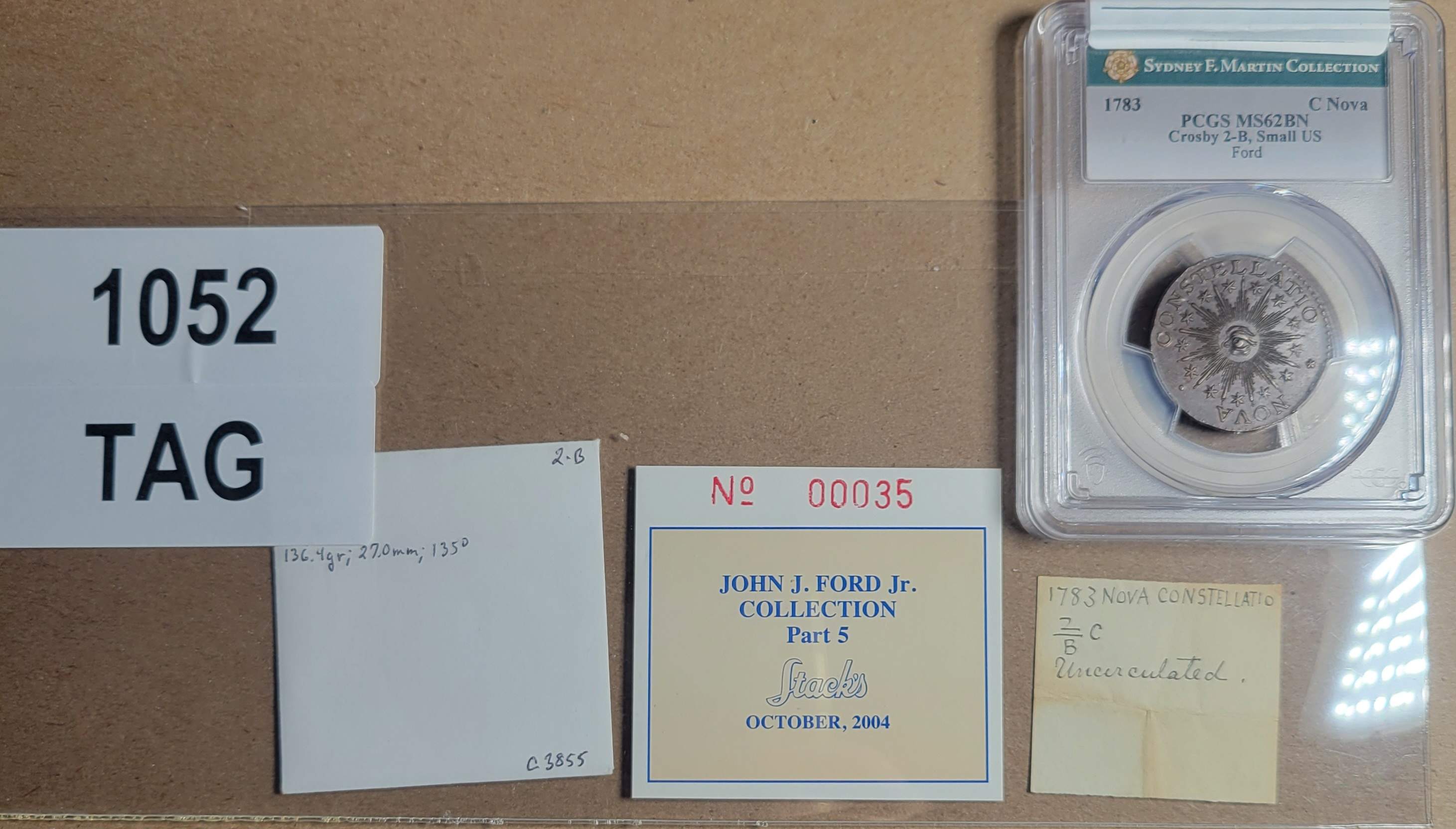
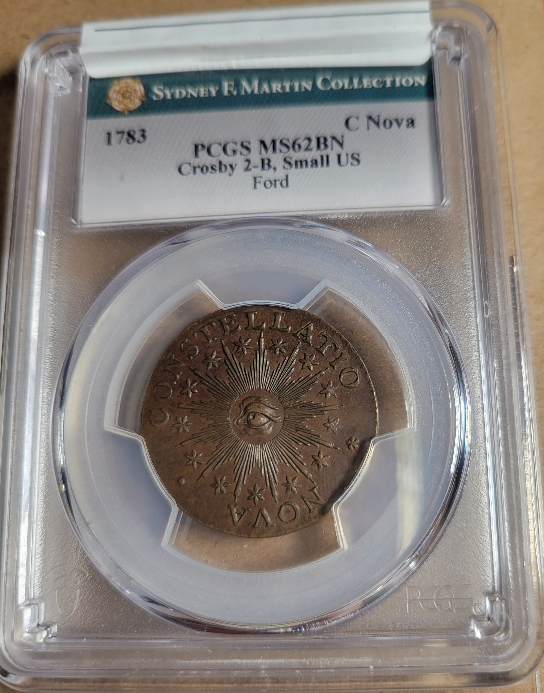
Absolutely spectacular example. Another numismatic treasure for your amazing collection.
|
|
Bedrock of the Community
 United States
18930 Posts |
I'm not going to look at the plates which make assessing this a little challenging as most folks, including me, rarely if ever have a chance to grade one.
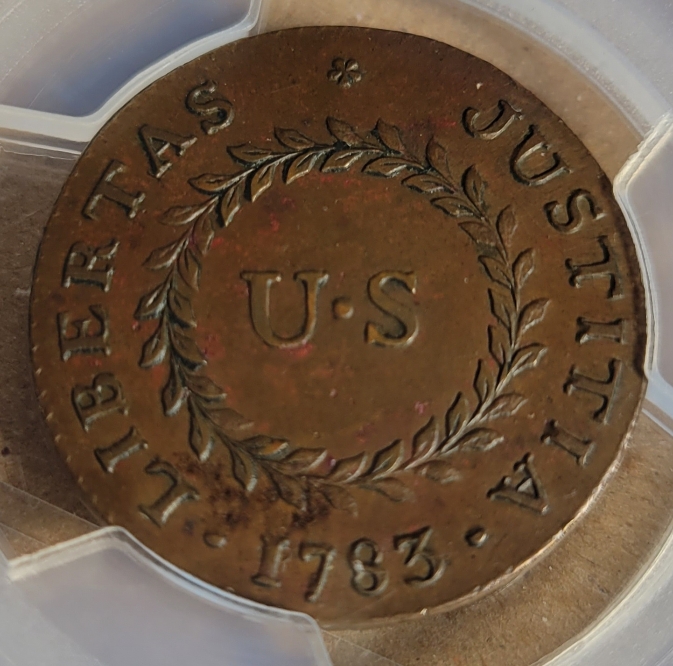
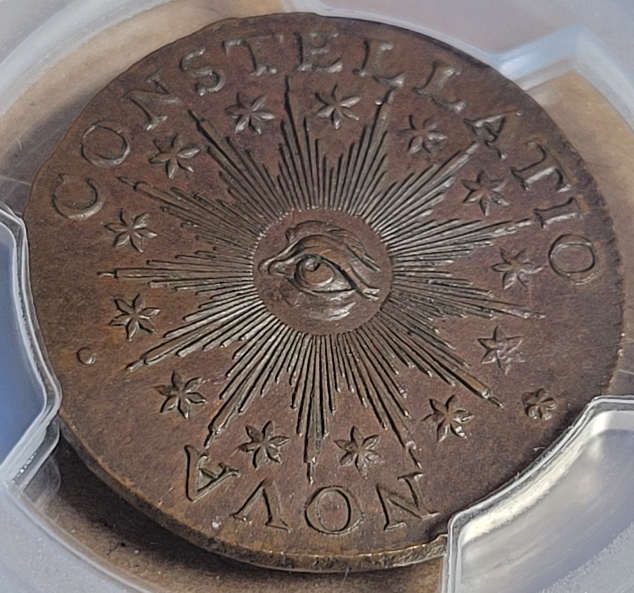
the eye is so well defined which I dont think is that common as it is so deep in the die. red peaking through on both sides makes for great eye appeal. a little discoloration at K7 reverse but its not in a key area and doesn't detract for me. everything about this coin screams MS
i think it could go as high as MS63 but I'm going with MS62 as the red is a little subdued. the surfaces are a little dull so its original patina is missing. the eye could be more defined so the strike could be a tad better on both sides and the discoloration on the reverse.
the coin would be a center piece for any colonial collection. congratulations on your acquisition.
|
|
Bedrock of the Community
 United States
11966 Posts |
Thank you for all of your kind words. I'm gonna sound like a broken record but in my view, this is not a colonial coin. At the time this coin was produced we had won the Revolutionary War for independence and a new nation had been created by our founding fathers. Morris and Rittenhouse with Hamilton and Jefferson were in the process of creating a new system of coinage for a newly born nation, the United States of America. For that purpose, a set of Nova Constellatio patterns was produced and was the first proposed coinage for the U.S.. Congress ultimately rejected these designs, opting for Jefferson's proposal to create dollars and cents also under the decimal system he had been exposed to as ambassador to Paris. This coin was a private issue of Robert Morris, one of our founding fathers. As Congress declined to make it official coinage, it is not really official money, but with the ingenuity of our forefathers, nothing was wasted and it was repurposed into state coinage and used in commerce as a token which still had value because of its copper content and scarcity of small change at that time.
The colonies were a relic of a time when we were subjects of King George III. This coinage represented our repudiation of British colonial rule and the birth of a self-governing new nation.
I believe that these coins were the first to bear the inscription of "US" predating the fugios of 1787 and that was the main reason I wanted it in my collection.
IN NECESSARIIS UNITAS - IN DUBIIS LIBERTAS - IN OMNIBUS CARITAS THE MAN IN THE ARENA, Theodore Roosevelt at the Sorbonne Paris on April 23, 1910: " It is not the critic who counts; not the man who points out how the strong man stumbles or where the doer of deeds could have done better. The credit belongs to the man who is actually in the arena, whose face is marred by dust and sweat and blood, who strives valiantly, who errs and comes up short again and again, because there is no effort without error or shortcoming, but who knows the great enthusiasms, the great devotions, who spends himself in a worthy cause; who, at the best, knows, in the end, the triumph of high achievement, and who, at the worst, if he fails, at least he fails while daring greatly, so that his place shall never be with those cold and timid souls who knew neither victory nor defeat." My coin website: https://fairfaxcoins.comEdited by numismatic student
03/21/2023 10:24 am
|
|
Bedrock of the Community
United States
18930 Posts |
Quote:
but in my view, this is not a colonial coin i hear what you are saying and why. PCGS categorizes it as colonial. how would you categorize then or does it even fall into any category of coinage? maybe as an SP since it actually never made it to production and is more of a pattern coin? Edited by panzaldi
03/21/2023 11:18 am
|
|
Bedrock of the Community
United States
11966 Posts |
I think this is the 1st US private issue coinage (sponsored by Robert Morris, the guy who financed the U.S. Revolutionary War and first Director of Finance of our Nation) which tried to become official coinage but failed in Congress. The patterns are the very rare 100 Unit, 500 unit, 100 Unit silvers and the 5 Unit copper. This coin is part of the business strikes made later from those pattern designs.
IN NECESSARIIS UNITAS - IN DUBIIS LIBERTAS - IN OMNIBUS CARITAS THE MAN IN THE ARENA, Theodore Roosevelt at the Sorbonne Paris on April 23, 1910: " It is not the critic who counts; not the man who points out how the strong man stumbles or where the doer of deeds could have done better. The credit belongs to the man who is actually in the arena, whose face is marred by dust and sweat and blood, who strives valiantly, who errs and comes up short again and again, because there is no effort without error or shortcoming, but who knows the great enthusiasms, the great devotions, who spends himself in a worthy cause; who, at the best, knows, in the end, the triumph of high achievement, and who, at the worst, if he fails, at least he fails while daring greatly, so that his place shall never be with those cold and timid souls who knew neither victory nor defeat." My coin website: https://fairfaxcoins.comEdited by numismatic student
03/21/2023 11:37 am
|
|
Bedrock of the Community
United States
18930 Posts |
thanks NS for the details on this coin. this is the reason for this forum
|
|
Bedrock of the Community
United States
11966 Posts |
Thank you panzaldi. It is weird that the Revolution was fought between 1775-1783 and the people in our country were deemed traitors to the British Crown. Then how does Morris go to British engraver Benjamin Dudley and ask him to engrave the Nova Constellatio pattern coins? Morris also contracts with the Birmingham minting companies and has the coppers produced. Wouldn't helping Americans produce the new coinage also be treason to the British crown. It is unclear to me how all that happened. Wouldn't all this activity constitute aiding and abetting the American rebels and traitors who expelled the British out of its colonies? Some of this doesn't make a lot of sense but I guess it just gives me more to try to learn and understand.
IN NECESSARIIS UNITAS - IN DUBIIS LIBERTAS - IN OMNIBUS CARITAS THE MAN IN THE ARENA, Theodore Roosevelt at the Sorbonne Paris on April 23, 1910: " It is not the critic who counts; not the man who points out how the strong man stumbles or where the doer of deeds could have done better. The credit belongs to the man who is actually in the arena, whose face is marred by dust and sweat and blood, who strives valiantly, who errs and comes up short again and again, because there is no effort without error or shortcoming, but who knows the great enthusiasms, the great devotions, who spends himself in a worthy cause; who, at the best, knows, in the end, the triumph of high achievement, and who, at the worst, if he fails, at least he fails while daring greatly, so that his place shall never be with those cold and timid souls who knew neither victory nor defeat." My coin website: https://fairfaxcoins.com |
|
Bedrock of the Community
United States
12057 Posts |
In the world of Colonial (or pre-Federal, or whatever other term you'd like) coinage, speculation, rumors, hearsay, and guesswork are more prevalent than well-documented, properly cited and reviewed scholarly research. That being said, a great deal of work has been done over the last 30-40 years to try to improve both the quality and quantity of available references and sources, but as collectors, much of the research materials we rely on are twice that age, or more. The actual contemporary sources that survive are, of course, themselves at least 200 to 220 years old.
H.C. Miller's 'The State Coinage Of Connecticut' is 61 years old.
Ed Maris's 'A Historic Sketch of the Coins Of New Jersey..." is 142 years old.
Sylvester S. Crosby's series of articles regarding "Pre-Federal" issues are 126 years old.
Sydney Noe's references on the Massachusetts Pine Tree/Oak Tree and Half Cent/Cent are 74 and 70 years old, respectively.
Robert (Bob) Vlack's 'Early American Coins' is 58 years old. (although his reference on the billon coinage of the French colonies is only 19 years old!)
Eric P. Newman's got one of the most recent of the lot - his updated guide to Fugio cents (co-authored with Wayte Raymond) was released in 2008, but the source material dates from the 1950s.
Q. David Bowers 'Whitman Encyclopedia...' came out in 2009, and updated in 2019; but again, much of the source material is drawn from the research of the above authors and references.
Because of this, long-entrenched thinking - "that's the way things have always been done" - is hard to displace. So if several generations of collectors have grown up calling them all "Colonial" coins, that's likely to stay the case, even though it may not be semantically or historically accurate or even correct.
The furor regarding the reclassification of the Fugio cent over the last year or two is a good example of just how deep the traditions and arguments run within the world of numismatics and early copper in general.
That being said, the organization is the Colonial Coin Collectors' Club - CCCC (C4), not the Early American Coin Collectors' Club, or the Pre-Federal Issues Collectors' Club, or the State-Issued Currencies Coin Collectors' Club -- and they themselves refer to it as "Colonial-era" coinage.
There is still much room for improvement on both the quality and amount of research that can be done on the subject, and it's fascinating to think what new discoveries have yet to be revealed; new information still comes to light about our nation's earliest coinage issues even 200+ years later thanks to the tireless work of Bill Eckberg and many others like him, especially as the magic of the Internet has made digital scans of original source materials far more accessible than ever before, somewhat obviating the need to dig through musty, fragile 100-200+ year old books in search of obscure references.
Member ANA - EAC - TNA - SSDC - CCT #890 "Most of the things worth doing in the world had been declared impossible before they were done." -- Louis D. Brandeis |
|
Bedrock of the Community
United States
11966 Posts |
John Platek gives us a sense of what North America looked like in 1774 just before the Revolutionary War. 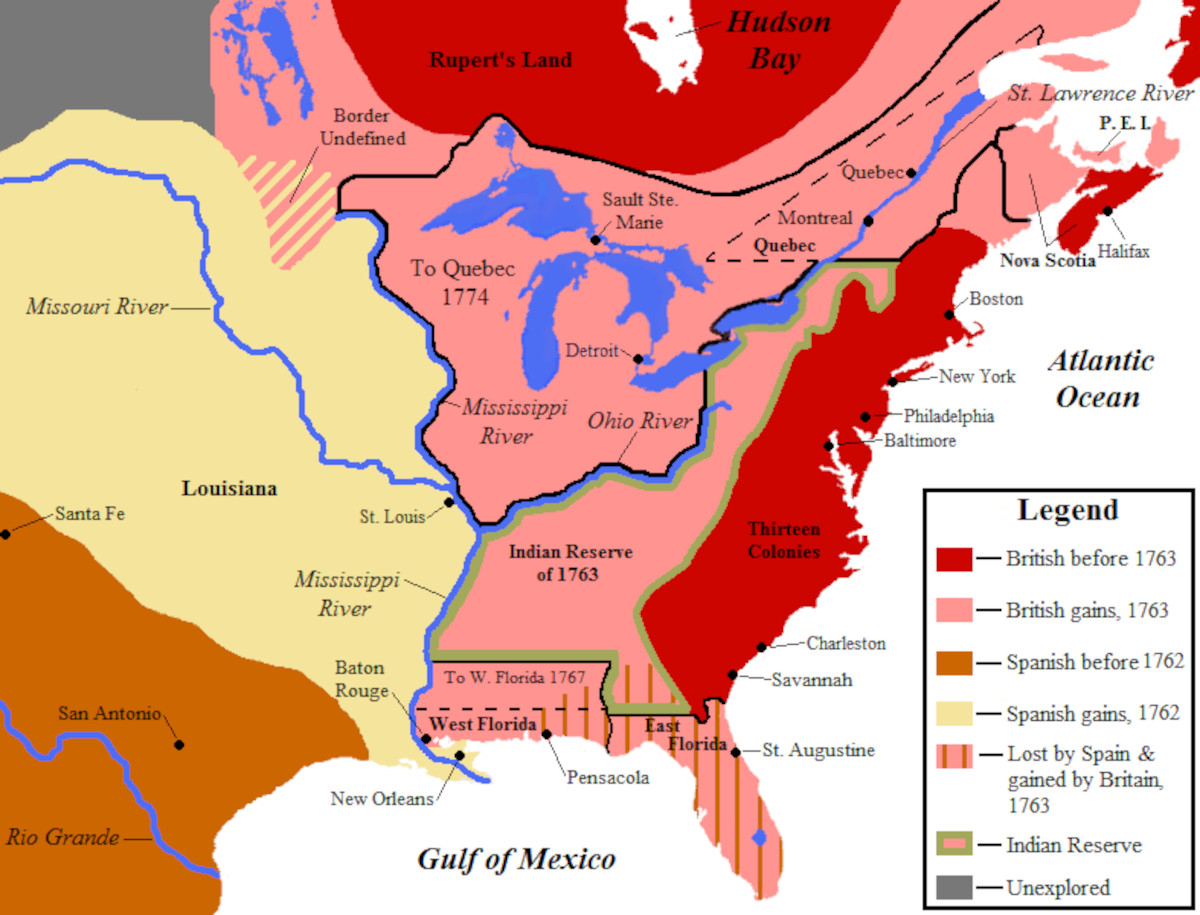 Our country looks like this after the Revolution. A lot happens in those intervening years. 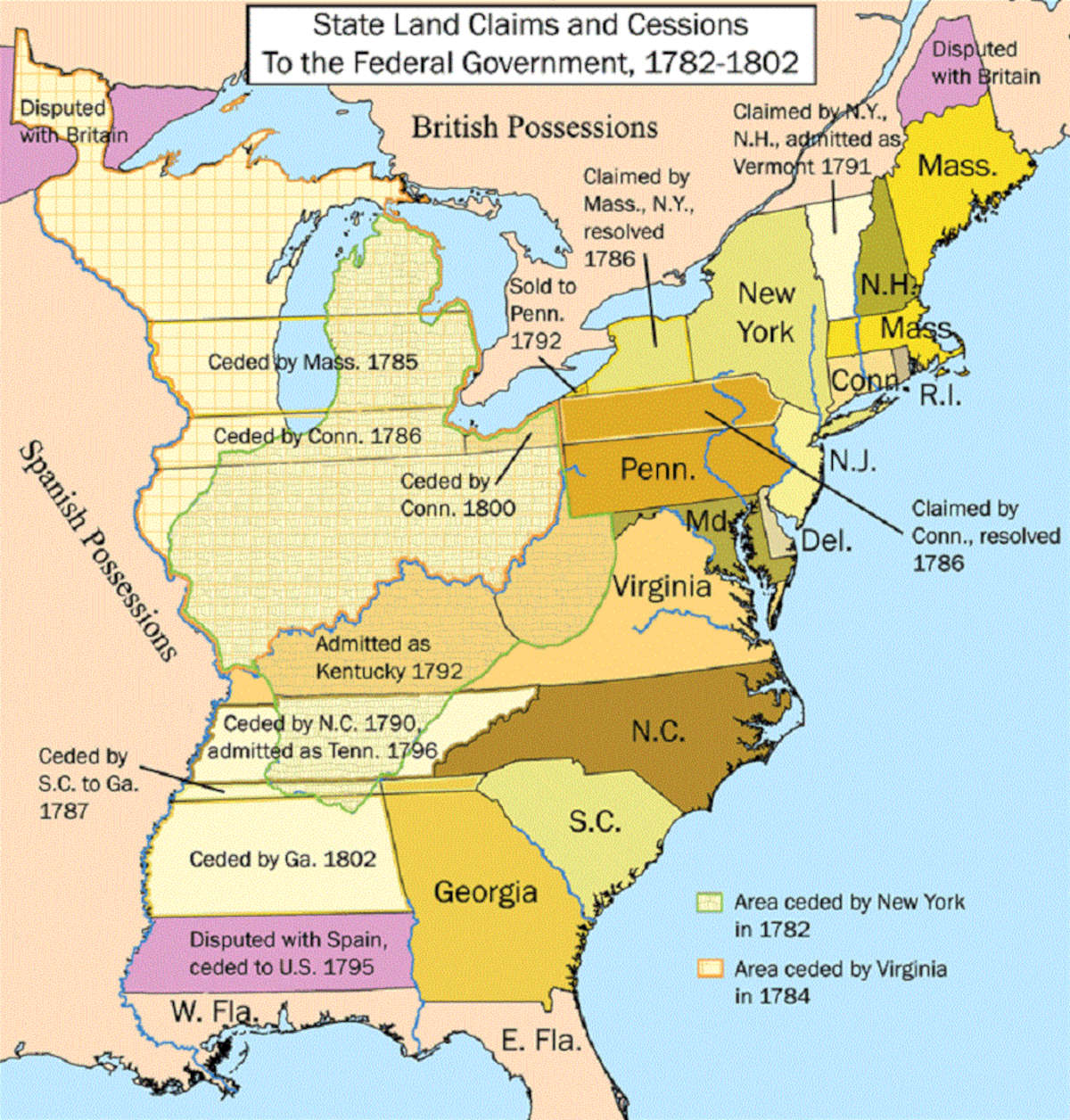 IN NECESSARIIS UNITAS - IN DUBIIS LIBERTAS - IN OMNIBUS CARITAS THE MAN IN THE ARENA, Theodore Roosevelt at the Sorbonne Paris on April 23, 1910: " It is not the critic who counts; not the man who points out how the strong man stumbles or where the doer of deeds could have done better. The credit belongs to the man who is actually in the arena, whose face is marred by dust and sweat and blood, who strives valiantly, who errs and comes up short again and again, because there is no effort without error or shortcoming, but who knows the great enthusiasms, the great devotions, who spends himself in a worthy cause; who, at the best, knows, in the end, the triumph of high achievement, and who, at the worst, if he fails, at least he fails while daring greatly, so that his place shall never be with those cold and timid souls who knew neither victory nor defeat." My coin website: https://fairfaxcoins.com |
|
Bedrock of the Community
United States
11966 Posts |
Weird how Massachusetts used to extend from Maine to Wisconsin and Connecticut extended out to Illinois...  Also interesting how the powerful Spanish, French and British completely surrounded our country and we were able to drive them all out. I guess they spent all of their fortune fighting each other in European wars and adventures. IN NECESSARIIS UNITAS - IN DUBIIS LIBERTAS - IN OMNIBUS CARITAS THE MAN IN THE ARENA, Theodore Roosevelt at the Sorbonne Paris on April 23, 1910: " It is not the critic who counts; not the man who points out how the strong man stumbles or where the doer of deeds could have done better. The credit belongs to the man who is actually in the arena, whose face is marred by dust and sweat and blood, who strives valiantly, who errs and comes up short again and again, because there is no effort without error or shortcoming, but who knows the great enthusiasms, the great devotions, who spends himself in a worthy cause; who, at the best, knows, in the end, the triumph of high achievement, and who, at the worst, if he fails, at least he fails while daring greatly, so that his place shall never be with those cold and timid souls who knew neither victory nor defeat." My coin website: https://fairfaxcoins.comEdited by numismatic student
03/21/2023 12:27 pm
|
|
Bedrock of the Community
United States
11966 Posts |
@paralyse - thank you for the context. I certainly walked into the discussion not knowing any of this. I'm ok with balancing tradition as we evolve in our understanding of how we all got here.
IN NECESSARIIS UNITAS - IN DUBIIS LIBERTAS - IN OMNIBUS CARITAS THE MAN IN THE ARENA, Theodore Roosevelt at the Sorbonne Paris on April 23, 1910: " It is not the critic who counts; not the man who points out how the strong man stumbles or where the doer of deeds could have done better. The credit belongs to the man who is actually in the arena, whose face is marred by dust and sweat and blood, who strives valiantly, who errs and comes up short again and again, because there is no effort without error or shortcoming, but who knows the great enthusiasms, the great devotions, who spends himself in a worthy cause; who, at the best, knows, in the end, the triumph of high achievement, and who, at the worst, if he fails, at least he fails while daring greatly, so that his place shall never be with those cold and timid souls who knew neither victory nor defeat." My coin website: https://fairfaxcoins.com |
|
Bedrock of the Community
United States
12057 Posts |
Of course. It's helpful to understand why, in context, people still refer to things using terminology that is demonstrably inaccurate or incorrect -- but tradition is a stubborn mule to break.
This country has never had a currency or coin known as a "penny" since 1793, and yet every day you will hear and see countless people using the term "penny" to refer to a one-cent coin. It is not correct, but it is so engrained in our collective consciousness that attempting to correct others regarding this fact often comes across as pedantic or arrogant even when you have the truth on your side.
To use another example, every day in our hobby we can hear, and see, discussion about "Seated Liberty" coinage (instead of "Liberty Seated", the preferred terminology.)
Of course, when it comes to our country, precisely how to label the various eras between the 1600s up to 1788 or 1793 is in and of itself a contentious matter informed by historical traditions that may or may not be a fair reflection of "the way things were" at the time. As a nation, citizens and historians alike by and large cannot even agree on when we first became "The United States of America!"
Member ANA - EAC - TNA - SSDC - CCT #890 "Most of the things worth doing in the world had been declared impossible before they were done." -- Louis D. Brandeis |
|
Bedrock of the Community
United States
11966 Posts |
IN NECESSARIIS UNITAS - IN DUBIIS LIBERTAS - IN OMNIBUS CARITAS THE MAN IN THE ARENA, Theodore Roosevelt at the Sorbonne Paris on April 23, 1910: " It is not the critic who counts; not the man who points out how the strong man stumbles or where the doer of deeds could have done better. The credit belongs to the man who is actually in the arena, whose face is marred by dust and sweat and blood, who strives valiantly, who errs and comes up short again and again, because there is no effort without error or shortcoming, but who knows the great enthusiasms, the great devotions, who spends himself in a worthy cause; who, at the best, knows, in the end, the triumph of high achievement, and who, at the worst, if he fails, at least he fails while daring greatly, so that his place shall never be with those cold and timid souls who knew neither victory nor defeat." My coin website: https://fairfaxcoins.com |
|
Bedrock of the Community
United States
12057 Posts |
I was at 63BN, PCGS says 62BN
Can't really offer thoughts, too busy drooling all over the keyboard...
Member ANA - EAC - TNA - SSDC - CCT #890 "Most of the things worth doing in the world had been declared impossible before they were done." -- Louis D. Brandeis |
|
Bedrock of the Community
United States
18930 Posts |
Bam...i think this is one of only non-government issued coin I nailed the grade  |
|
Page 2 of 2
|
Replies: 21 / Views: 2,589 |
Page 2 of 2
|
To participate in the forum you must log in or register.
Disclaimer: While a tremendous amount of effort goes into ensuring the accuracy of the information contained in this site, Coin Community assumes no liability for errors. Copyright 2005 - 2026 Coin Community Family- all rights reserved worldwide. Use of any images or content on this website without prior written permission of Coin Community or the original lender is strictly prohibited.
Contact Us | Advertise Here | Privacy Policy / Terms of Use
|
| Coin Community Forum |
© 2005 - 2026 Coin Community Forums |
| It took 0.81 seconds to rattle this change. |
 |
|
| |
| |







 First Page


 Posted 03/21/2023 09:42 am