| Author |
 Replies: 23 / Views: 945 Replies: 23 / Views: 945 |
Page 2 of 2
|
|
|
|
Bedrock of the Community
United States
79876 Posts |
|
|
New Member
 United States
40 Posts |
*** Edited by Staff to add Quote tags. [quote][/quote] Please use them in the future.  *** ***Quote:Definitely a Vise Job, not a genuine error, sorry. I hope you didn't pay much money for it. The reversed lettering gives it away. Also, the obverse is all flattened looking from the damage. https://www.error-ref.com/squeeze-j...-garage-job/ did you read the initial post? what would revisiting that link serve? please fill me in with makes you so sure and sympathetic about how I acquired it? Check that. Really only interested in what makes you so overwhelmingly sure. Lets skip the rest.
|
|
New Member
United States
40 Posts |
My understanding:
This error requires two coins in the minting press at the same time: an already struck coin that fails to eject, and a new, blank planchet.
The Stuck Coin ("Brockage Maker"): An already struck coin sticks to one of the dies (usually the hammer die).The New Planchet: A fresh, blank planchet is fed into the coining chamber underneath the stuck coin.
The Strike: When the die comes down, it presses the blank planchet against the previously struck coin.The Result: The side facing the die gets a normal, stamped impression.
The opposing side, which was pressed against the raised design of the stuck coin, receives a sunken, mirrored (incuse) impression of the first coin's design.
Variations in the "Flat" SideThe appearance of the opposing side depends on the specific circumstances of the strike:
Normal Strike: If the planchet is properly trapped inside the minting collar and receives the full force of the opposing die, the side facing the die will display a normal, properly struck design.
Broadstruck (Flattened) Strike: If the minting collar malfunctions or is out of position, the pressure can cause the metal to bulge outward. In these cases, the face stamped by the die may be featureless, stretched out, or completely flat while still showing the reversed incuse design on the other side. <<<<<OBLONG SHAPE AND FLAT ON ONE SIDE.
|
|
Bedrock of the Community
United States
79876 Posts |
Yes, I've have read your post. If you take a look at the link I provided, it's 100% a Vise Job. I already explained why it is a Vise Job. It's not a genuine mint error. This will be my last comment, as I am not going to argue with you about it.  Errers and Varietys.
|
|
New Member
United States
40 Posts |
Huh. Argue? Heh. This ain't arguing. Its more sifting through things and drilling down for facts I can work with. Don't take it personal though, it just came across as you needed a re-read of the original post. Have a great day.
|
|
Bedrock of the Community
United States
79876 Posts |
Thank you, bv2. I appreciate the kindness.  I take my last comment back. I'm sorry if I took it the wrong way. I just didn't know if it the thread was going to go south, as they sometimes do. Take care. Errers and Varietys.
Edited by Errers and Varietys
06/16/2026 2:27 pm
|
|
Bedrock of the Community
 United States
27514 Posts |
I am convinced that this is a vise job. Brockage coins usually have one "normal" side and one "abnormal" side. This second side is either a smeared side or a mirror of the smear. You can't get a smeared flattened side opposite of a multiply struck side.
b2v, please relate the sequence of events in the striking chamber which could have resulted in your coin. Then do the same with a hammer and pile of cents on a concrete slab or anvil.
Inordinately fascinated by bits of metal with strange markings and figures
|
|
Pillar of the Community
United States
593 Posts |
The obverse is the key to this being PMD. The obverse clearly was fully struck up, evident by the date, design rim and remains of the bust. A second force, however, had to be applied to flatten the previously struck up details, and if the coin remained in the chamber it would have received the force while up against the same die, resulting in some form of obverse "re-impressioning". Instead we see that the second force was applied while the obverse was against a flat surface, meaning post mint mechanical alteration is the most likely answer. |
|
Moderator
United States
108675 Posts |
Quote:
This error requires two coins in the minting press at the same time: an already struck coin that fails to eject, and a new, blank planchet Except that the 'new planchet was already struck properly - if the previously struck coin that was 'stuck' in the chamber, then the new blank planchet would not have gotten a proper strike . I say that this is a hammer and anvil job (seeing how the obverse is smashed flat and smooth.) |
|
Bedrock of the Community
United States
10601 Posts |
I'm just going by the way the obverse details were flattened = pounding on the reverse. Just my observation. I don't have the patience to study coins for very long though.........
|
|
Pillar of the Community
United States
7600 Posts |
Quote:
obverse details were flattened = pounding on the reverse. The most accurate answer. Everyone correctly identified the coin not to be a true mint error. The multiple incused impressions on the reverse and the flattening of the obverse only points to one thing: a POUNDING by a Hammer. Bottomn line: the coin did not leave the Mint this way............ |
|
Pillar of the Community
 United States
5722 Posts |
I agree with everyone that this appears to be created by pounding another coin over the coin in question. But would someone care to explain the 2 copies of E Pluribus Unum, both of which appear raised and not inverse?
|
|
Bedrock of the Community
United States
27514 Posts |
Quote:
But would someone care to explain the 2 copies of E Pluribus Unum, both of which appear raised and not inverse? A flattened coin is hammered on top of the reverse of a cent, creating a negative impression. That coin is then hammered on the reverse of another cent, creating a second reverse impression over the first. Inordinately fascinated by bits of metal with strange markings and figures
|
|
Pillar of the Community
United States
7600 Posts |
Quote:
2 copies of E Pluribus Unum, both of which appear raised and not inverse? You'd be surprised how it is done with a little ingenuity it'll take a little practice but there are plenty bored people out there, Press a blank thru a vise onto a coin ,it'll pick up the reversed details ,put that back over another cent and pound it and you'll get the impression of the correctly oriented devices on that coin. On this coin you can see the reversed lettering of AMERICA in front of the word CENT. lol @HondoB and I posted the same respond about same time.  Quote:
my LCS looking for a reversed image he did not see 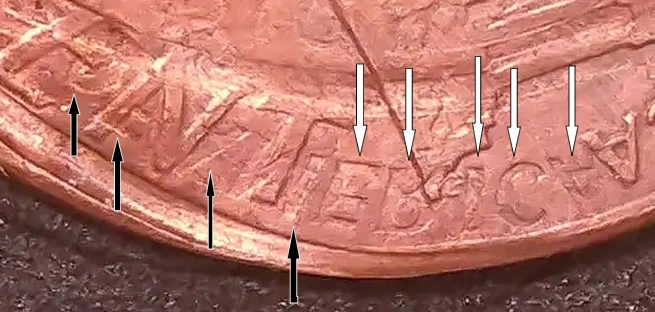 Edited by Chase007
06/17/2026 12:46 pm
|
|
Bedrock of the Community
United States
27514 Posts |
Quote:
You'd be surprised how it is done with a little ingenuity Chase, I must admit to having hammered a few coins in my youth. And put coins on railroad tracks. Shot them with BB guns. Gnawed on them with wire cutters and tin snips. Unfortunately I never had a torch - parents wouldn't let us have fire ever since that incident behind Paw-Paw's shed... Inordinately fascinated by bits of metal with strange markings and figures
Edited by HondoB
06/17/2026 1:45 pm
|
|
Page 2 of 2
|
Replies: 23 / Views: 945 |
Page 2 of 2
|





 First Page

 Posted 06/16/2026 12:06 pm


