| Author |
 Replies: 16 / Views: 440  |
Page 2 of 2
|
|
|
|
Moderator
 Australia
17061 Posts |
The short and simple answer to the question "Why Doesn't America Use The Dollar Coin?" is, "Because the American government refuses to force its people to stop using dollar notes".
Pretty much every other country which, when faced with inflation during the 20th century, replaced their dollar-note-equivalent with a dollar-coin-equivalent, they simply stopped making dollar notes, thus "forcing" everybody to use the coins.
Great Britain, 1983. Stopped issuing £1 notes, started issuing £1 coins.
Australia, 1984. Stopped issuing $1 notes, started issuing $1 coins.
Canada, 1987. Stopped issuing $1 notes, started issuing $1 coins.
Australia, 1988. Stopped issuing $2 notes, started issuing $2 coins.
New Zealand, 1991. Stopped issuing $1 and $2 notes, started issuing $1 and $2 coins.
Canada, 1996. Stopped issuing $2 notes, started issuing $2 coins.
In every single example cited above, there may have been a bit of grumbling - quite a bit of grumbling for Australia in 1988, because nobody liked those tiny little $2 coins - but people simply got used to it. In not one example cited above, did "don't vote for them again, they got rid of a banknote and replaced it with a coin" become an election issue that cost anybody an election.
Are banknotes more "convenient" than coins? Yes. Do coins cost more than banknotes to ship around a country - especially a large country? Yes. Are paper banknotes easier to counterfeit than coins? Also yes. But the benefits to the government bottom line (saving production costs in not having to replace banknotes that wear out after just a few months in circulation) have historically been deemed to be "worth it".
Are there other countries where the highest value coin had the same face value as the lowest-value note, and that country continued to issue both the coins and notes? Yes.
Germany (both West Germany and post-Unification): the 5 deutschmark coin and 5 deutschmark note circulated side-by-side. The coins were rarely seen in circulation pre-1975 when they were still being made of silver, but after 1975, they both circulated. Which one people used, tended to be determined by what people wanted to use them for. 5 mark coins were more useful for vending machines, in an era when vending machines accepting paper money was still essentially unheard of. They even redesigned the old 1960s-era 5 mark note in 1996, just a few years before the deutschmark itself was abolished and replaced by the euro. Germany "made it work".
Switzerland: produced both 5 franc coins and 5 franc notes up until 1952, circulating side by side. The 5 franc coin was quite large (silver-dollar-sized) and made of silver, making them an awkward choice to carry around in bulk, so the paper alternative was understandably popular. The notes were abolished long before the coin composition switched to cupronickel in 1967.
Japan: post WWII, japan issued 100 yen banknotes. They introduced 100 yen coins in 1957, but did not stop printing 100 yen notes until 1974; nearly 20 years of the coins and notes circulating side by side. The 100 yen coins switched from silver to cupronickel in 1967, which seems to have seen a surge in their use.
Later, in Japan: began issuing 500 yen coins for circulation in 1982, alongside the 500 yen note. The note was withdrawn in 1984; it was apparently always the intention to abolish the note soon after the coins were introduced. Again, the driving force seems to have been allowing higher denominations in vending machines, especially as Japan has historically been a much more vending-machine-aligned culture.
So, has any other country actively attempted for 50 years to replace a banknote with a coin, and failed? Um, no, not really. Sorry, America, you're on your own there.
Don't say "infinitely" when you mean "very"; otherwise, you'll have no word left when you want to talk about something really infinite. - C. S. Lewis
|
|
Valued Member
Canada
408 Posts |
I sort of dispute Sap's contention that coins are harder to counterfeit than bills........the Canada has a flood of counterfeit toonies and loonies....readily available from various stores and available in amounts of 10,000's and up for barely hundreds of dollars and probably every couple rolls will yield some (although to be fair I've see so descriped100 dollar bills security strips and all on ebay here as well). Enforcement of the laws is important. |
|
Moderator
Australia
17061 Posts |
Paper bills are easier to make a "bad counterfeit", in the sense that all you really need is a colour printer or colour photocopier. 20th-century-technology banknotes like the current US$1 kind of assumed nobody had such machines at home, and when those machines became commonplace, paper money had to become more high tech (and more expensive). To make a fake coin, you need some industrial assets: a press, a supply of rolled blank metal, and a way of punching out blanks of the correct size. Not really something that "anybody can do in their home office" - though perhaps metal-filament 3-D printers are getting there, and will no doubt get cheaper and more common in the coming decades.
Countries with high-face-value circulating coins - like, well, all of the countries named in my post above, as well as the Eurozone, all do indeed have a high prevalence of counterfeit coins in circulation - but that's because those coins are (for the most part) being manufactured overseas in bulk, and imported illegally. So these coins might be "easy to get" if you're criminally-inclined, but they're still not really "easy to make".
Don't say "infinitely" when you mean "very"; otherwise, you'll have no word left when you want to talk about something really infinite. - C. S. Lewis
|
|
Moderator
United States
200807 Posts |
I do not have anything to add because Sap said it all and then some.  |
|
Pillar of the Community
United States
7639 Posts |
Quote:
Why doesn't America use the dollar coin? Because the sellers on ebay are hording them and selling them fo Five figures  https://goccf.com/t/494101 |
|
Moderator
United States
200807 Posts |
Quote:Because the sellers on ebay are hording them and selling them fo Five figures  |
|
Bedrock of the Community
United States
20101 Posts |
End the US $1 note now please! The $1 coins will circulate out of necessity.
|
|
Pillar of the Community
United States
7096 Posts |
Dollar bills are far more convenient than coins. When I traveled in Europe, I found receiving big coins back in change to be mildly annoying. They were handy for train fares, though. I think now, most people use cards for that.
|
|
Moderator
United States
200807 Posts |
Quote:
End the US $1 note now please! The $1 coins will circulate out of necessity.  Quote:
Dollar bills are far more convenient than coins. But they smell a lot worse. |
|
Pillar of the Community
United States
7096 Posts |
 I don't make it a habit to smell my currency!  I can't remember the last time I had a gross or smelly dollar bill. I think that's more of a big city thing. |
|
Moderator
United States
200807 Posts |
It was a joke. Tough crowd.  |
|
Pillar of the Community
United States
7096 Posts |
Heh, sorry for being a bad audience! I decided to ask a recognized smelly-things expert. 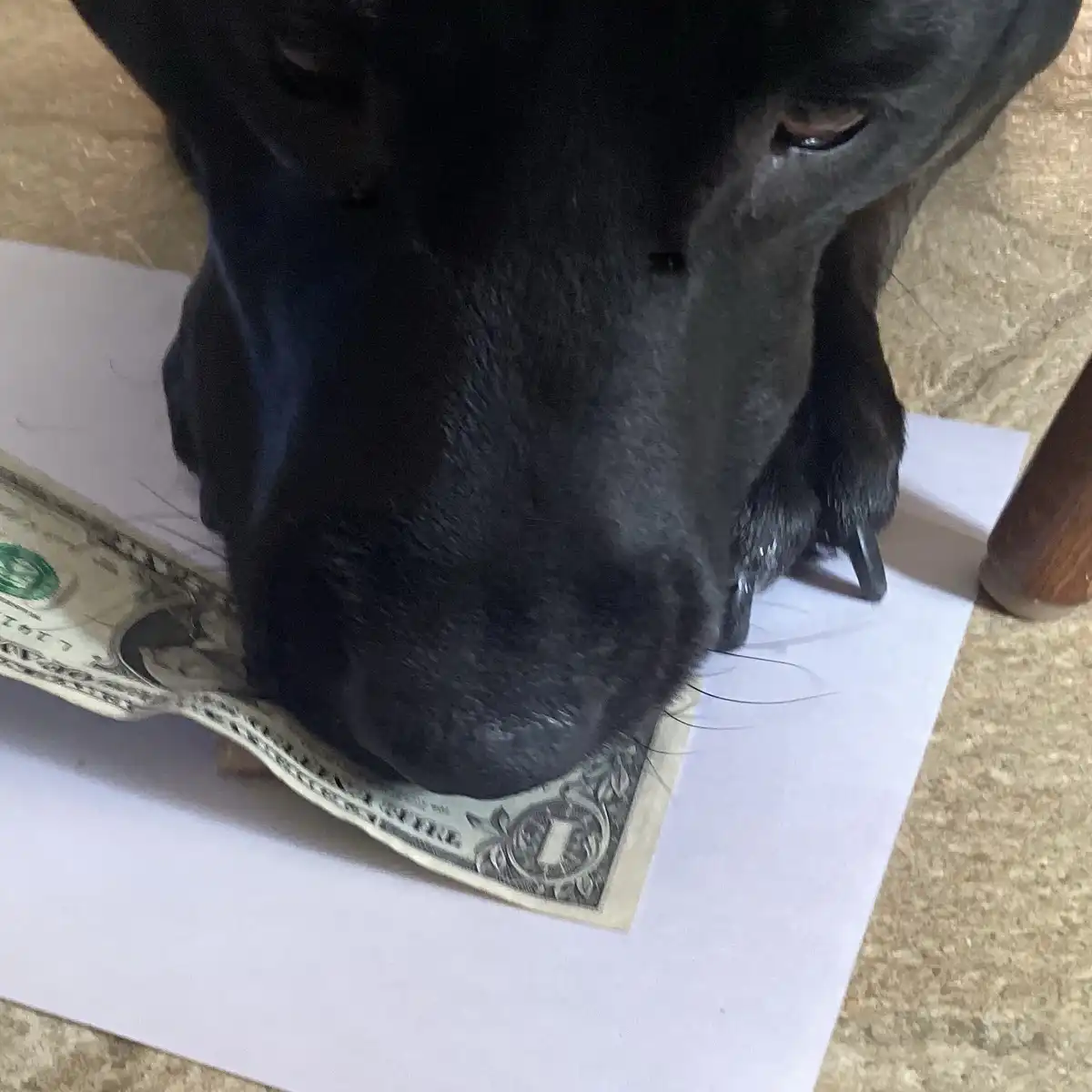 Verdict: smells like people hands. Recommendation: trade stinky people paper for treats! Edited by Brandmeister
Yesterday 10:46 am
|
|
Moderator
United States
200807 Posts |
Well played!   |
|
Valued Member
United States
473 Posts |
Americans have never accepted a dollar coin. The early silver dollars were suspended after 1803 until 1840. (About 7 dated 1804 were minted in the 1830s as presentation pieces, with a similar number of restrikes made later). Seated dollars were not minted in large numbers and most circulated as bullion in the Far East. Trade dollars were not legal tender for years, and were minted for circulation in the Far East, too. Enormous quantities of Morgan dollars were minted between 1878 and 1904 under the pork barrel Bland-Allison Act which mandated the US government to purchase huge quantities of Nevada silver at above market cost and mint them into Morgan dollars. Some of these did circulate, especially in the American West, but most were unwanted by the public and ended up stored in bags still in mint state. For lack of sufficient storage space, the government ended up storing the bags in post offices and other minimally secure government owned buildings. A bunch did prove popular at Las Vegas casinos, however. Finally the government sold off the stored Morgans to collectors in the 1960s and 1970s. I have no clue why many millions of *** Edited by Staff - The bad word filter is in place for a reason. Bypassing the filter and making the intended word obvious anyway is completely unacceptable. *** low relief Morgans were minted in 1921. The Peace dollar appeared in 1921 to commemorate the end of the Great War, the war to end all wars. It was minted in large quantities from 1922 through 1925 and then petered out and was discontinued in 1935. It did circulate some and was frequently given as a gift or an expression of gratitude. Gold dollars from the California Gold Rush were minted in large quantities for a few years beginning in 1849, and were in demand in the coin starved American West, but they also were soon produced in minuscule quantities until being discontinued after 1889. The traditional silver dollar sized Ike was introduced in the 1970s but no one really used it. Like its silver predecessors, it was big, bulky and inconvenient, although attractive and desirable to numismatists. The inconveniently sizes Kennedy half didn't circulate, either. At the urging of vending machine companies the smaller Susan B. Anthony was introduced. People didn't use it either. The smaller sized golden Sacagewia dollar is a thing of beauty that occasionally comes up in circulation, but it is also unpopular. Nowadays, I really can't think of anything one can buy with a coin. Can't even buy a candy bar for a dollar anymore. Personally I don't carry change. I stopped carrying coins in the 1980s when I became acutely aware of a co-worker's approach as coins rattled in his pocket when he walked down the hall. I don't usually carry much cash anymore, and my wallet is often empty of all but credit cards. If I am going to have dollars on my person I want them folded in my wallet, not rattling in my pocket. Yes, one and two Euro coins circulate in Europe, and I get a bunch of them in change for larger denomination bank notes. But when I come back to the U.S. with a handful of them, the banks won't accept foreign coins for exchanging into dollars. They take only easy to handle paper currency. Personally, I don't think discontinuing the paper dollar and minting only dollar coins is any more likely to sell in America now than it has in the past. They will end up in people's change jars like coins do now. So the government will have to produce billions each year, like it did pennies, because they will drop out of circulation almost immediately, and need to be replaced so merchants can make change. Americans are stubborn creatures of habit who still won't accept the metric system. |
|
Moderator
United States
200807 Posts |
Quote:
Americans are stubborn creatures of habit who still won't accept the metric system. This. Upsetting. I learned metric all through grade school in the '70s and then in junior high they said, "Nope!"  |
|
Page 2 of 2
|
Replies: 16 / Views: 440 |
Page 2 of 2
|





 First Page


 Posted 11/15/2026 10:19 pm


