Up for review today is the 1934 half-dollar commemorating the 200th anniversary of the birth of explorer, frontiersman, settler and American icon Daniel Boone. The coin is presented via an example in PCGS MS-66.
Though Daniel Boone is most strongly connected with the exploration and settling of what is now Kentucky, he was not born there -- he was born in Pennsylvania in 1734. He moved with his family to what is now North Carolina in 1753 and stayed there for more than a decade. He began his explorations of what is now Kentucky in 1767 and under contract in 1775 established a road through the Cumberland Gap for settlers to travel to and settle in Kentucky. He built a fort at what would become Boonesborough, Kentucky and helped establish there one of the first settlements west of the Appalachian Mountains.
Read More: Commems CollectionWith such a strong tie to the founding of Kentucky, it is no surprise that a Kentucky Daniel Boone Bicentennial Commission was created and that a commemorative coin was sought. Augustus Lukeman was selected to design the coin and was given specific instructions regarding what was to appear on the coin by the Commission. The obverse was to feature a portrait of Boone that was to be based on the bust of Boone prepared by Albin Polasek for the Hall of Fame for Great Americans at New York University. Lukeman chose not to use the Polasek bust for his portrait and thus touched off a battle with the Bicentennial Commission. His obverse/reverse designs were at first rejected by the Kentucky Commission, but with some relatively minor changes were ultimately accepted by them after being unanimously approved by members of the US Fine Arts Commission and being supported by an influential local newspaper.
The reverse of the coin features a standing Boone facing Shawnee Chief Black Fish; the Boonesborough Fort is in the background. The two men are depicted discussing a potential peace treaty between the Shawnee and the settlers prior to a Shawnee attack on the fort. The talks were ultimately unsuccessful, with the result being the Shawnee laying siege to the fort for nine days; the Shawnee were ultimately unsuccessful in winning the battle and left without further incident at Fort Boonesborough.
The Boone commemorative half-dollar was struck between 1934 and 1938; one of nine classic silver commemoratives to be dated over multiple years. The 1934 coins were only struck at Philadelphia, but the subsequent annual issues were struck at all three US Mints.
The coin shown is a nice, lustrous first year of issue example. The finish on Boones ranged from flashy to satiny over the years, but it is recommended to avoid examples that are "so satiny" that their surfaces appear flat and lifeless.
Enjoy!
1934 Boone Birth Bicentennial - Obverse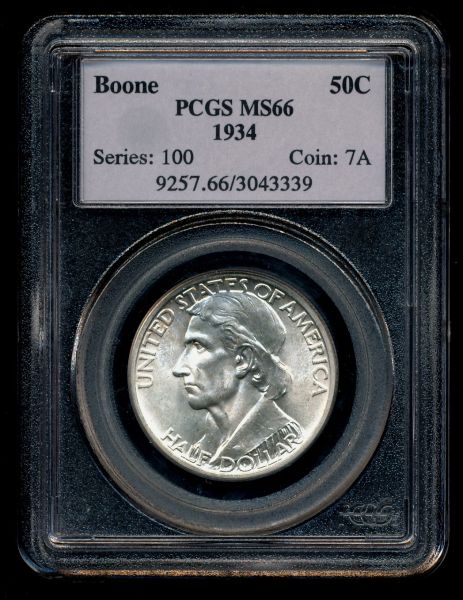 1934 Boone Birth Bicentennial - Reverse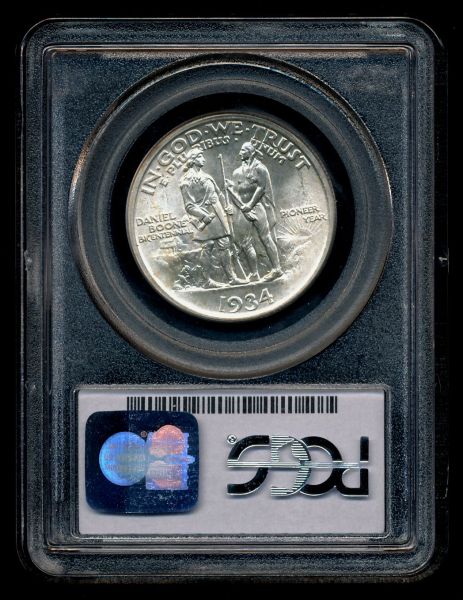










 Posted 04/27/2012 7:07 pm


