Tonight we take a look at another "add on" commemorative, the 1951 George Washington Carver -- Booker T. Washington half-dollar. The coin is presented via an example in PCGS MS-65.
Like the Arkansas Statehood Centennial -- Robinson half-dollar, authorization for the Carver-Washington commemorative was "tagged on" to already approved legislation -- namely, that for the original 1946 Booker T. Washington half-dollar. Here's a link to my post on the BTW half-dollar:
http://goccf.com/t/116437Read More: Commems CollectionCarver's rise from a child born to slave parents to a prominent agricultural scientist, educator and farming consultant is a story too long for telling here; I encourage the reader to seek out his full story via other sources. For our purposes here, I will mention that it was Booker T. Washington who, in his role as the president of the Tuskegee Institute, hired Carver to serve as head of the Institute's Agriculture School thus firmly establishing the long-term link between the two men. Carver flourished in the position and remained at the school for 47 years. Much of Washington's work was directed toward the cultivation of alternate crops to cotton to provide more opportunities for farm families (especially the poor among them). One of the alternate crops enthusiastically promoted by Carver was the peanut, a crop with which he will forever be linked -- he helped develop dozens of peanut-based products in his lifetime.
The 1951 Carver-Washington half-dollar was the last classic series commemorative coin to be authorized. In 1951, Congress was not in much of a commemorative coin "mood" and new coins were simply not being approved. The sponsor of the Carver-Washington took what was likely the only tact that would result in approval -- stating that the profits from the coin's sales were to be used to fight "the spread of Communism among Negroes, in the interest of national defense." Why was this approach successful? At the time, the spread of Communism in the US was a burning issue and Senator Joseph McCarthy was vigorously fanning the flames. Nearly anything that would purport to fight Communism would likely have been well-received by Congress.
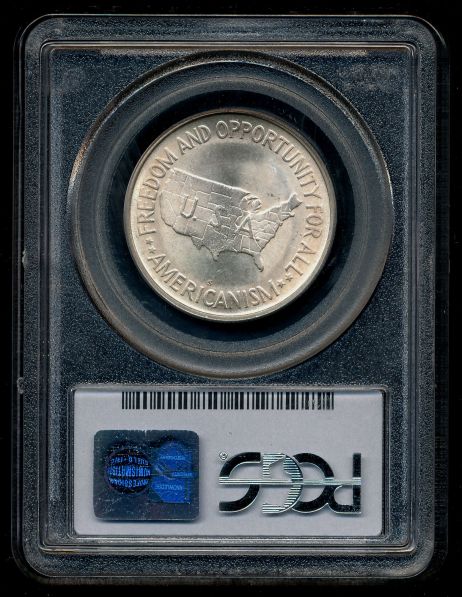
The obverse of the coin features conjoined portraits of Carver (front) and BTW; the reverse presents a map of the pre-Alaska/Hawaii US. The coin designs are the work of Isaac Scott Hathaway who also designed the Booker T. Washington half-dollar. With all due respect to Mr. Hathaway's efforts, the reverse of this coin ranks as my least favorite in the entire series. The map is unimaginative and looks childish to my eyes; the overall composition is simply lacking (IMHO). I believe so much more could have been done artistically to better promote "Americanism."
Trivia Question: Which state of the contiguous 48 is missing from the US map on the coin's reverse?The authorized mintage of the Carver coins was to come from a combination of authorized-but-never-struck BTW coins (~1.84 million) and BTW half-dollars that were to be returned to the mint for melting (~1.58 million). So, the coin had a potential mintage of more than 3.4 million; just over 2.42 million were struck. Though the coin was struck for four years (1951 through 1954) at all three US Mints, sales of the coins did not meet the >3.4 million level that was possible. In total, a little more than 1.3 million were sold and over 1.1 million coins were returned for melting.
The coin shown is a brilliant, San Francisco-struck example with the typical luster I seek for my coins. It is another coin that could be upgraded relatively inexpensively, but my thoughts regarding its design aesthetics positions its upgrade rather low on my priority list.
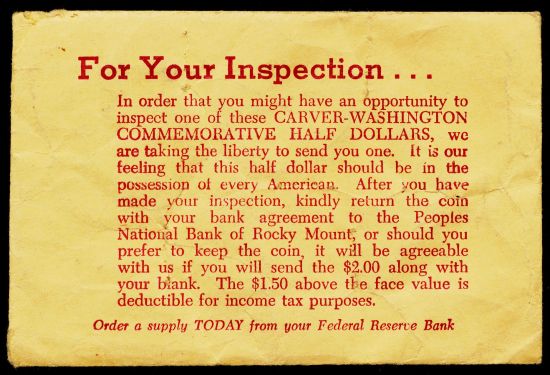
In addition to the coin, I've included one of the envelopes used by the Booker T. Washington Memorial Foundation to distribute the Carver-Washington half-dollars. As you'll see from the text printed on it, the envelope was used to send coins "on approval" with instructions on how to either pay for the coin or return it.
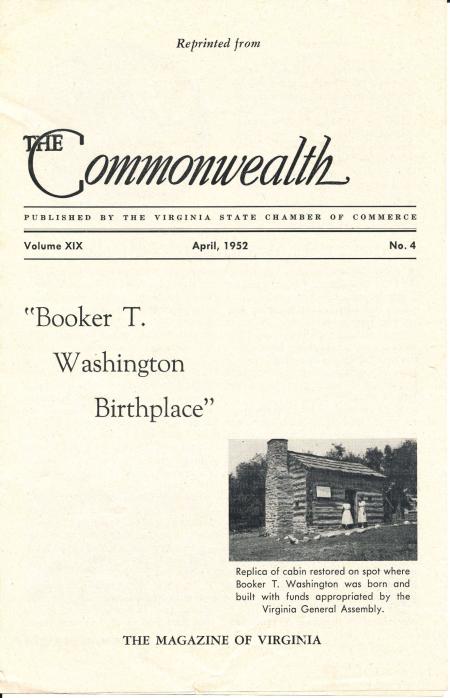
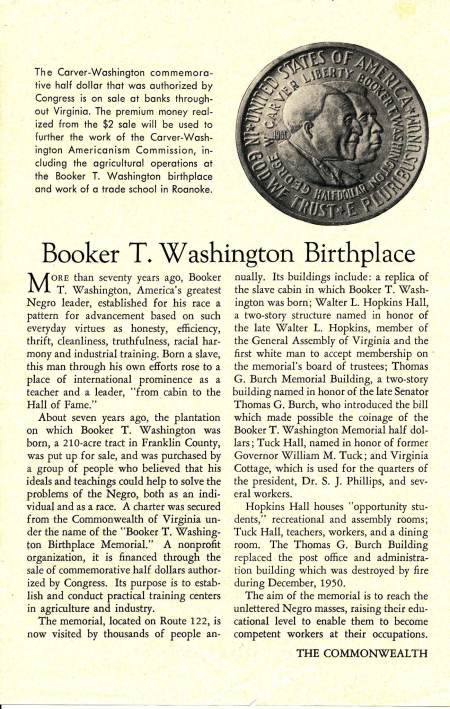
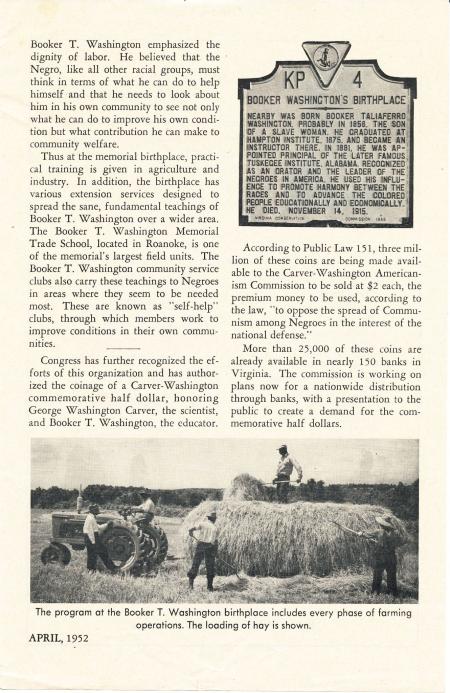
I've also included a small flyer/reprint of an article about the Booker T. Washington birthplace memorial that features an illustration and discussion of the Carver-Washington coin.
Enjoy!
1951-S Carver-Washington -- Obverse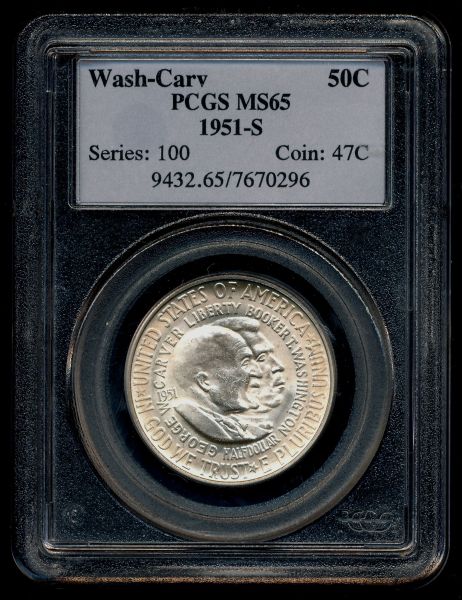 1951-S Carver-Washington -- Reverse
 Carver-Washington Half-Dollar Original Mailing Envelope
 BTW Memorial Article -- Front
 BTW Memorial Article -- Interior - Left
 BTW Memorial Article -- Interior - Right
 BTW Memorial Article -- Back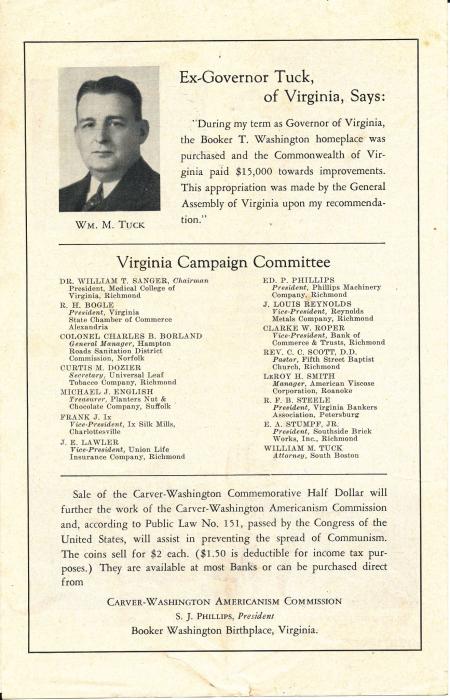






 Posted 05/03/2012 9:57 pm





