| Author |
 Replies: 14 / Views: 1,523 Replies: 14 / Views: 1,523 |
|
|
Pillar of the Community
United States
1549 Posts |
This Soter Megas tetradrachm is not very high grade but it is the only one I have from the early period at the Balkh mint when the tamghas on both sides show four prongs rather than the three used at the common mint (Taxila). I am not terribly clear on the details of the several mints (style, tamghas and letter form) and how the ray count on the portrait relates to dating (this one has 12 rays). Neither am I clear on whether the scheme laid out in Mitchiner is accurate when it comes to the significance of these features. This coin is overcleaned and scratched but will do for now to represent its kind in my collection. If someone can provide a good summary of the mints and dating system that updates Mitchiner, I would love to hear. 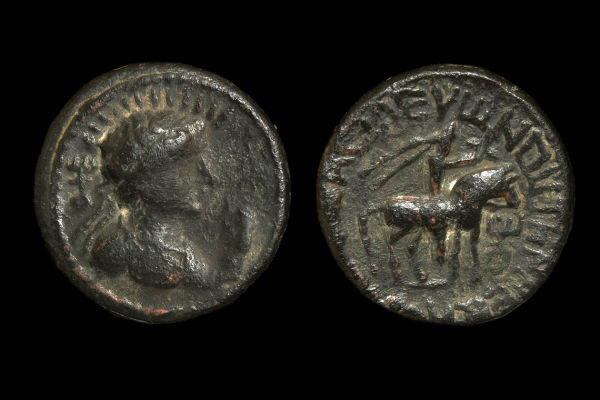 |
|
|
|
Pillar of the Community
 United States
1549 Posts |
BTW, the horseman on this coin carries what is referred to as a hatchet. I would also be interested in seeing a photo of a weapon from this time and place that would show the details of what is shown in the rider's hand.
|
|
Pillar of the Community
Canada
1411 Posts |
Look up axe to see what it would have looked like  Hatchet is another word for axe... This specific one is double headed, like a small battleaxe  |
|
Pillar of the Community
3352 Posts |
yummy => beautiful horse Tet ...  ... sorry, that's all I got |
|
Pillar of the Community
United States
5155 Posts |
|
|
Pillar of the Community
United States
1549 Posts |
Yes, they all seem to have the same weapon but it is more clear on some. Unlike what most of us think of as a hatchet or axe, it seems to have a long and narrow spike on the front that would be for piercing rather than chopping. You would not use it for firewood. That is why I would like to see a photo of a Kushan hand weapon and why looking up a modern word would do absolutely no good.
The other matter of interest is that the rays seem to count down if we believe Mitchiner with the 14 ray coins being older than the 6 ray ones. If this is a date one has to ask how they knew to start at 14 and how long a period was covered by one ray. I have seen nothing on the Kushan calendar system. Since the range of ray counts is a lot less than the number of years allotted to this reign, this might not be one year. These are the questions that come to mind with very little thought. If we work on it we probably could come up with a dozen other things we don't know that made sense at the time. When you have that much trouble thinking of the questions you must expect the answers to follow slowly if at all. Remember that we know very little about the Kushans and coins are a major source of information for many ancient societies.
|
|
Pillar of the Community
United States
5010 Posts |
don't know a thing about it....but I like it.
|
|
Pillar of the Community
Canada
1411 Posts |
I was about to upload one...
Except I had to shutdown the CPU...
They were like a hatchet on one side and the other side was a long spike, like a halberd.
Look up an English halberd, and remove the top spike and much of the pole.
Result: War Axe
|
|
Pillar of the Community
United States
5155 Posts |
A similar weapon 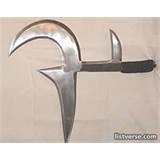 |
|
Pillar of the Community
3352 Posts |
nicely done, A-Dwag ...
=> it'll cut the grass, open a tin can, and will easily sever a Gorgon's head!!
|
|
Pillar of the Community
Canada
1411 Posts |
I had the EXACT same picture.... Remove the little spike near the handle and it is very close to what anoob showed.
|
|
Bedrock of the Community
United States
10045 Posts |
Wow--that thing looks nasty! (not the coin, but Ancientnoob's weapon).
I've never seen anything similar in a medieval Europe armory...halberds look tame by comparison.
|
|
Pillar of the Community
United States
567 Posts |
Good reference books on Baktrian, etc.
Alexander Cunningham, The Coins of Alexander's Successors in the East. Reprinted in 1969/70 by Argonaut.
A little dated but a good, solid intorduction to Bactrian/Indo-Greek Post Alexander coins. Good charts and clear illustrations. Good for a beginner in this series, and you can find it without too much difficulty and for around $25-35.
O. Bopearachchi, Monnaies gréco-bactriennes et indo-grecques, Catalogue raisonné, Bibliothèque Nationale, Paris, 1991
The new standard work on Indo-Greek and Baktrian. Fairly hard to find and expensive (>$200) if you can find it. In French.
Hope this helps.
|
|
Pillar of the Community
United States
5155 Posts |
I have been looking for the Osmund Boperachchi in English and I doubt it exists. I can't read French, unfortunately. But I would love the source just to look at pictures. Thanks for reference there bud, and welcome to the CCF!
|
|
Pillar of the Community
United States
567 Posts |
That one by Boperachchi hasn't been translated into Englsh. There are two other books by OB on the subject that are quite useful: O. Bopearachchi & W. Pieper, Ancient Indian Coins, Brépols, Turnhout, Belgique, 1998, Indicopleustoi, vol. 11 O. Bopearachchi, Sylloge Nummorum Graecorum. Graeco-Bactrian and Indo-Greek Coins. The Collection of the American Numismatic Society, Part 9, New York, 1998 The one in Indicopeleustoi is available from the publisher (Brepols). For the SNG you'd have to talk to one of the nunimsmatic literature dealers to find a copy. -John |
| |
Replies: 14 / Views: 1,523 |
|







 Posted 12/11/2012 7:45 pm


