Without a doubt, James Madison - the "Father of the US Constitution" - and the Bill of Rights are each certainly worthy of being remembered via a US commemorative coin. My previous "dark side" comment (
https://goccf.com/t/151444) refers to two elements of the back story of the JM/BoR coin program: 1) The date of issue for the coins, and 2) The view of coin collectors held by the James Madison Memorial Fellowship Trust Fund (the recipient of the surcharges collected).
First up, the 1993 issue date for the coins: 1993 is not a major anniversary for either James Madison or the Bill of Rights. The original amendments that form the Bill of Rights were proposed by Congress in 1789 and were ratified by enough states in 1791 to become a permanent part of the US Constitution. Such events would make either 1989 or 1991 reasonable bicentennial commemorative dates. Madison was born in 1751 and died in 1836; marking the 250th anniversary of Madison's birth in 2001 would also have been reasonable.
The somewhat awkward "1993" date came about because the original proposals for a commemorative coin did not gain enough support in the 101st Congress (1990) to be passed. (Side Note: Competing bills were introduced in the 101st - one for a single silver dollar and another for a three-coin gold and silver program.) The bill that ultimately lead to an approved coinage program was introduced into the 102nd Congress in September of 1991 and finally passed (after revisions) in May of 1992.
It seems that with earlier planning and better decision making regarding what type of program to pursue, the Fellowship Trust could have achieved a commemorative coin that marked an actual, important milestone anniversary (as stated in some of the proposed bills) vs. a coin with an issue date "in the neighborhood" of a true milestone date. Unfortunately, commemorative coin sponsors aren't always concerned with actual commemoration dates as long as they can get their coin approved. For example, consider the 1921 Alabama Statehood Centennial half-dollar. The coin was authorized in 1920 and issued in 1921. Problem was, Alabama marked the 100th anniversary of its statehood in 1919. Oh well!
The other "dark side" aspect of this particular issue involves the view held by the Fellowship Trust regarding its coin program and coin collectors. Q. David Bowers has written about a call he received from a representative of the Madison organization during which the representative stated that they were looking for ways to raise funds and wanted to "get in on the commemorative bonanza" and realized that coin collectors "represented buying power and ready cash" for which they could create some type of commemorative. While the statements are essentially true (and echo the thoughts of other coin sponsors), they're not the most flattering or complimentary view of the coin collecting community in my opinion. Basically, to the Madison organization "Coin Collector = $$$." The representative's statement leaves me with the impression that the quality of a potential coin was not of much concern and that if commemorative plate collectors represented a potentially more lucrative market, they would not have pursued coins and would have instead worked to release a series of plates.
All that said, I hold no animosity against the James Madison Fellowship Trust Fund and fully support the work it does to promote understanding of the US Constitution. And yes, I own nice uncirculated versions of each of the gold and silver commemorative issues.
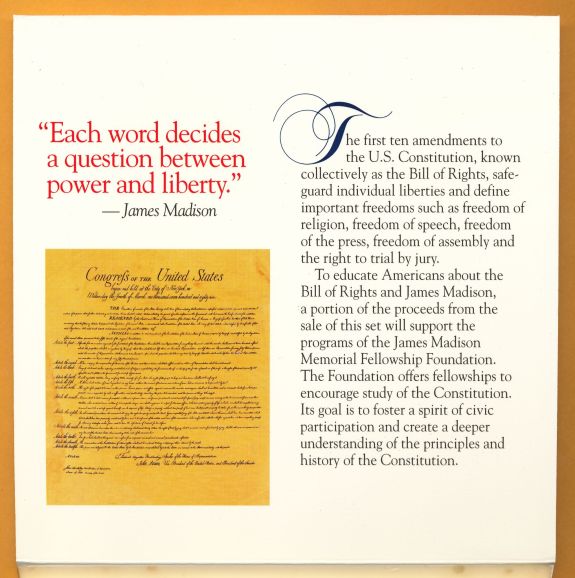
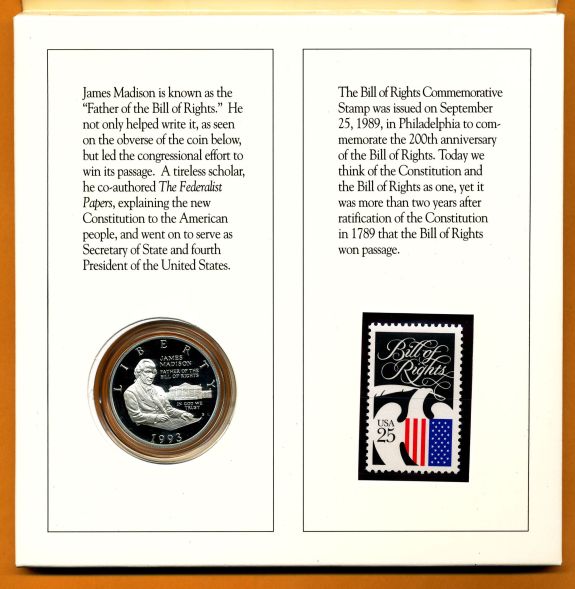
Here are images of the silver half-dollar (in proof) within the limited edition
Coin and Stamp Set.
Enjoy!
1993 JM / BoR Coin and Stamp Set - Front Cover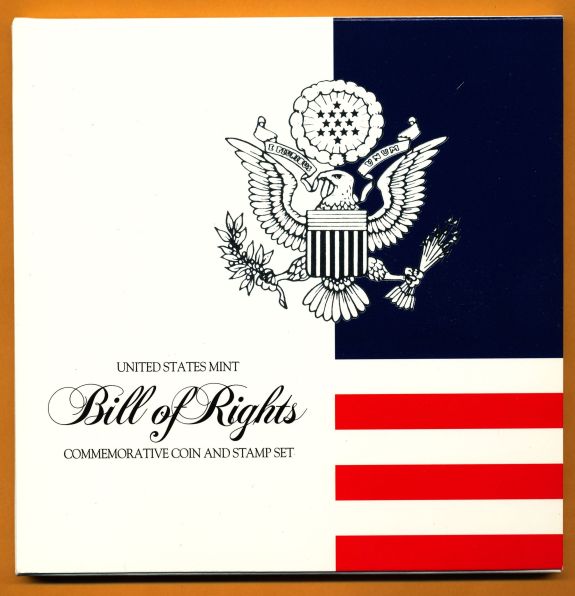 1993 JM / BoR Coin and Stamp Set - Interior Panel / Top
 1993 JM / BoR Coin and Stamp Set - Interior Panel / Bottom
 1993 JM / BoR Coin and Stamp Set - Back Cover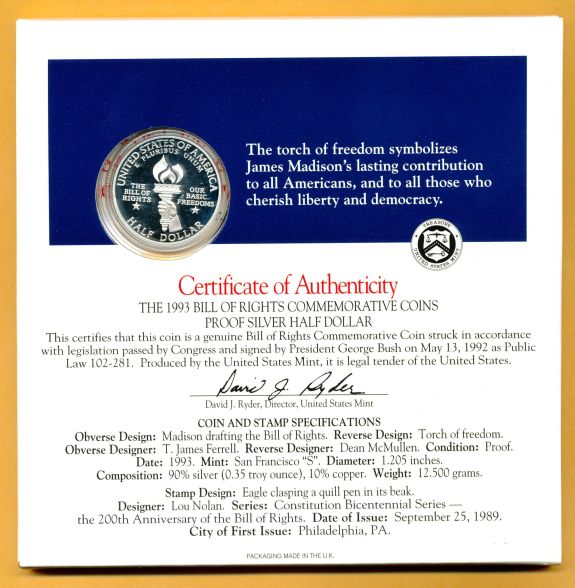






 Posted 06/13/2013 9:48 pm





