My initial post on the 1935 Spanish Trail commemorative half dollar was among my first here on CCF and lacked the "story" that most of my later posts included. So, I decided to revisit the coin and ramble on a bit...
A bill calling for the coin was introduced in the 74th Congress in early 1935. The bill proposed "the coinage of 50-cent pieces in connection with the Cabeza de Vaca expedition and the opening of the Old Spanish Trail."
The commemorative half-dollar was the work of L.W. Hoffecker, a prominent coin dealer in El Paso, Texas - his coin business operated under the name of Watkins Coin Company. Mr. Hoffecker was associated with three US commemorative coins, two that were issued (1935 Spanish Trail; 1936 Elgin, IL) and one that was vetoed by President Herbert Hoover (1930 Gadsden Purchase).
Read More: Commems CollectionWhen I say that the coin "was the work of L. W. Hoffecker " what I mean is that he conceived of the coin, he designed the coin, he lobbied for the coin in the US Congress, he personally funded the purchase of the coins from the US Mint and he acted as the coin's official distributor. Given the opportunity, I think he might also have agreed to run the presses that struck the coins!
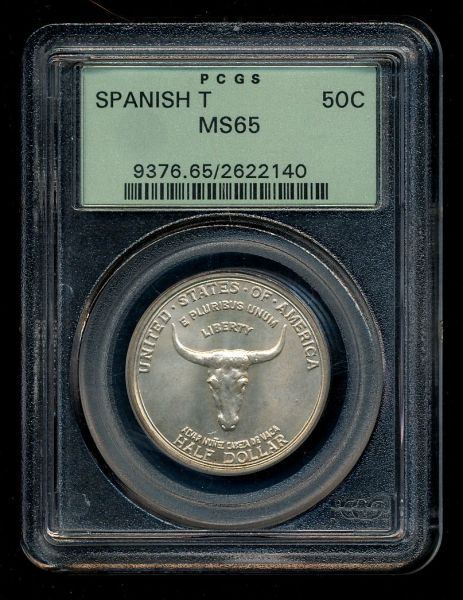
I remember when I first saw pictures of the Spanish Trail half-dollar in the "
Red Book" - my first coin reference book - I didn't find the design very attractive. Based on the map featured on the coin's reverse, however, I imagined a great expedition led by a renowned Spanish conquistador that opened up and claimed a new territory for Spain. I was mostly wrong.
Álvar Núñez Cabeza de Vaca was, in fact, part of a Spanish Expedition that came to the New World in 1527. He was not the expedition's leader, but rather its treasurer. The leader of the ill-fated expedition was Páanfilo de Narváez. The expedition met with much hardship - storms, shipwrecks, disease, unfriendly aboriginal peoples - and ultimately was reduced from its initial complement of roughly 700 men to just four or five. Alvar Nunez Cabeza de Vaca was one of the few survivors.
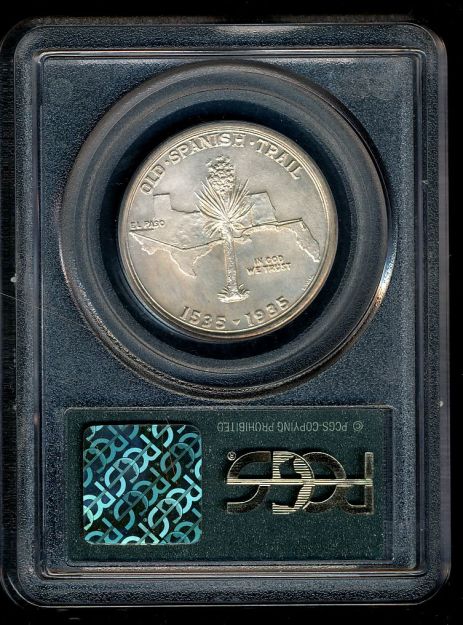
The trail shown on the Spanish Trail half dollar is a rough approximation of de Narváez's expedition from the time it arrived on the gulf coast of Florida to when a small remnant of it landed (it is believed) on Galveston Island off the coast of present-day Texas. It also (theoretically) depicts Cabeza de Vaca's journey across Texas, but it doesn't show his travels into New Mexico, Arizona or the northern provinces of Mexico. It's interesting to note, however, that the coin does depict a trail that terminates in El Paso, Texas - the home of Hoffecker's coin shop - even though Cabeza de Vaca traveled beyond Texas. It does make one wonder...
Moving past the inaccuracy of the coin's trail map, the coin's theme/subject is also a bit of a misnomer. The name "Old Spanish Trail" is actually associated with a trail that connected Santa Fe, New Mexico with southern California. The creation of the trail was largely driven by the desire/need to link Santa Fe and Los Angeles for trading purposes; it developed in the late 1820s / early 1830s (vs. Cabeza's trip in the 1530s). The trail shown on the coin was never part of this trade route through the western expanse of the future US states of New Mexico, Arizona, Colorado, Utah, Nevada and California.
While Cabeza de Vaca was the first European to explore and document the areas of the American West in which he traveled, the path he took never became a "trail" that was followed by others. In fact, when he set out across Texas, he was in search of a Spanish outpost in Mexico rather than embarking on a journey of pure exploration. As he didn't know the location of the post, he was not able to travel directly to it and the actual path he followed is not known.
Cabeza de Vaca published an account of his journey in 1542. You can read it here:
http://www.pbs.org/weta/thewest/res...e/cabeza.htm. It includes lengthy discussions of his time spent with the local Native Americans.
It's clear that in his zeal to secure approval of a commemorative half dollar, Hoffecker was willing to bend the truth a bit. It's not that the expedition of Alvar Nunez Cabeza de Vaca is unimportant in the history of the American West, it's just that it doesn't quite measure up to the impact made by the actual "Old Spanish Trail" and appropriating its name doesn't change that fact.
I think maybe I'll start calling the coin the "Narváez - Cabeza de Vaca" half dollar. It's more of a mouthful, but it's a more accurate name than "Old Spanish Trail."
Here are images of my current example of the coin. It was one of the first coins I purchased when I began upgrading my set from MS-63 to MS-65 and beyond.
Enjoy!










 Posted 06/20/2014 11:29 am


