| Author |
 Replies: 26 / Views: 5,269 Replies: 26 / Views: 5,269 |
|
New Member
United States
42 Posts |
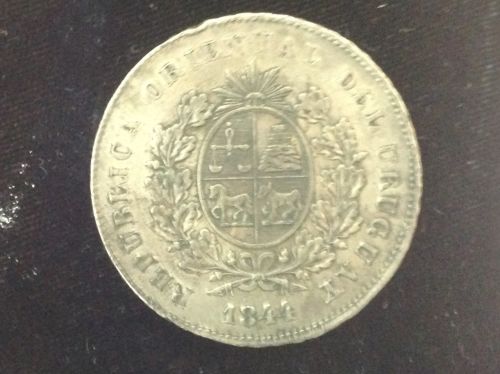
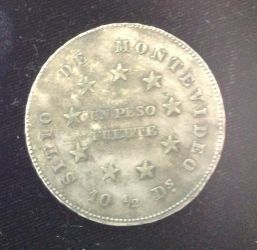
Does anyone know any good resources on the 1844 Uruguay Seige Peso? I am specifically interested in the comparative rarity of the coin and medal alignment varities.
|
|
|
|
Pillar of the Community
United States
5362 Posts |
That is a very specific question for such a scarce coin. The indicated mintage of 1500 coins is likely from a single die pair (based on a quick review of photos). The axis reversal which is noted in Krause means that each variety is by no means common.
I presume that your question is meant to determine if a "premium" value is attached to one or the other type. I suspect it would be provided the answer is actually a known fact and also if there is more than one person asking the question.
The coin is a one year type and most collectors I know of have likely never heard of the issue. Specialist collectors of type coins and siege coins would be the likely buyers and they go for high grades.
Heritage has never auctioned one of the 1500 coins. Stacks on the other hand has handled 6. Of the 6 only half of the auctions indicated the actual axis. Of those three coins 2 were coin axis and one was medal. The three auctions that mentioned the axis are more recent sales and all went for more than $2,000. Only two coins were in the same grade. An NGC graded coin MS-62 with coin axis sold for $3,800 while an NGC MS-62 medal axis sold for $2,800.
A graded example NGC AU 50 sold for $1,380 but no axis was mentioned.
My overall take away is that it probably does not matter which axis is involved. Grade will ultimately determine value.
My question is do you have one? I would love to see it.
|
|
New Member
 United States
42 Posts |
Swamper,
Thank you for your through reply. I wouldn't be at all surprised if it was one die pair. The peso was minted over a two day period in February of 1844 (22nd and 23rd if memory serves) and celebrated the reopening of the Casa de Moneda in Montevideo. The silver was collected through a donation drive from the citizens and churches of the city while it was under seige. Heritage has handled a few but these are all AU MS examples. I do have a line on one that is unslabbed with an old collector/dealer who has owned it since the 60s. I am going to do some more investigating before I buy. The one I am looking at is VF but may be better based on some of the grades on Heritage's site. I am guessing these coins were struck in not the most perfect circumstances so mint state might not match European equivalents of the time. I am trying to determine a good price as this coin is medal alignment. One Heritage write up said medal was rarer but nothing I have found says how much so.
|
|
New Member
United States
42 Posts |
|
|
Pillar of the Community
United States
5362 Posts |
I did some hunting in my library which is about 50% unpacked as of yesterday. I found an article reprinted from the 1911 Numismatist that discussed the Emergency Peso of Uruguay. The article only two pages long was written by the editor of the Numismatist (no name given) and was titled "Unfamiliar Coins". The introduction indicates the reason the series of articles was being produced.... Quote:
In this and the subsequent papers a series of coins will be described, not all of which are necessarily rare or even scarce; they are simply chronicled on account of their infrequent occurrence in catalogues, a fact which makes them but little known to the average collector. This particular article was subtitled The Earliest Issues of Uruguay. It includes early proclaimation coins and buttons that resemble coins and three 1840 copper issues only two of which appear in Krause. It also includes THREE different issues of the 1844 Peso. The article includes a photograph of what purports to be the actual "Emergency Issue of Montevideo". The picture DOES NOT MATCH any of the coins in the Heritage group or the Stacks coins. It appears to be a totally different die version of the same design. The most easily seen difference are the dots above and below the center of the scale in the upper left corner of the shield are not in direct contact with the scale. In addition the lower dot is shifted to the left. All of the versions sold by Stacks and Heritage show a disconnected dots with the lower dot shifted slightly to the left. The 1911 version also shows a few missing denticles on the right margin of the shield side of the coin. Here are the final three entries in the article which to me seems to indicate there was a second larger issue of 1844 Pesos which "is well known to collectors...." Quote:
1844 Obsidonal peso (= 8 reales or 800 centisimos). Silver. F. 10156. R. 1454. S. 3019. This was issued at Montevideo during the siege of the city by General Manuel Oribo.
1844 Same in lead. F. 1057. S. 3020.
After the siege a new coinage (dated 1844) was instituted; this issue is so well known to collectors that it does not come within the scope of the coins now under description. Since Krause indicates only one issue for 1844 - I am a loss to explain what this article actually means. The reprint is included in Volume 5 of an Anthology of Gleanings from the Numismatist. "The Coinages of Latin America and the Caribbean" edited by E.A. Furber, 1958. |
|
New Member
United States
42 Posts |
What you are saying about 3 variations makes sense. I have seen one reference to that before. A book that was referred to as "SA", which I believe is a Spanish book, catalogued 3 variants: 7.1.1 with coin alignment, 7.1.1R with coin alignment but overstruck on Bolivian 8 Soles, US Silver Dollars, Mexico 8R and Spanish pieces, 7.1.2 with medal alignment. Possibly the variant in the 1911 article is one of the overstrikes with some of the old coin showing through? I am not sure which book uses catalogue numbers, maybe it can give more
|
|
New Member
United States
42 Posts |
I looked at the picture in the article you mentioned and it seems that there is no dot below the scale. 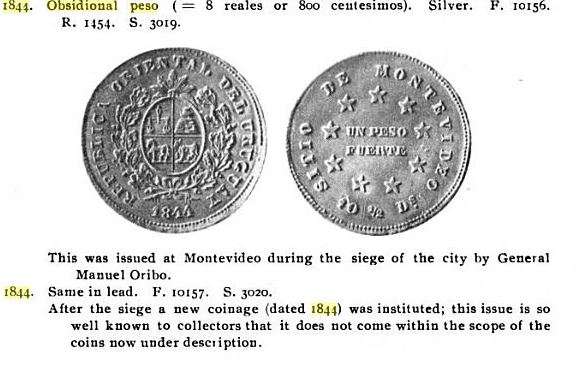 |
|
New Member
United States
42 Posts |
|
|
Pillar of the Community
United States
5362 Posts |
How in the world did you get such a good looking picture of the page? I do horribly when I try to do that.
I see the dot as being PART of the center of the scale and that the detached dot is actually misplaced on the (for lack of a better word) restrike.
I suspect that all of the copies now for sale are restrikes made to satisfy collector demand from a VERY popular issue in the immediate time period following 1844. The original estimates of survivors that I found tends to support a much smaller than 1500 coin original mintage.
Your coin looks like the restrike variety not the original. I dare not guess if it is original or not. I do lean toward the possibility that it might be a genuine restrike example as the higher possibility. I have NEVER seen a numismatic forgery of this coin. They may exist but I have not seen one.
|
|
Pillar of the Community
United States
1962 Posts |
I actually picked one up last year... an XF or so w/the usual few "hojitas" these come with. Aside from price, didn't research it all that thoroughly at the time, but interpreting the info posted here and glancing elsewhere quickly, checking archives... -- A REALLY quick glance at Heritage examples would seem to indicate coin alignment is (as was claimed) more common than medal alignment. Many examples are certified, so you can figure this easily by a visual check even if not stated. It does seem, however, that there might be enough medal alignment specimens to where there shouldn't be much price difference -- It does seem that this type shows up rather frequently... probably more than you'd usually expect for a piece with such a (supposedly) low mintage (that brings such strong prices) - 1500 minted? Wikipedia (?!) says "about 1226" (such an exact number must have come from some source, right?)... However, seeing how it kind of was almost more of a medallic issue than a true circulating coin (and meant ONLY for Montevideo city limits apparently?), it might make sense that a lot of these sat in wealtheir families for generations rather than get melted to pay rent. In other words, a lower than usual attrition rate. Heritage has those 21 examples as shown... I count (4) on Goldberg, several from Sedwick... I find at least several from both old Ponterio and old Stack's (prior to those mergers) beyond what is shown on the putrid archive search of the current combined company), and more than a few from European houses. Further to the point (or guess?) that many of these probably sat unmolested as heirlooms for years is that, as noted, many of the pieces that come to auction are rather high grade... Since the price point on these is such (and has been for a while) that even lower grade examples should merit the "individual coin lot" treatment... where ARE the lower-grade examples? Few and far between... -- Pics of the piece in question obviously aren't great, but from what I've seen of the surfaces, toning, etc on "circulated" examples, the piece looks legit. The edge knock/light taps look honest as well... Compare to kinda-splotchy toning to this piece... looking at other circ pieces, it seems like the alloying wasn't perfect, and in general they have sort of a "flat" patina. http://www.acsearch.info/media/imag...1/632181.jpgEdited by realeswatcher
03/18/2015 11:07 pm
|
|
Pillar of the Community
United States
1962 Posts |
Quote:
How in the world did you get such a good looking picture of the page? Google Books! There are more than a few old Numismatist previews/full books on there. The original Fonrobert reference is on there too, in all its sparsely-illustrated glory... Numismatist: https://books.google.com/books?id=z...ge&q&f=falseFonrobert: https://books.google.com/books?id=SwA3AQAAMAAJ--- By the way... I don't know exactly what to make of that part about new coinage "dated 1844" being "so well known to collectors". This 1844 peso may not be the rarest type, but I don't think it could have ever been classified in that way based on what appears on the market in modern times... and I don't think that could refer to the big copper 1844 20/40 cent. pieces either (which are both rather scarce... especially since he mentioned the 1843 copper which is no rarer). Perhaps the author was referring to the still-common 1857 and up issues? My guess is that he was conflating his notes, didn't get around to correcting it, and thus it was submitted. Given that he's treating those ubiquitous Paris gaucho "coin-style" buttons in the same realm as actual coinage, I wouldn't necessarily treat every word as gospel. Edited by realeswatcher
03/19/2015 12:15 am
|
|
Pillar of the Community
United States
5362 Posts |
realeswatcher I am less willing to entirely discount the existence of a second silver issue. The article written in 1911 was based on earlier references from 60-70 years prior. Those would be relatively close in time. They also noted the existence of a mega rare lead version.
I also wonder then what coin was used as the exemplar of the original issue - it is NOT the same die pair as is responsible for all the pieces seen on all the auction cites. It makes as much sense to see there is a clear possibility that the article was illustrated with the rare version of the 1844 peso and the others - the well known coins - are the die variety seen in all the auction catalogs.
I need to do more searching on Google books. I still rely on my old hard copy library. I am mired in the mid 20th century as my kids have told me on more than one occasion. Thanks for the references.
|
|
Pillar of the Community
United States
1962 Posts |
Again, even though the amount of these that seem to pop up at auction seems somewhat higher than you might expect based on the mintage figures out there (which I think can be explained by a higher than typical survival because of the nature of this issue - plus the fact that because of the going price, they are always featured as individual lots)... there is simply no way that "... so well known to collectors" could in any way refer to any iteration of 1844 peso based on the apparent extant population of said coins today. If that WAS meant to somehow to refer to some type of strike/restrike of 1844 peso... it's simply incorrect. The issue has long been popular - they didn't all disappear/get melted. Should be noted that there's nothing concrete in that statement (aside from the "dated 1844" blurb) that says he is referring specifically to the 1844 peso... and it happens to be in that spot in the writeup b/c that happens to be end of the early issues he was discussing. "New coinage" may just mean "a new series of coinage". Also, he is working chronologically, but inserts the Paris gaucho button thingys between 1830 and 1840... when these apparently date to around 1870. So there, we know the writeup is somewhat... sloppy. Keep in mind, this is simply a short blurb in a collector's journal... not the magnum opus of all time. ----- Regarding possible die variation - firstly the denomination side, which is shown clearly enough on the Google Books image and of course in auction pics... they all look to be exactly the same die from a quick comparison. Not going to look for much proof in the denticle area b/c from checking auction specimens, it would appear that the apparent overstruck host coins are tinkering with how this area can look. See, e.g., the following: http://www.acsearch.info/media/imag...6/423754.jpgAs far as the shield side... I don't think there's enough clarity in that Numistatist image of the coin to see exactly what's going in the scale - not the crispest image of a somewhat worn example. From what I see on that image compared to all the other auction examples, all of the positioning of legend letting looks pretty identical. The one area that looks like MAYBE there was some alteration is the digits of the date. To me, the 8 sort of looks different on some pieces (sort of a "flat top" on certain examples).... Hard to tell if this isn't just due to strike, though. |
|
New Member
United States
38 Posts |
I wrote a note on the apparent discrepancy between the small mintage figure and relative availability of the Montevideo 1844 Peso. http://coins.ha.com/itm/uruguay/uru...type=NGC3037The lead variety is presumably a trial strike. Few examples are known, one for example the Ex Medina specimen sold, if my memory serves well in the Hans Schulman sale of "Selections of the Jose Toribio Medina collection" in 1968 I think. |
|
New Member
United States
38 Posts |
"I suspect that all of the copies now for sale are restrikes made to satisfy collector demand from a VERY popular issue in the immediate time period following 1844. The original estimates of survivors that I found tends to support a much smaller than 1500 coin original mintage."
Not very logical in my opinion. The coin is rather available which contradicts apparently the small mintage figure. less than 1500 coins struck is very few...
The restrike theory seems a fantasy to me.
|
|
Pillar of the Community
United States
5362 Posts |
There are differences other than the scales. Look at the horse's rear leg positions - significantly different. Less significant but still different is the cow's foreleg bend the shape of the head and horn. The temple on the mount has different surface features as does the hill itself. I also see rotational differences in several letters and some slightly different font shapes even on the side with the denomination. So I see a clearly different die pair being involved. However, even if the original dies survived and were used later in 1844 (or subsequent years) - there would still be two issues (although indistinguishable). In 1844 coin collecting was still a novelty and many mints including the US restruck coins to order for collectors - see US 1/2 cents, Gobrecht dollars, the 1804 Silver dollar, the 1804 cent restrike and many others that were made for collectors not for circulation. These were also confused with genuine coins (for circulation) in many cases. These kinds of coins all tend to survive in very high grades. So making a new die to strike or an old die to re-strike a popular coin is nothing that was unheard of at the time. Regarding the numbers of the mintage - I believe that people who see 1500 as an insignificant number of coins are using "modern" lenses in their glasses. It is a very significant number that would have been well known to the small group of interested collectors in the three-four decades after the siege. The original "emergency issue" may have only numbered from a few dozen to a few hundred copies. Too few to satisfy demand but enough to attract attention and get a distinct reference in Fonrobert, 1878 (35 years later); Rosa 1892 (48 years later) and Salbach 1911. All three of these authors were over one hundred years closer to the events than we are and they did not provide mintage figures. However, Fonrobert considered the original as a very rare coin - the Numismatist editor relies almost exclusively on Fonrobert's wording in this respect. Given the timing of that book a mintage of 1,500 would be far more than enough to meet demand. I think we are at a point where substantial additional research must take place before we can dismiss any theory. I certainly would not too quickly adopt a theory that the entire mintage including all known examples are a single unified issue. |
| |
Replies: 26 / Views: 5,269 |









 Posted 03/16/2015 12:20 am