I haven't posted a "What if?" story in quite some time, so.
In the years immediately following the July 4, 1776 approval of the Declaration of Independence by the Second Continental Congress, Virginia laid claim to a vast territory that extended west to the Mississippi River and north / northwest to the Great Lakes region. Its territorial claims included, in whole or in part, the present-day states of Illinois, Indiana, Kentucky, Michigan, Minnesota, Ohio, West Virginia, Wisconsin and, of course, Virginia.
Following the official end of the American Revolution in 1783 (via the Treaty of Paris), the US Government called upon its member states to relinquish their territorial claims west of the Appalachian Mountains and to turn the land over to the central government. It did so to avoid ongoing competing claims between existing states and to facilitate its regulation of the establishment of new states in the area. As more and more settlers were moving west at the time, future requests for statehood from those settling in the region was a foregone conclusion and having the land under a central authority would create the least complicated path to statehood.
In 1784, Virginia ceded its territory to the north and west of the Ohio River but held onto the land west of the Appalachian Mountains and south of the river stretching west to the Mississippi River; this tract included present-day Virginia, West Virginia and Kentucky.
After a roughly eight-year effort by its residents, the district (county) of Kentucky finally gained approval to be formally separated from the Commonwealth of Virginia; the measure was approved by the Virginia legislature on December 18, 1789. The legislature also supported the district's desire to become a new state. Following the legislature's actions, representatives of the Kentucky district petitioned the US Congress for statehood. The petition was positively received, and on February 4, 1791 the first US Congress passed an Act that recognized Kentucky as the 15th state - effective June 1, 1792.
Fast forwarding.
As the 150th anniversary of Kentucky's admission into the Union approached, its General Assembly created a Sesquicentennial Commission to plan and organize the state's anniversary celebrations. The use of public funds was not authorized, however, so the Commission was also tasked with raising the money it needed to carry out its mission. It worked with local committees across the state to stage parades, pageants, formal dinners and other commemorative events during the anniversary year of 1942.
In addition to securing donations and sponsors, the Commission raised funds through the publication and sale of two historical accounts of Kentucky:
Sesquicentennial Stories and
Kentucky in Retrospect: Noteworthy Personages and Events in Kentucky History, 1792-1942.The Commission's fund-raising efforts also included seeking approval for a commemorative half dollar. To this end, it enlisted the assistance of Representative Virgil Munday Chapman (D-KY). Munday introduced the necessary coinage bill into the House of Representatives on February 27, 1942.
However, the Kentucky Commission faced an uphill battle to get its coin approved. By 1942, Congress had cooled significantly on the concept of issuing commemorative coins - the last commemorative coins authorized by Congress were the 1937 Battle of Antietam 75th Anniversary and the 1936 Norfolk Bicentennial half dollars which were both approved in June of 1937 (Yes, the 1936-dated Norfolk was approved and struck in 1937!). It is also worth noting that by February/March of 1942, the Mint was already engaged in developing potential new compositions for the five-cent piece so as to free up nickel for the war effort. Such activities were a much higher priority for the Treasury Department / US Mint than was the striking of commemorative coins!
Despite these obstacles, the Commission was not bashful in its request for a coin. Chapman's bill called for one million of the commemorative 50-cent pieces! The bill did not include language that would have limited where the coins could be struck, so it is likely the Commission would have asked for coins to be struck at Mint facilities in Philadelphia, Denver and San Francisco to create more varieties for collectors. The bill specified that the coins were to be made available to the Sesquicentennial Commission of Kentucky for their use in funding their planned anniversary celebrations.
If the bill had gained any traction, it is very likely that the number of coins to be struck would have been greatly reduced by the House Committee on Coinage, Weights and Measures to which it was referred. Traction was not to be found, however, and the bill died quietly in Committee.
Though it missed out on an official US coin, the Kentucky Statehood Sesquicentennial was not completely bypassed by the Federal Government. The US Post Office issued a three-cent commemorative stamp on June 1, 1942 (the state's exact anniversary date); the stamp features a vignette of Daniel Boone (and others) looking out over the Kentucky River.
From my research, it appears the Commission did not pursue a privately-struck medal to aid in Kentucky's celebrations. I have not yet located any contemporary medal or token - or even a discussion of one in newspapers of the time! If someone knows differently, I'd love to hear about it!
Hope you enjoyed the story!
1942 Kentucky Statehood Sesquicentennial 3-cent Stamp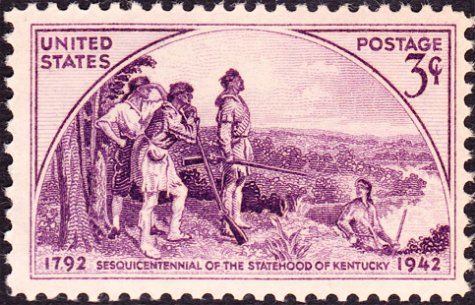








 Posted 08/24/2018 11:58 pm


 ).
).


