Throughout the history of their issue, US commemorative coins have had sponsors that promoted their coin to Congress and then lined up to profit from their sale once the coin was approved for issue.
In the "classic era," the sponsors purchased the coins from the Mint at face value and then sold them for a higher price to collectors. In some cases (e.g., the World's Columbian Exposition coins), the coins were given to the sponsor as an appropriation at face value by Congress who allowed them to sell the coins for a higher price. The sales model for US commemorative coins changed with the launch of the modern program in 1982, however.
The new model saw the US Mint take over the promotion and sale of the coins; the Mint also took on the collecting of a surcharge on each coin sold as outlined in the coin's authorizing legislation. Most every commemorative coin issued has received its designated surcharge funds. Since Congress put reforms in place in 1996 that require the recipient organizations to raise matching funds to potential coin surcharges and require the Mint to recoup all of its costs for the program before paying surcharges to a sponsor, however, not all programs have received their anticipated funds. The 2005 Girl Scouts program is one that comes to mind. Its total sales did not reach a level that enabled the Mint to cover its costs, and so no surcharges were paid to the Girl Scouts of the United States of America organization.
Not all commemorative programs have had a private sponsor, however. I thought it would be interesting to take a quick look at those that did not.
1982 George Washington 250th Anniversary of Birth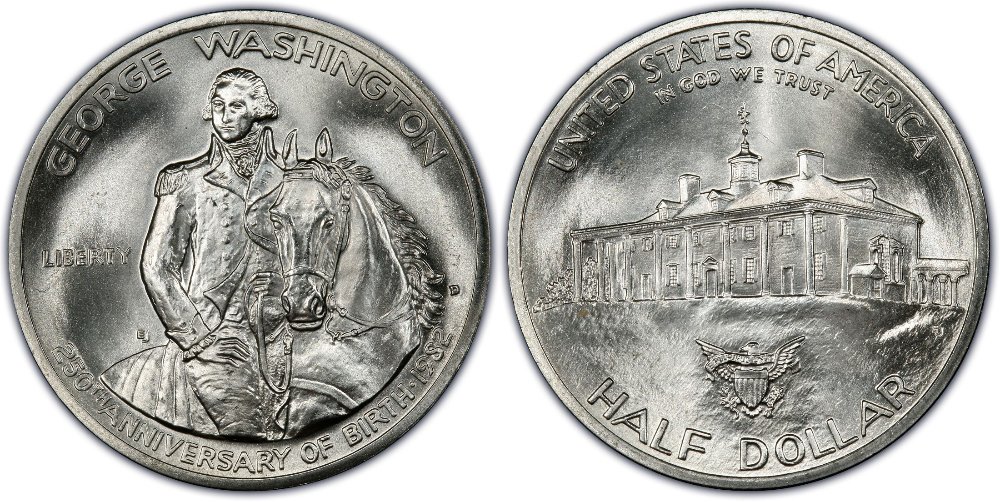
First up is the first modern commemorative, the 1982 George Washington half dollar - for the moment, I'll ignore the US Bicentennial commemorative coins of 1975-76. The authorizing legislation for the 90% silver Washington half dollar specified that the Secretary of the Treasury could set a sales price for the coins that included a surcharge of not more than 20% of its minting and distribution costs for the coin; it also specified that all surcharges collected were "to be deposited in the general fund of the Treasury and [to] be used for the sole purpose of reducing the national debt." Per the Government Accounting Office (GAO), the Mint did not separate surcharge income from net profits for the Washington program, so it is impossible to state exactly to what extent the national debt was reduced via coin sales - the Mint did report an overall net profit of $14.4 million for the program, however. So, it appears that the surcharges collected contributed $14.4 million or less to debt reduction.
1987 US Constitution Bicentennial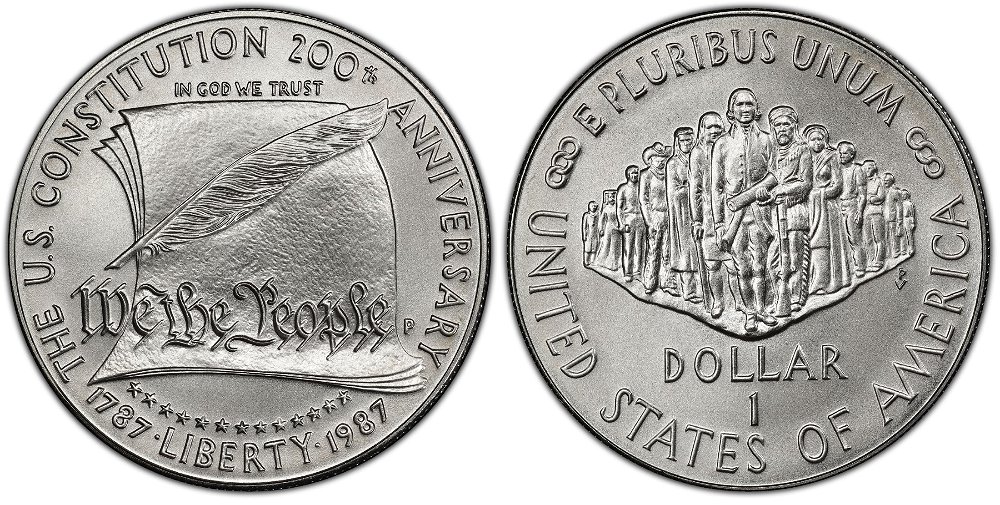
A few years later, the 1987 Bicentennial of the US Constitution gold $5 and silver $1 coins were issued and their authorizing legislation specified a $35 surcharge on the gold coin and a $7 surcharge on the silver dollar. The legislation also included the same "national debt" language as the Washington half dollar. Almost 886,000 of the gold coins were sold as were 3.199 million of the silver dollars - a very successful program. The Mint has reported that $52.7 million in surcharges were collected and paid into the general fund for debt reduction.
1989 US Congress Bicentennial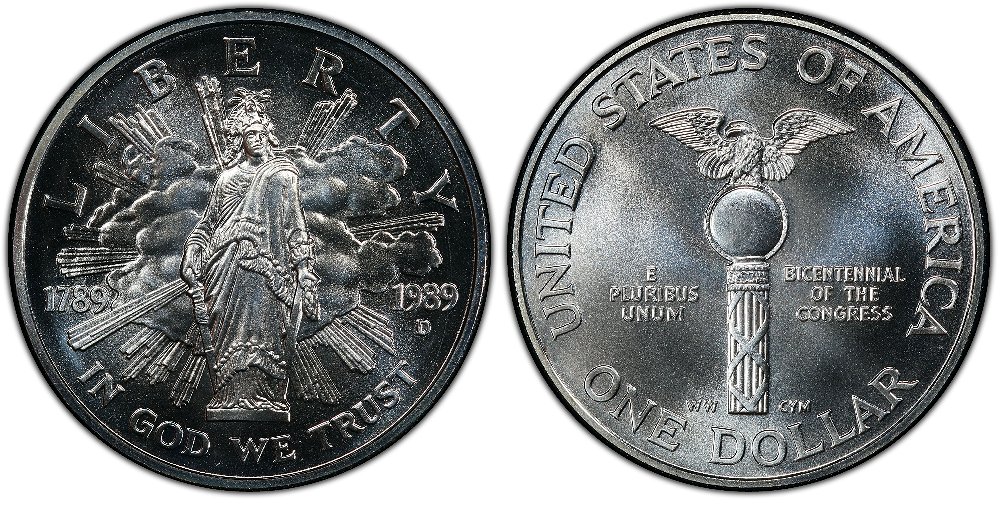
The 1989 Bicentennial of the US Congress commemorative program was a
split program in terms of its surcharges. The first $40 million of surcharges collected were to be paid to the Capitol Preservation Fund of the United States Capitol Preservation Commission for "providing for improvements in, preservation of, and acquisitions for, the United States Capitol" and "providing for works of fine art and other property for display in the United States Capitol and at other locations under the control of the Congress." After that obligation was met, any additional surcharges were to be used to reduce the national debt. More than 2 million total coins were sold (211.6K gold $5, 897,4K silver dollars and 931.65K CuNi half dollars) and roughly $14.6 million in surcharges were collected. As the surcharge total fell far short of the $40 million threshold, no funds were available to reduce the national debt!
1990 Dwight David Eisenhower Birth Centennial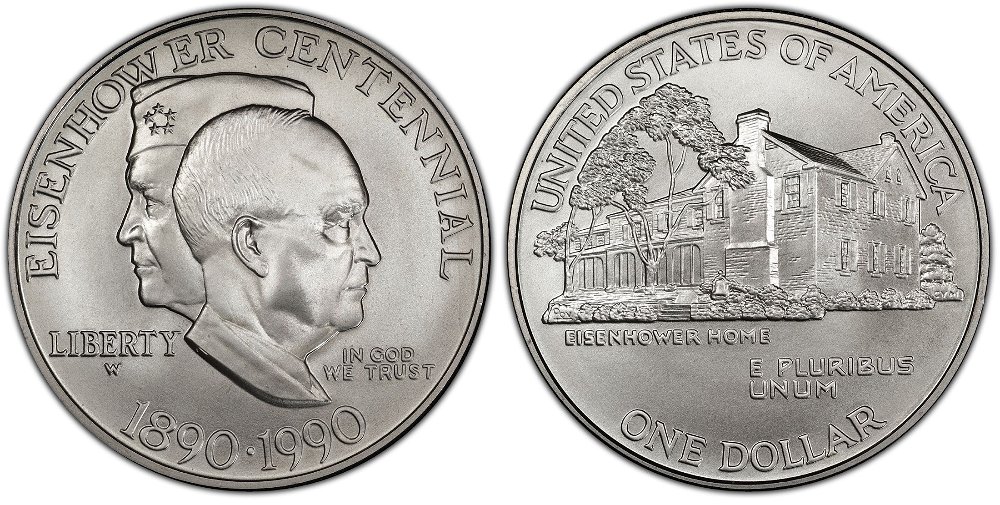
The 1990 Dwight David Eisenhower commemorative program that was created to mark the 100th anniversary of Eisenhower's birth included a $7 surcharge on each silver dollar sold. The surcharge funds collected were again directed to be paid into the general fund of the Treasury and then used to reduce the Federal deficit (the legislation wording changed from "national" to "Federal"). Though the Mint reported an overall loss of $1.1 million for the program, $9.7 million in surcharges were collected and paid to reduce the debt.
1991 Mount Rushmore Golden Anniversary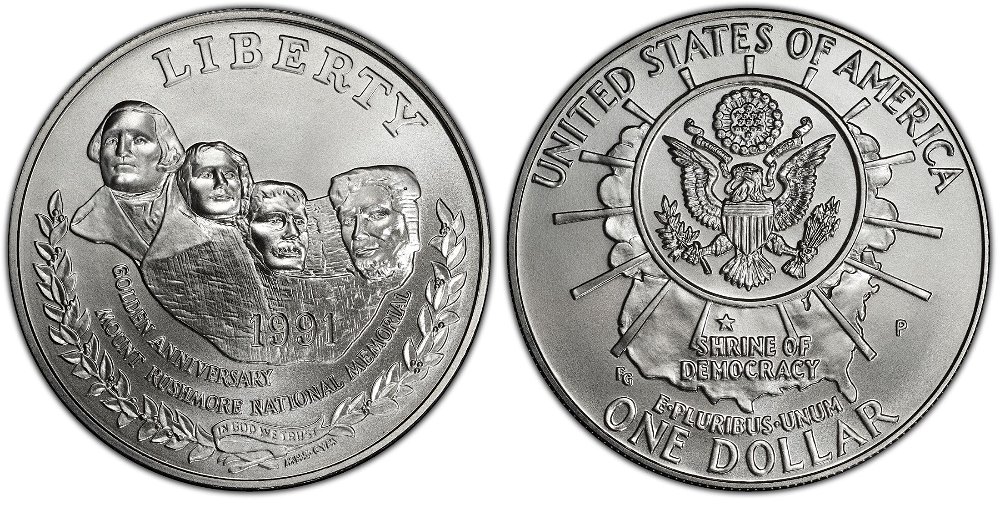
The 1991 Mount Rushmore National Memorial program was another split revenue program, but this time Congress initially incorporated language to ensure the Treasury would get a piece of the pie. The legislation stipulated that 50% of the surcharge funds collected were to be used to reduce the national debt, with the other 50% to be paid to the Mount Rushmore National Memorial Society of Black Hills "to improve, enlarge, and renovate the Mount Rushmore National Memorial." The program's gold $5 coin had a $35 surcharge included in its sales price, the surcharge on the silver dollar was $7 and the price of the CuNi half dollar included a $1 surcharge. Later, to ensure a set amount would be received by the Society, an amendment to the original Rushmore Act was passed. It stipulated that $18.75 million was to be paid to the Society first and that the remainder would be used to reduce the national debt. As the program generated just over $12 million in total surcharge funds, the amendment effectively blocked any of the funds collected from being used to reduce the national debt.
1991 United Service Organization (USO) 50th Anniversary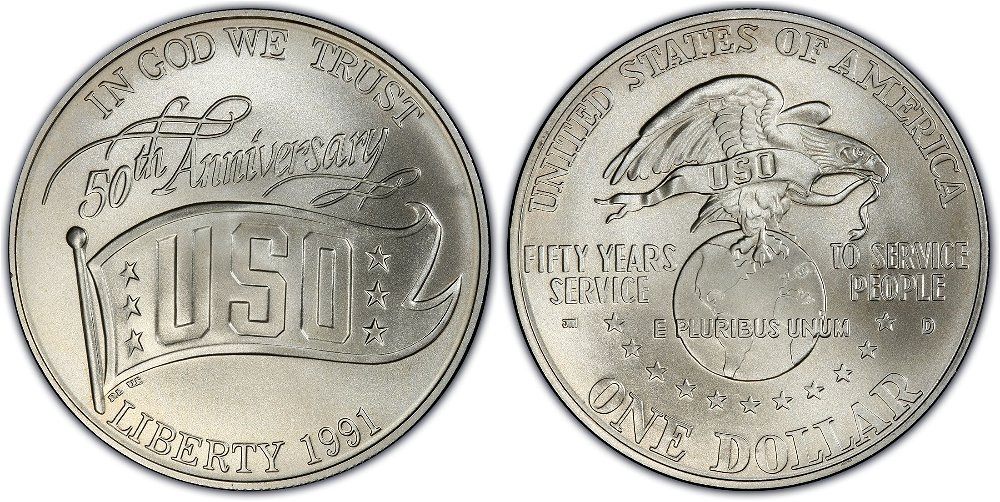
The 1991 United Service Organization (USO) commemorative program was another that specified a 50/50 sponsor-national debt split for its collected surcharges. A $7 surcharge was assigned to each silver dollar. The funds received by the USO were to be used "to fund programs, including airport centers, fleet centers, family and community centers, and celebrity entertainment." Approximately $3.1 million was collected via surcharges on silver dollar sales, so roughly $1.55 million (half) was deposited in the general fund of the Treasury to be used for debt reduction.
From that point forward, Congress identified a sponsor to receive surcharge funds in all of its commemorative coin legislation. So, though the authorizing legislation for six of the first ten modern commemorative programs included debt reduction language, the practice lost favor and was discontinued. In total, north of $65 million of coin surcharges was applied to reducing the national debt before the practice was abandoned - a true
drop in the bucket but at least an attempt was made!
Hope you enjoyed the read!
Image Credits: All images are courtesy of PCGS CoinFacts at http://www.PCGS.com/coinfacts.









 Posted 06/06/2020 7:59 pm


 I had heard of at least one commemorative having surcharges designated for the debt, but I couldn't remember which one and I certainly had no idea about all of these! In the case of the USO dollar, I think the story behind it is more interesting than the coin itself.


