Back in 2012, I made a brief post about this limited edition piece, but have long believed a more thorough look was justified. So.In May 1992, as part of a bill that also included the 1992 White House Bicentennial, the 1994 World Cup USA and the 1992 Christopher Columbus Quincentenary commemorative coin programs, President George HW Bush authorized the 1993 James Madison/Bill of Rights commemorative coins.
The Madison/Bill of Rights program consisted of a silver 50-cent piece, a silver dollar and a gold $5.00 (i.e., half eagle). The sponsor and beneficiary of the coin program was the Federally-chartered James Madison Memorial Fellowship Foundation (JMMFF); the Foundation was created by Congress in 1986. The surcharge funds received from sales of the program's coins were specified to "be used to encourage teaching and graduate study of the Constitution of the United States, its roots, its formation, its principles, and its development." (To read more about the coins and their unexpected date pf issue, see my
1993 James Madison / Bill of Rights Coins post.
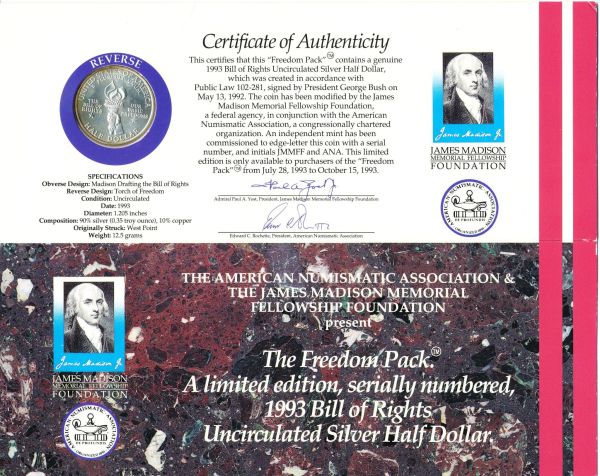
The American Numismatic Association and the JMMFF collaborated in 1993 to create a special package option for the Madison half dollar that was to be sold by the
ANA vs. the US Mint; they each kicked in $5,000 to launch the program. From there, the
ANA was the primary financial backer. The
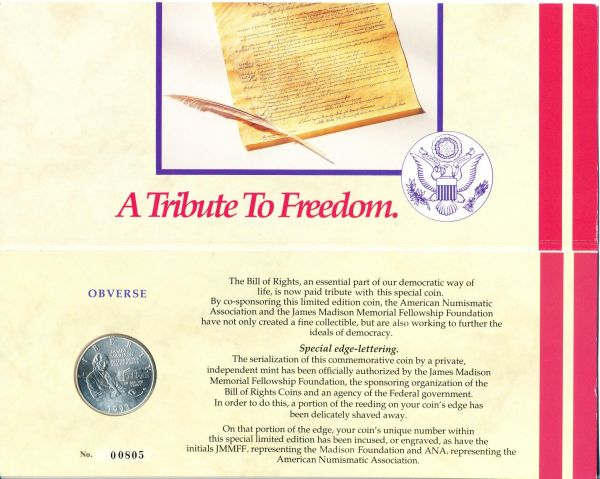
ANA purchased uncirculated Madison half dollars in bulk from the Mint, arranged with Silvertowne of Winchester, IN to shave off a portion of the reeded edge on each coin and then stamp each with a unique serial number and the initials "JMMFF" and "
ANA". A more elaborate graphical edge design was considered early in the process, but simple edge lettering prevailed.
The counterstamped coins were secured in specially-designed folders that feature information about the altered coin and the ANA-JMMFF co-sponsorship; the package was marketed under the name "Freedom Pack." Sales were launched at the 1993
ANA Convention in Baltimore,MD on July 28th and continued until the pre-announced closing date of October 15, 1993; total sales were reported as 9,656 units. Some of the Freedom Packs (reports have ranged from ~700 to 832) were given to those who either joined the
ANA via 5-year membership or renewed their membership for five years (the 832 figure represents the number of 5-year memberships paid for in 1993; the
ANA has not reported a definitive number of Freedom Packs awarded to this membership category).
It is likely that more than 9,656 sets were prepared/assembled, but I am not aware of what happened to any of the leftover/unsold coins/packages. Does anyone have a Pack with a serial number greater than 10,000?
The Freedom Pack was sold for $19.95 - about $8.50 to $10.00 more than the cost of coins in standard US Mint packaging. (The half dollar's pre-issue price from the Mint was $9.75; its regular price was $11.50.) Due to its bulk purchase, the
ANA likely paid about $9.00 per coin (just a guess on my part).
The endeavor was primarily an
ANA activity that was sanctioned by the JMMFF as the
ANA handled production, sales and distribution. As a result, the
ANA netted about $5.00 per unit sold while the JMMFF received only the $3.00 surcharge it was due from the coin's initial sale. The JMMFF did not receive any money from the
ANA as a result of Freedom Pack sales.
It was reported in the
ANA's
The Numismatist magazine that the dies used for the edge engraving were destroyed at its Colorado Springs, CO headquarters on December 2, 1993, thus officially ending the program.
Part of the marketing strategy for the coins was to draw a parallel to the counterstamped 1925 Stone Mountain half dollars by stating that the new piece was only the second US commemorative coin to ever be counterstamped with the full and official support of its sponsor. While technically true, it is far from a perfect parallel. Many of the Stone Mountain counterstamped coins were auctioned by the coin's sponsor for large sums - from $100s to >$1,000 to support the Stone Mountain monument's construction. With the Madison coin, the counterstamp plan was initiated by a third party (the
ANA) who kept the profits generated from the altered coins and used the money for its own programs. So, a very different purpose and outcome was experienced by each.
At the time, the collecting community had mixed feelings about the special collectible. Some believed that the
ANA should not have anything to do with altering
US coins and then selling them for a profit. Others believed it to be a great idea that helped promote the hobby. I supported the effort at the time and purchased two of the sets while attending the
ANA's Baltimore Convention; I still have both today. Today, many collectors are not aware they even exist so there is very limited furor or controversy associated with them. They can typically be purchased for $20 to $30 in the retail marketplace (sometimes, even less).
Within the last few years, PCGS has begun grading the Stone Mountain counterstamp coins but it does not appear to grade these Freedom Pack coins. The same appears to be true for NGC; they don't appear to grade the altered Madison coins.
I have enjoyed having the Freedom Packs in my collection for their "place in history" within the modern US commemorative coin series, not for their investment potential. Sometimes, having something interesting is the only value I need.
My brief original post can be found here:
ANA-JMMFF Freedom Pack.
More of my posts about US commemorative coins can be found here:
Read More: Commems Collection 






 Posted 12/28/2020 10:33 am





