You would think that if coin proposals for the smallish cities of Bridgeport, CT, New Rochelle, NY and Elgin, IL were approved by Congress, a proposal to mark the centennial of the larger and more "national" city of Atlanta, GA would sail through without issue. It turns out, nothing is guaranteed and timing is everything!
But first, a word about the centennial that was the subject of the proposed coin -- it was not the centennial of Atlanta's incorporation, but, rather, something that predated such an event.
In December 1836, the Georgia legislature approved a plan to construct a new rail line that would be part of a system that would ultimately connect Georgia's port city of Savannah to Chattanooga, Tennessee. The Act was titled, "To authorize the construction of a Rail Road communication from the Tennessee line, near the Tennessee river, to the point on the Southeastern bank of the Chattahoochee river, most eligible for the running of branch roads, thence to Athens, Madison, Milledgeville, Forsyth, and Columbus; and to appropriate monies therfor." The Act was approved/signed by Georgia Governor William Schley on December 21, 1836.
(Note: Except for the direct quotes I've included which use the term "Rail Road," I will follow modern lexicon and use today's combined term "railroad" in this post.)Section 9 of the Act specified the name of the new railroad as the "Western and Atlantic Rail Road of the State of Georgia." The railroad is owned by the State of Georgia to this day and is leased by the State to CSX Transportation.
Important to the coin bill, Section 2 of the Act instructed the Governor to appoint a "competent engineer" to "make an accurate and instrumental examination, survey, and location of said road." In 1937, Colonel Stephen Harriman Long, a US Army engineer, was selected to conduct the survey, and to determine the best location for an advantageous termination spot for the new rail line. His survey work extended from May 12, 1837 through November 3, 1840. A key component of his assignment was to identify a spot that could serve as an ideal hub for the connection of the other regional rail lines being contemplated. He ultimately selected a terminus spot that was then in an unincorporated rural area, but today is a spot just northwest of the Five Points area of Atlanta. Long drove a stake into the ground to mark the location of the rail line's mile zero.
Beginning in 1839, homes and businesses began to be built near the stake Long drove into the ground. It was informally called "Thrasherville" after John Thraser who was the first to build in the area. The "Zero Mile Post" stake was moved a short distance to the southeast in 1842. Development continued in the area and the town became known as "Terminus" - quite original!
A few years later, the name was formally changed to "Marthasville" in honor of Governor Wilson Lumpkin's daughter Martha; Marthasville was incorporated in December 1843. The name of the growing settlement would be be changed to "Atlanta" when it was incorporated as the City of Atlanta on December 29, 1847. Governor Lumpkin's daughter's middle name was Atalanta, so he supported the new name.
So, it turns out, the bill for Atlanta's centennial used the 1837 "Zero Mile Post" date as the basis for the anniversary vs. the city's incorporation in 1847. A little unusual, but certainly defensible.
Just FYI: Atlanta became the capital of Georgia in 1877.The bill proposing the Atlanta coin was introduced during the 75th Congress in March 1937. It called for up to 25,000 coins to be struck at a single facility of the Mint. The coins would be dated "1937" and only be made available to the Atlanta Centennial Commission, in groups of at least 5,000 coins, for a period of one year following enactment of the bill.
The bill was introduced and immediately referred to the House Committee on Coinage, Weights, and Measures where it remained. The bill was never reported out for further consideration by the House - a victim of the general distaste that Congress had developed for new commemorative coin proposals.
So, the 1937 Atlanta Centennial half dollar was not to be. The Bridgeport, New Rochelle and Elgin coins were all approved in 1936 - a year in which it seemed Congress - to paraphrase Will Rogers - "never met a coin bill it didn't like." Who knows? If the Atlanta bill had been introduced in the 74th Congress, when the commemorative coin environment was much more hospitable, it might have been passed without issue and commemorative collectors today would have one more "city coin" to add to their cabinet.
I have not come across a medal from 1937 that commemorates the centennial of Atlanta, though it's possible a limited run of such medals was produced - I will continue to search!
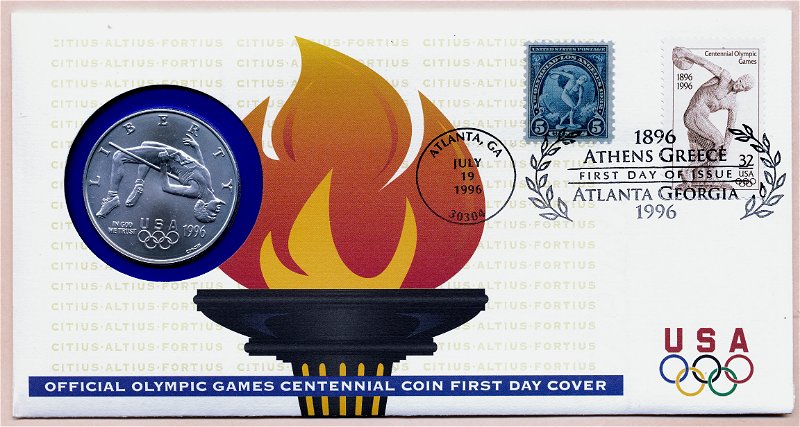
With no medal to image and present, I'm left to my own devices...here's an Atlanta-themed philatelic-numismatic cover (PNC) with a 1996 Atlanta Olympics High Jump commemorative silver dollar. The centennial of the modern Olympic Games was being celebrated in Atlanta in 1996 and was the catalyst behind a very large US commemorative coin program. (At least my PNC prompted me to use "Atlanta" and "centennial" and "commemorative coin" in a sentence together!

)
To check out my other US commemorative posts:
Read More: Commems Collection









 Posted 01/08/2021 8:00 pm


 .
.


