NGC -
This altered issue features removed arrows and rays.In 1853 the United States Mint in Philadelphia struck more than 15.2 million quarters. However, only some 44,200 had been produced before February 21, when Congress voted to lower the weight of U.S. silver coinage to discourage melting for a profit. To signify the slight change (6.68g to 6.22g), the mint added arrows on either side of the date, and rays behind the eagle on the reverse. It then recoined a large quantity of back-date specimens into new, lighter examples.
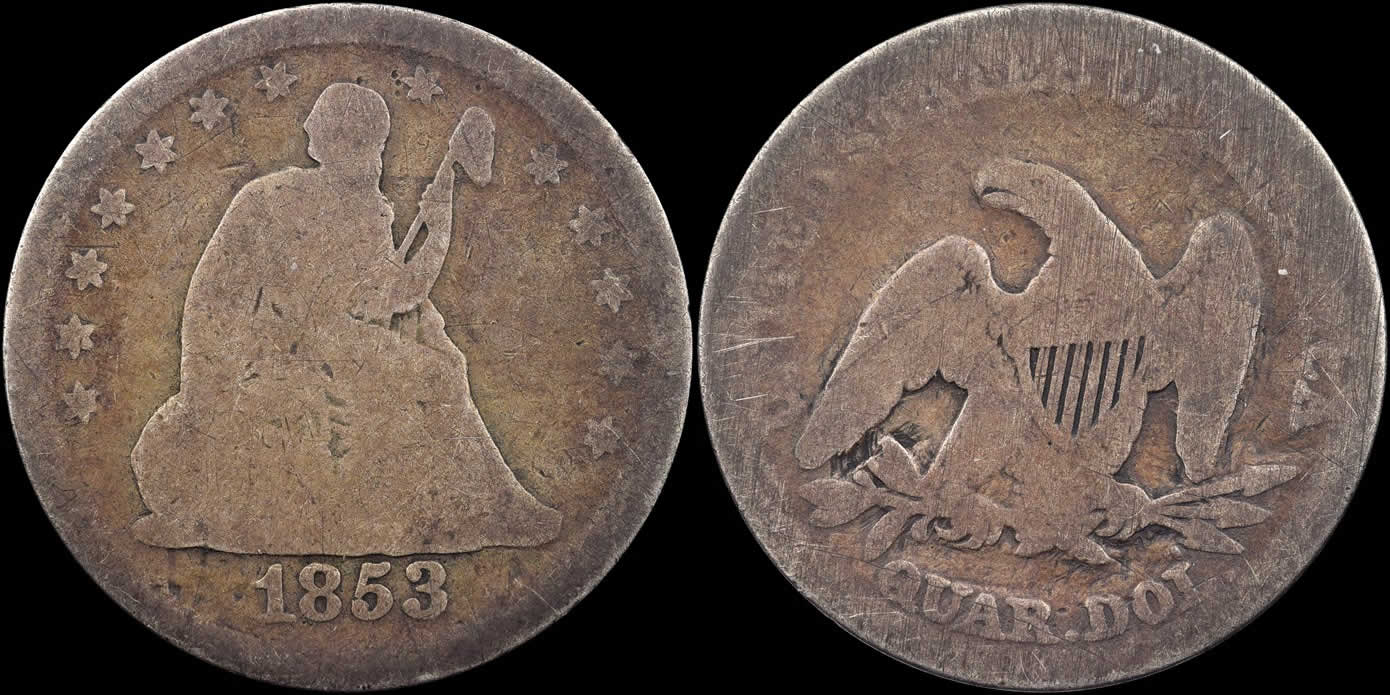 Altered 1853 Seated Liberty Quarter
Thus, the 1853 "Arrows at Date, Rays Around Eagle"
Seated Liberty quarter is plentiful today, while an 1853 without these elements is a real rarity. Of course, because of the large price discrepancy between the two issues ($50 versus $800 in Very Fine, according to A Guide Book of
United States coins, a.k.a. the "
Red Book"), some enterprising forgers have resorted to removing the arrows and rays. That is the case with an altered coin that Numismatic Guaranty Corporation (NGC) graders recently noticed.
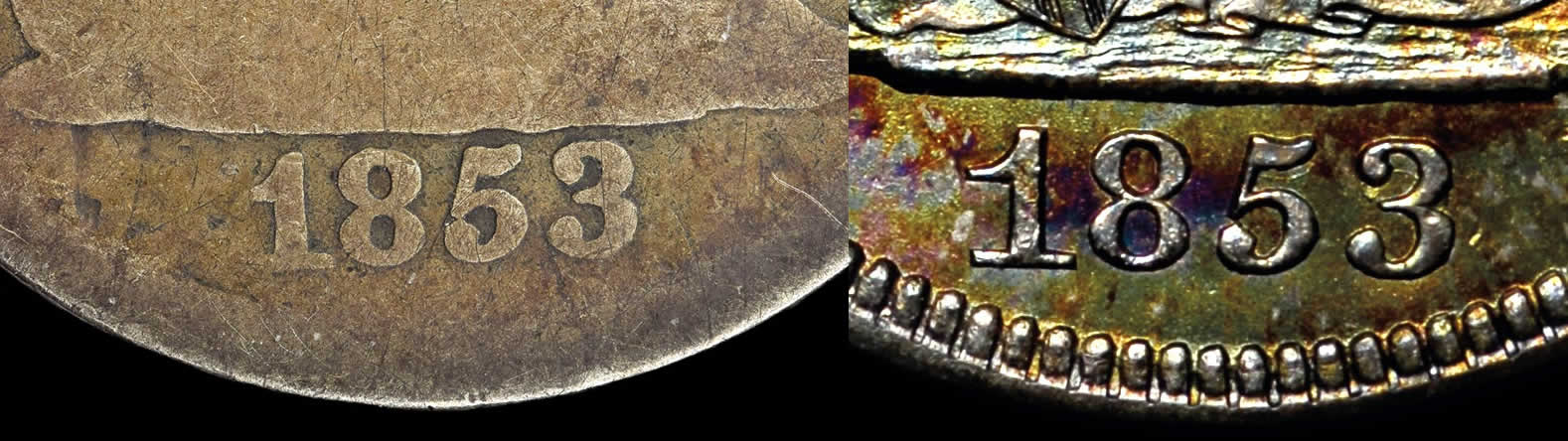 The arrows on this altered quarter (left) have been removed without noticeably upsetting the metal. However, the date is positioned noticeably higher than it should be.
At first glance, this piece appears to be a typical circulated
Seated Liberty quarter. Although there is some slight disturbance in the metal, the forger did a relatively adequate job eliminating the arrows on the obverse. However, he botched the removal of the rays on the reverse. Obviously, with so much more metal to extract, it is a lot more difficult of a task, one this forger was incapable of completing in a convincing manner.
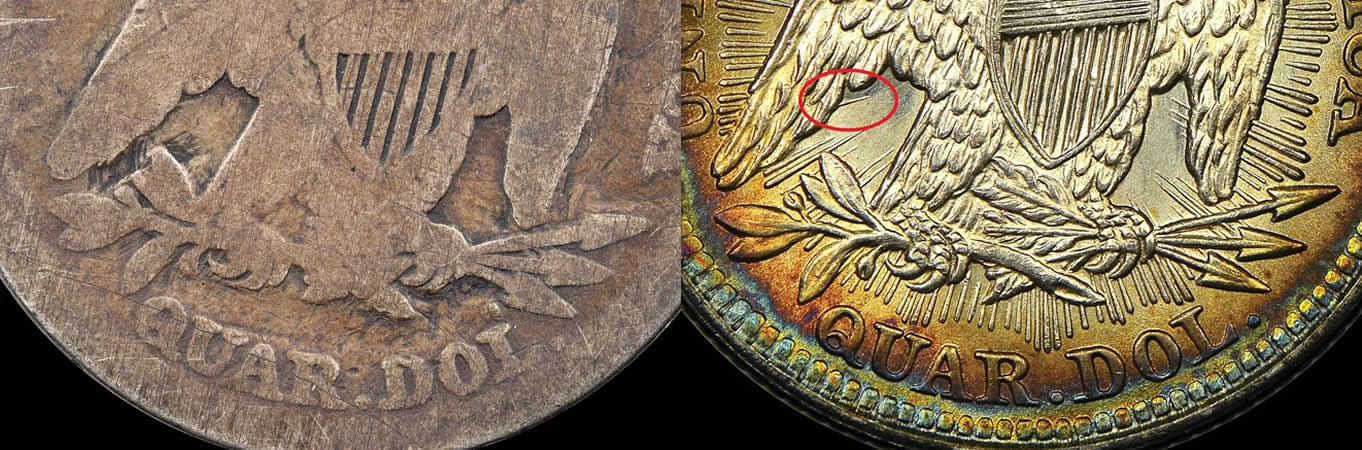 This leftover ray (left), as well as clumsy tooling in the field behind the eagle, are telltale signs this coin has been tampered with. A genuine example with rays is shown at right.
From the photo here, you can see there are many areas of extensive tooling where the forger removed the rays behind the eagle. This was done very poorly, and it left dark gouge marks that stick out like a sore thumb. Additionally, he apparently missed a small ray underneath the eagle's right wing.
Because of wear, this coin weighs only 5.66 grams, much lower than a genuine example. Lastly, all known 1853 no arrows and rays quarters have dramatic repunching of the date, which this altered example lacks.
This is one of the most ambitious alterations we have seen recently, though this specimen was not particularly well executed. It is important to remain vigilant when purchasing key-date coins, especially when there is a relatively small design difference between an expensive and cheap variety. As such, it's better to purchase a coin already encapsulated by NGC, as it is guaranteed to be authentic, unaltered and graded properly.
Read More: Counterfeit Detection Series.











 Posted 02/02/2021 6:55 pm


