NGC -
Determining this coin's spurious nature is all in the details.The Oregon Trail Memorial half dollars, which were struck at various mints from 1926 to 1939, boast a celebrated design from husband-and-wife team James Earle and
Laura Gardin Fraser. Just over 200,000 were sold, and most surviving examples are mint state. The highest-graded pieces can realize thousands of dollars at auction, while average coins usually fetch a few hundred dollars. None of the combinations of dates and mintmarks are particularly rare, although there is a modest premium on the 1939 issues due to their lower mintage.
The Numismatic Guaranty Corporation (NGC) grading team recently encountered a counterfeit 1928 Oregon Trail half dollar. Although the fake's weight is close to the expected 12.5g, a metallurgical analysis determined it is predominantly copper and zinc rather than silver. But plenty of other red flags are evident without the aid of high-tech equipment.
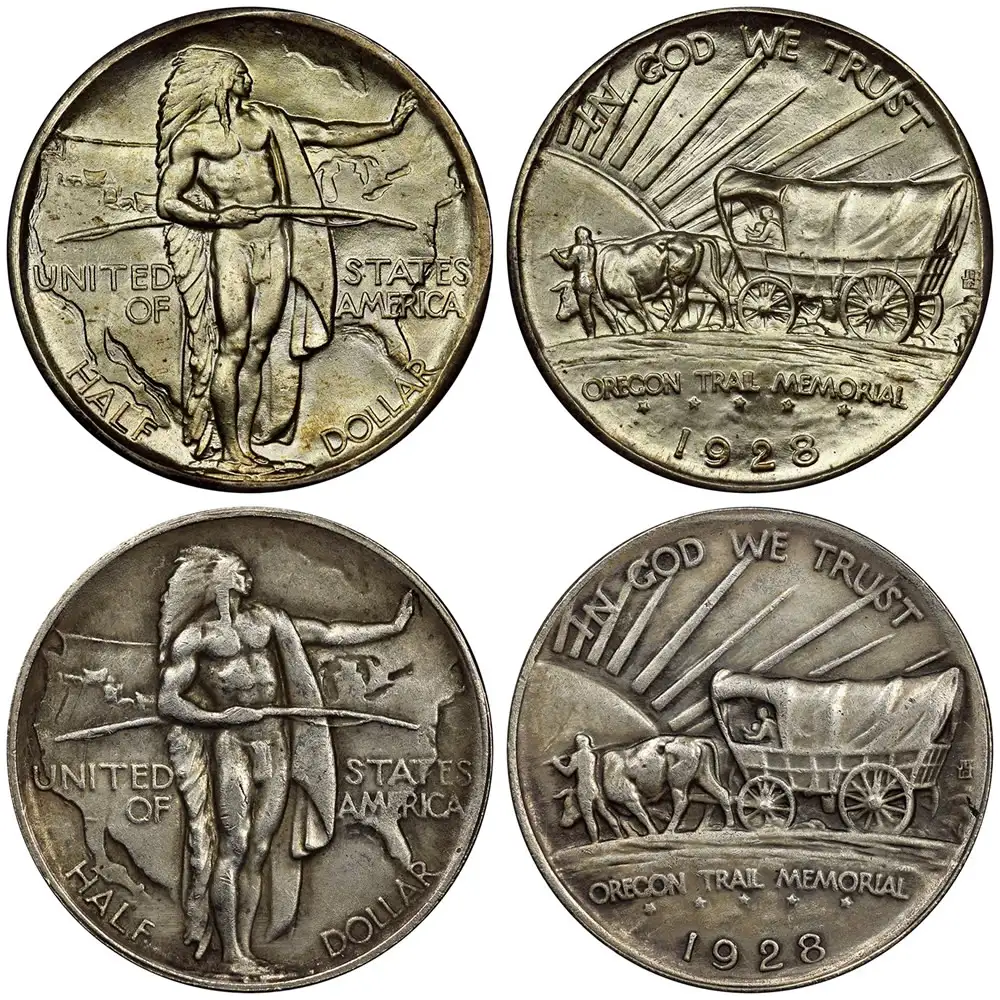 A genuine 1928 Organ Trail Half Dollar (top) and its spurious counterpart (bottom).
Overall, the coin has rough, porous surfaces. Its details are poor and even missing in some places. On the obverse, the letters OREGON TRAIL MEMORIAL and parts of the wagon appear rough. These high points on the coin correspond to the deepest parts of the die. This indicates the strike was so poor that it left behind significant traces of the original planchet's surfaces.
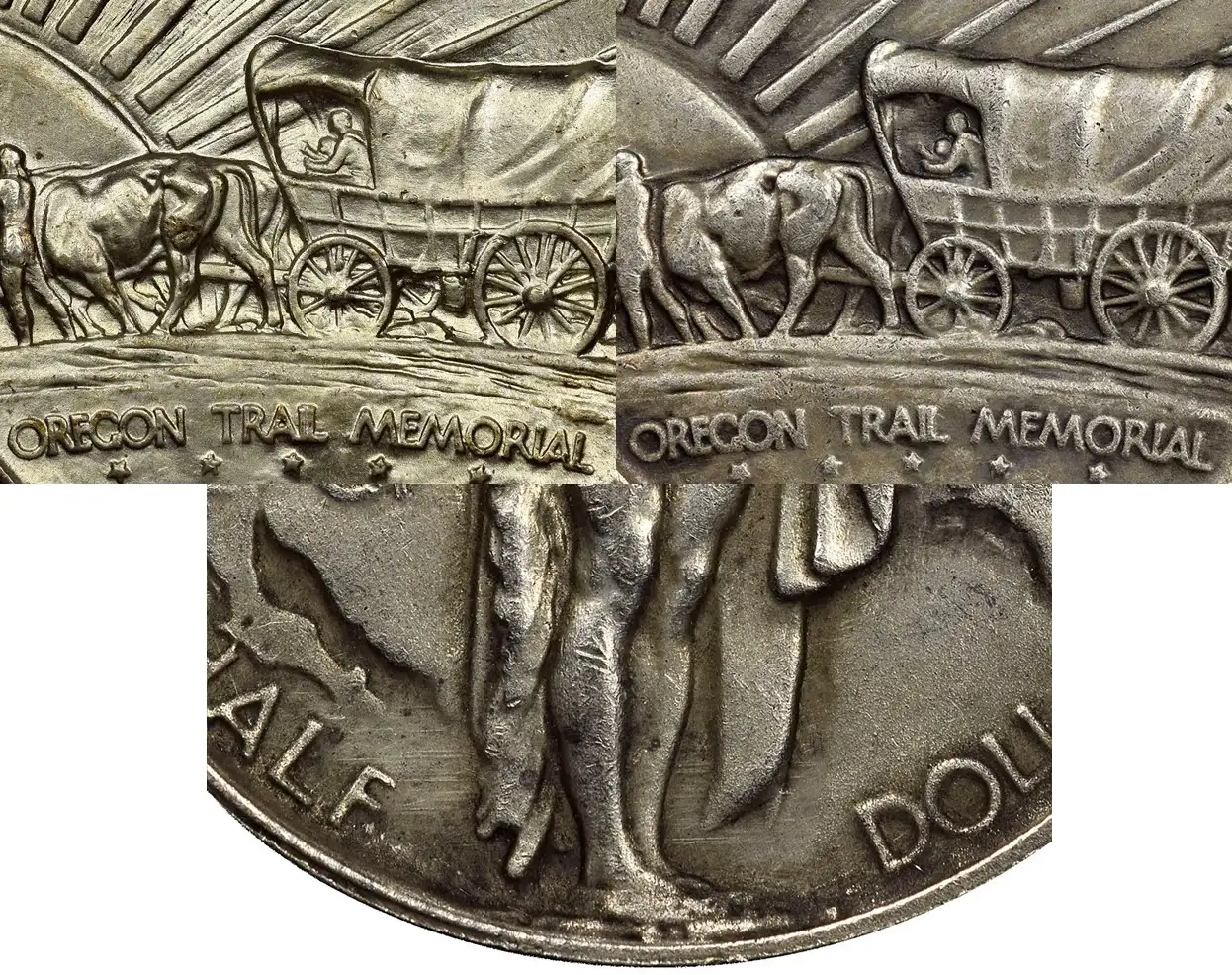 This counterfeit lacks the detail of a genuine issue, particularly around the wagon on the obverse and garment folds on the reverse. (Left: genuine, Right: counterfeit, bottom: counterfeit obverse)
 The bottom of the Baja California Peninsula fades to nothing on the reverse. Likewise, some of the folds have disappeared from the Native American's garment, and the wavy lines off the coastal areas are almost entirely absent.
 Check Oregon Trail Half Dollars on ebay
.
Read More: Counterfeit Detection SeriesRead More: Commems Collection 











 Posted 10/25/2021 4:58 pm


