NGC -
Test your authentication skills on this poor-quality fake.The Liberty Head nickel series began in 1883 and ended with the famous 1913 mintage of just five proofs, each of which are worth well over $1 million. Excluding these rarities, it's relatively easy to build a proof or business-strike set. However, the business strikes include two challenging dates, 1885 and 1886, where all but the most worn examples are worth hundreds of dollars.
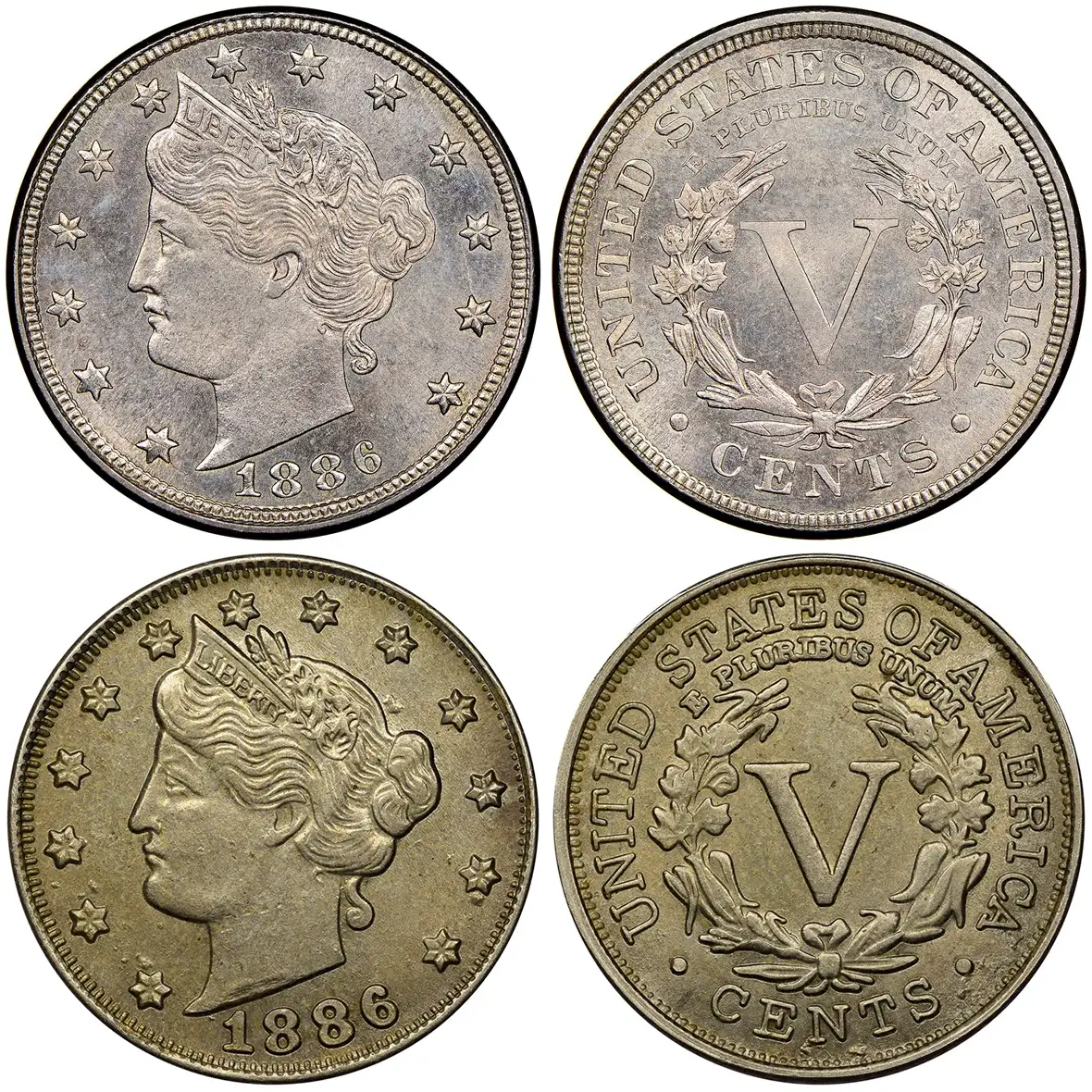 The genuine 1886 Liberty Head (top) and its spurious counterpart (bottom).
This counterfeit features rounded details, and each letter and number is the same thickness.Numismatic Guaranty Corporation (NGC) recently received a purported 1886 Liberty Head nickel. It's an obvious fake, but the ways that this can be determined offer an excellent opportunity to hone your authentication skills:
1) Weigh the coin. This counterfeit weighs 5.3g, well over the expected 5g and outside the acceptable mint tolerance.
2) Look at the characters. A genuine specimen features an elegant font with varied thickness. However, each letter and number is the same on the fake.
3) Check for inconsistencies. The word LIBERTY on the coronet is incuse on a genuine example, but it is raised on the counterfeit. Also, Liberty's mouth is closed on the fake, and she seems to be scowling. This discrepancy is most obvious when compared to a genuine piece.
4) Examine the details. Overall roundness and a lack of details are common on coins struck from counterfeit dies. This is especially noticeable on the reverse's wreath and the motto above.
5) Look for anything else out of the ordinary. Notice how small and disconnected the denticles are on the obverse between 12 and 3 o'clock. That's a sign that the counterfeiter either over polished the dies or the denticles weren't there in the first place. Also, the field around Liberty contains lumps that are caused by die imperfections. Sometimes, a forger will remove these, leaving behind telltale toolmarks.
To assist in the authentication process, NGC has access to special equipment that measures the metallurgical contents of a coin. A Liberty Head nickel should contain 75-percent copper and 25-percent nickel; while the fake is composed of both elements, it also contains 19-percent zinc. If you are unsure of a coin's authenticity, remember that NGC backs its determinations of authentication and grade with the NGC Guarantee.
Read More: Counterfeit Detection Series Check out 1886 Liberty "V" Nickels on ebay
.










 Posted 01/02/2022 8:22 pm





