In 1950, a bronze commemorative medal was struck to commemorate the 100th Anniversary of the first use of what became the National Flag of Cuba.
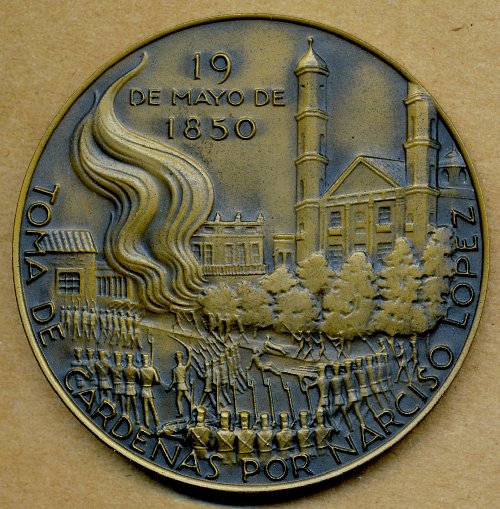
The history of the flag extends back to 1850 when it was hoisted by Narciso López during his coup attempt against Spain at Cardenas. The flag was raised there for the first time on May 19, 1850 after the city had been taken over by López's followers/supporters. It is this event that is depicted on the reverse of the medal. The included "TOMA DE CARDENAS POR NARCISO LOPEZ" inscription translates to English as "Taking of Cardenas by Narciso Lopez."
The medal's obverse presents tha Cuban National Flag waving in the wind, with surrounding commemorative inscriptions: "MEDALLA COMMEMORATIVA" which translates to English as "Commemorative Medal" and "AÑO DEL CENTENARIO DE LA BANDERA DE CUBA" which translates as "100th Anniversary of the Flag of Cuba."
Cuba National Flag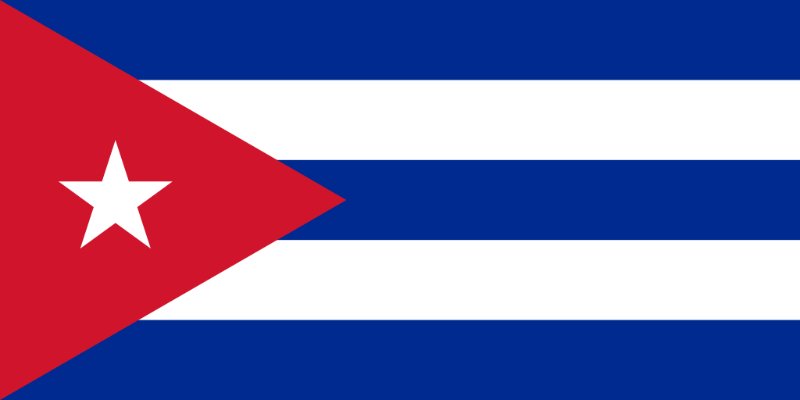
In terms of symbolism, the flag's three blue stripes (top, middle and bottom) represent Cuba's three administrative departments (circa 1850): Western (Occidental), Central and Eastern (Oriental); the Spanish Colonial Government created these units in 1827. In 1879, the Colonial Government created six provinces from the original three departments; today, the Republic of Cuba has 16 provinces. The choice of blue was also meant to symbolize the high/lofty ambitions of Cuban patriots/freedom fighters.
The white stripes in between the blue are meant to represent the purity of the ideals of the Cuban patriots. At the hoist end of the flag is a red triangle meant to represent the unification of the people of Cuba with its three equilateral sides being symbolic of the strength of their principles. The white/silver star on the red triangle is meant to represent Cuba's destiny as a free Republic.
The flag's symbolic elements draw inspiration from the red, white and blue banners of the American colonies during the American Revolution and the people of France during the French Revolution. It incorporates the ideals of
Liberty, Equality and
Fraternity, which were central to the efforts of both predecessors.
Note: I have provided the original symbolism intended for the flag's elements as decided in 1849 - I've read modern interpretations that have changed the meanings to, seemingly, better suit modern tastes.I find the 3" medal to be an attractive piece and a nice companion to my type set of US Mint-struck coinage for Cuba. Though the series did include a few commemorative issues, no commemorative coins were issued in 1950 for the flag's centennial - the medal is a nice stand-in!
1950 Centennial of Cuban Flag Commemorative4 Medal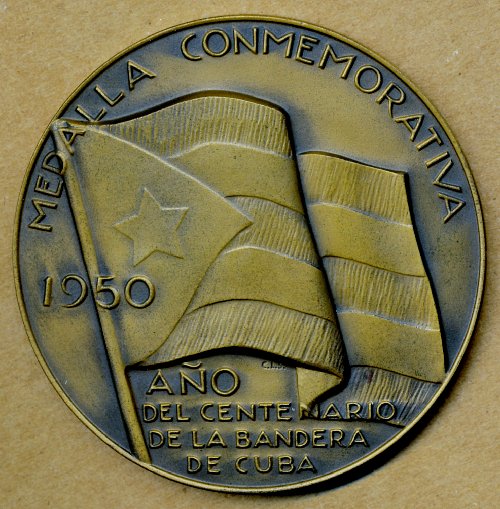










 Posted 08/02/2021 09:11 am


