Authorization for the Louisiana Purchase Exposition (LPE) gold dollar(s) did not come from a standalone Act, the enabling legislation was included in the Civil Sundry Appropriations Act for Fiscal Year 1903. It was included in the section that authorized construction of a US Government Building for its exhibits and the collection, transportation and care/safekeeping of the material featured in the exhibits.
The Louisiana Purchase Exposition (aka the St. Louis World's Fair) was originally scheduled to open in the Spring of 1903 (during the actual LP centennial year), but various construction, and other, delays pushed its opening until 1904. The Exposition ran from April 30 through December 1, 1904. Over 19.5 million people attended the Exposition, which was held on a 1,200 acre site in St. Louis that, today, is occupied by Forest Park and Washington University. The Exposition hosted exhibits from 63 foreign nations, the US Government and 43 (of 45) states.
Louisiana Purchase Exposition - US Government Building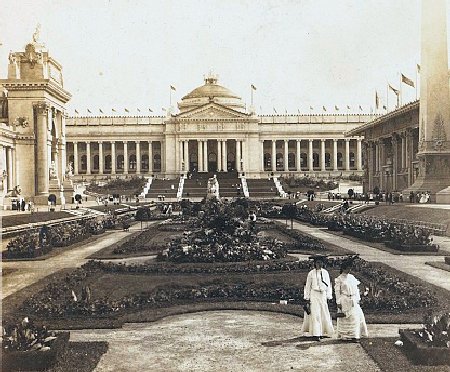 (Image Credit: US Library of Congress, Prints and Photographs Division. http://www.loc.gov)
From the Missouri Digital-Heritage web site, "The Fair was a combination of trade show, civic showpiece, and monument to culture, along with more than a tinge of American pride. The Fair showcased the grandiose ambition of the gilded age, forming a kind of collective tribute to the nineteenth century's international understanding of the furtherance of peace, prosperity, and progress. It's a grand snapshot in time of American and foreign societies as they wished to portray themselves."
https://www.sos.mo.gov/archives/mdh...oll=muellis)The LPE language in the Civil Sundry Act served to amend the previous 1901 Act that established the Louisiana Purchase Exposition Commission and made a $5 million appropriation to support the Exposition; the 1901 Act did not include authority to strike commemorative coins.
As originally introduced in the House, the Civil Sundry bill also did not include coining authority language. When considered in the Senate, language for the coin(s) was amended to Section 12 (which originally only set an expiration date for the Commission). The amendment called for "two hundred and fifty thousand gold dollars of legal weight and fineness, to be known as the Louisiana Exposition gold dollar, struck in commemoration of said exposition."
A few interesting notes about the coin provisions:
1. The coins could be struck at any/all US Mint facilities - no single-mint restrictions were put in place.
2. No limit on the number of designs that could be placed on the coins was stated. This loophole resulted in two different obverse designs, but even more, theoretically, could have been requested.
3. The coins were to be given to the Louisiana Purchase Exposition Company as part of the $5 million appropriation granted in the 1901 Act - they were not an additional appropriation. The Company was allowed, however, to sell the coins above face value to raise additional funds. (The coins were sold at the Exposition for $3.00 each; after poor sales, many were later sold for a discounted price.)
As the Civil Sundry bill covered a large number of diverse appropriations of the Government, many disagreements arose between the House and Senate. To resolve the differences, a conference of the chambers was called. (A conference is an ad hoc meeting of selected members of each chamber that is dedicated to resolving differences in the bill(s) placed before them. The small group acts on behalf of the chamber as a whole to reach agreement on a bill's provisions. Agreements reached in conference are not final, they still must be considered by each chamber in full.) The Senate's coin amendment, however, did not become an issue when the House considered the Senate changes and, ultimately, it became part of the approved bill.
The Civil Sundry bill was signed into law by President Theodore Roosevelt on June 28, 1902. With his signature, the LPE gold dollar(s) were born.
As designs for the gold dollar were considered, there arose a desire to honor William McKinley and have the coin serve as a memorial to the assassinated President. McKinley had been assassinated at the Pan-American Exposition in Buffalo, NY in September 1901 (he was shot on September 6 and died on September 14). McKinley had signed the Act that created the Louisiana Purchase Exposition Commission and set the stage for the US Government's participation in the Exposition.
IMO, it's very possible that had McKinley not been assassinated at the Pan-American Exposition, the LPE gold dollar would have had only one obverse design - a portrait of Thomas Jefferson. Though a "Then and Now" themed pair with one coin depicting Jefferson (US President at the time of the original purchase) and the other featuring Theodore Roosevelt (US President at the time of the Exposition) would have had its appeal. (Such a design approach was used for the 1926 American Independence half dollar.)
All 250,000 coins authorized were struck by the Mint in December 1902 and January 1903; they were all dated "1903." Approximately 86% of the coins struck were ultimately returned to the Mint to be melted - coin sales of ~35,000 (~14%) were definitely far below expectations!
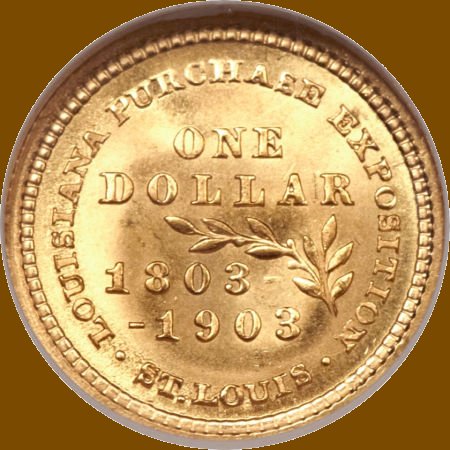
1903 Louisiana Purchase Exposition - Jefferson Type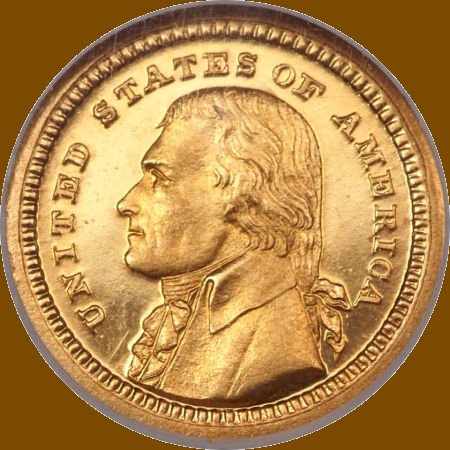
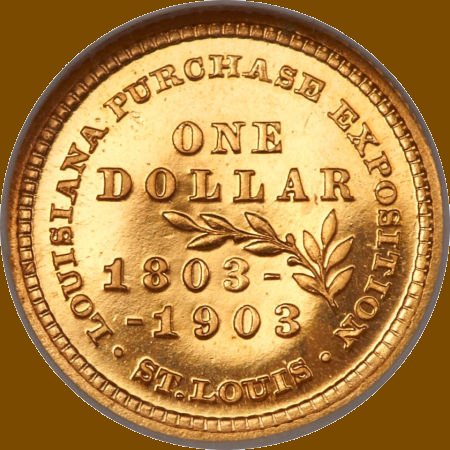 1903 Louisiana Purchase Exposition - McKinley Type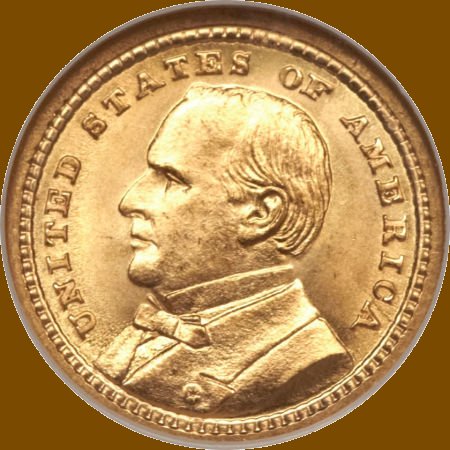
For a look at a related piece of Louisiana Purchase Exposition ephemera, see:
-
1903-04 Louisiana Purchase Exposition Wooden Post CardFor a variety of commemorative-themed posts about coins and medals, check out:
Commems Collection. 




 Posted 04/01/2022 3:12 pm