Continuing my look at Government Officials on classic-era US commemorative coins,,,
There are noticeably fewer coins that feature portraits of non-President Government Officials than coins with one (or more) Presidents - and one shares the stage with a President vs. having an individual coin!
Secretaries of StateJohn Quincy AdamsThe highest ranking, non-President, government official to appear on a US commemorative of the classic era was
John Quincy Adams - he appeared on the 1923 Monroe Doctrine Centennial Half Dollar and occupies the front position among the two left-facing conjoined portraits. Adams was the US Secretary of State under James Monroe at the time of the Doctrine, and is generally credited with writing it for Monroe for his address to Congress in 1823. He was the eighth US Secretary of State, serving September 22, 1817 through March 3, 1825. He then succeeded Monroe as US president (the sixth) and was in the lead office from March 4, 1825 to March 3, 1829.

 GovernorsGeorge Kilby - William Bibb
Thanks to the use of a conjoined portrait design, two Governors are featured on the same coin - the 1921 Alabama Statehood Centennial Half Dollar of 1921. The portrait at the front of the design is that of
George Kilby, the then-current Governor of Alabama. Kilby served from January 20, 1919 to January 15, 1923. (Trivia Note: The coin is the first US coin to feature the portrait of a living person - Kilby lived until October 22, 1943.)
The coin also includes a portrait of Alabama's first Governor,
William Bibb. Bibb was in office from December 14, 1819 to July 10, 1820; Alabama became the 22nd State on December 14, 1819. Prior to serving as the State of Alabama's first Governor, he was the Governor of the Territory of Alabama. Bibb served in the Territory office between March 6, 1817 and December 14, 1819.

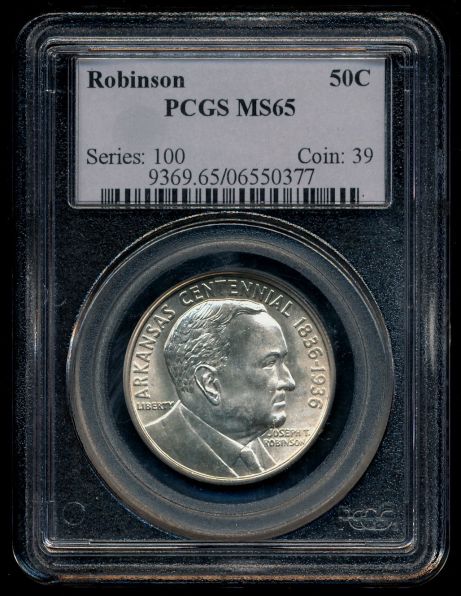
 SenatorsSenator Joseph T. RobinsonJoseph Robinson
 was a Governor, a US Representative and a US Senator. His success and leadership in the Senate drove my inclusion of the 1936 Arkansas Statehood Centennial - Robinson Type Half Dollar under the "Senators" category.
Robinson was born in Lonoke, Arkansas in August 1872 and grew up to be a life-long politician. He began his career with his election to the Arkansas Legislature in 1894. He was elected to serve as a US Representative in 1902 and served five consecutive terms. His next political victory was being elected Governor of Arkansas, taking office on 15 January 1913. He served just 55 days as Governor, however, as the Arkansas legislature voted to return him to Washington, DC as a US Senator to take the seat that opened when recently re-elected Senator Jefferson Davis died. Robinson served over 24 years in the US Senate, including the last four as Senate Majority Leader. In 1928, he was on the Democratic Presidential ticket as the Vice Presidential nominee. Senator Robinson died in Washington, DC in July 1937 (while still in office); he is buried in Arkansas.
 Senator Carter Glass
The 1936 Lynchburg, VA Sesquicentennial Half Dollar features Senator
Carter Glass on its obverse and is the second of the classic-era US commemorative coins to feature a US Senator- a portrait of Glass is found on the coin's obverse.
Glass had strong ties to Lynchburg, he was born there in 1858. He was an important political figure in Virginia for many years, including serving as a US Congressman from 1902 to 1918, and US Senator from Virginia from 1920 to 1946. (In between, he was US Secretary of the Treasury as part of the Woodrow Wilson administration.) He was also significantly involved in shaping our current financial system, including playing a significant role in the creation of the Federal Reserve System as well as the Federal Deposit Insurance Corporation (FDIC)..


You can find my previous posts on each of the coins listed above here:
-
Commems Collection (There are multiple on each.)
Part III of this series will include several coins that feature portraits of men who were not government officials at the time being commemorated by the coin, but would go on to hold an office in the subsequent years. Any guesses? 






 Posted 04/11/2022 05:33 am


