.
NGC - Early American coppers are a particularly unusual and interesting area of US numismatics. The collectors in this corner of the hobby pay particularly close attention to the many nuances of these coins and often collect by variety and even die-state. This subset of numismatics encompasses the first coins ever struck by the fledgling United States in 1793 through the discontinuation of the
Half Cent and large cent in 1857. Unsurprisingly, the history of these coins adds immense interest, and often value, for collectors.
NGC recently received two Early American coppers among a larger submission: a 1796 Large Cent and an 1803
Half Cent. The 1796 Large Cent looks quite similar to many large cents of the era. Standards at the early Mint were not nearly as stringent back then, and planchets often had many defects, as did the finished products. However, an astute eye will note quite a few features that just don't look right.
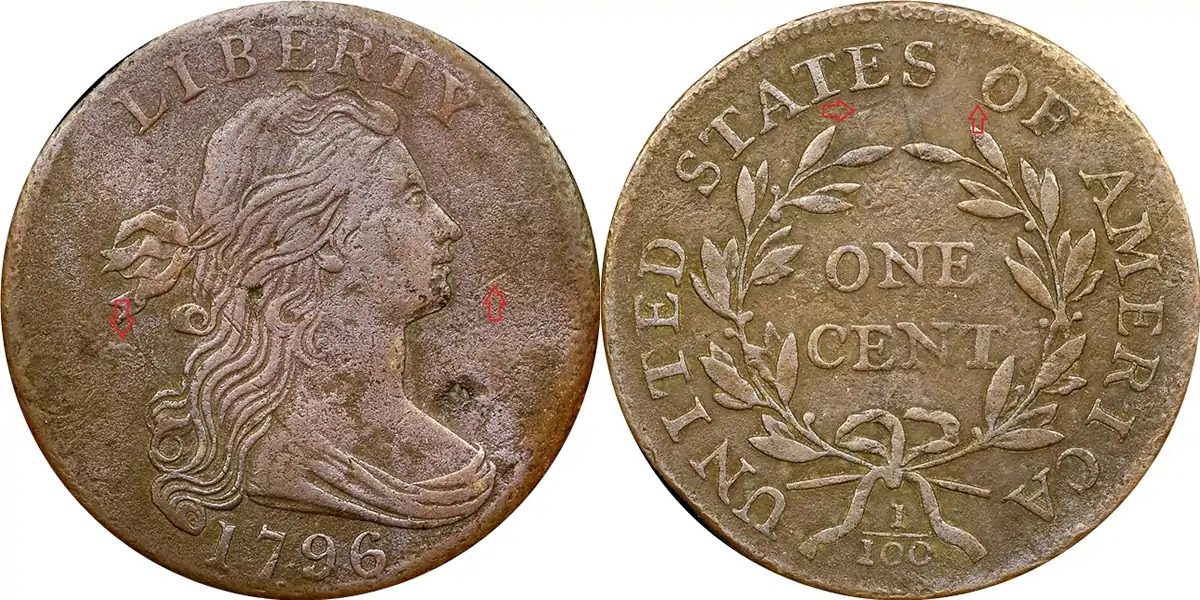
This coin is what is known as a transfer-die counterfeit. A genuine "host" coin is used to create a false die, which is then used to strike coins that are essentially identical to the host coin, albeit with a slight loss of detail. The problem with this type of counterfeiting is that every defect on the host coin shows up on all subsequent coins. For example, on this coin, the area behind the head is seen on other examples of this fake, as well as the depressed area in front of the face, likely from a hit on the genuine host coin.
The reverse, too, has a couple repeating issues, most notably a depression under the "E" in "STATES." A die crack can also be seen coming off the "O" in "OF" but this is a feature that could show up on genuine examples struck from the same dies which struck the host coin. This piece has also been artificially worn and even corroded in an attempt to hide issues.
Many genuine Early American coppers of this era have pitting due to corrosion so by itself this is not necessarily a sign that the coin is counterfeit. The fact that many legitimate pieces are seen in low grades with corrosion helps a fake such as this to blend in.
The 1803
Half Cent was also struck from transfer dies, but the host coin was likely of a higher grade. The spurious coin was not artificially worn or corroded, which allows for a much easier view of the repeating issues.
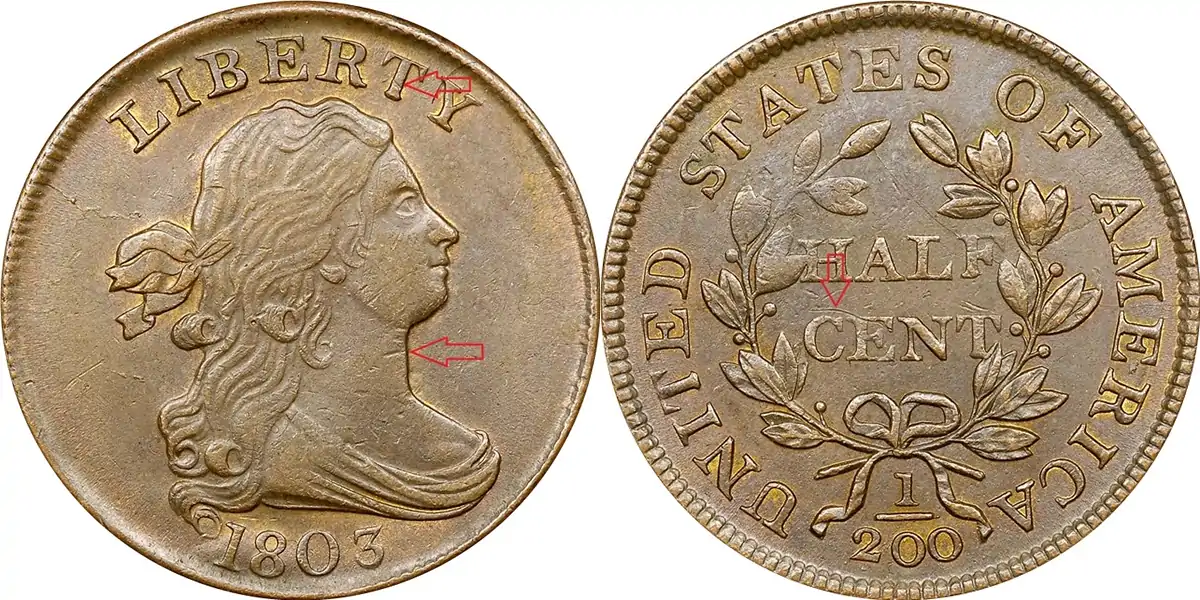
The large depression in the neck is seen on all examples of this rather deceptive counterfeit. Without a second example of this fake for comparison, one might think it was a simple hit. The same can be said about the depression in the "T" of "LIBERTY." The major repeating issue on the reverse of this counterfeit is the large scratch above the "CE" of "CENT." This scratch was on the authentic host coin and therefore has been transferred to all of the fakes struck from these phony dies.
As you can see, counterfeits of early American coppers can look vastly different. Sometimes they can be artificially worn and corroded in an attempt to hide their spurious nature as was the case with the 1796 Large Cent. Other times, however, they can look like a relatively nice example that doesn't raise much suspicion until you look closely for repeating issues.
Read More: Counterfeit Detection Series










 Posted 05/09/2023 10:46 am


 Uncirculated American Silver Eagles


