In February 1962, a bill was introduced in the House of Representatives that called for "special 50-cent pieces in commemoration of the two hundredth anniversary of the founding of Charlottesville. Virginia." The bill stood alone; no companion bill was introduced in the Senate.
Charlottesville, VA was established in 1762 and was named after Queen Charlotte. Its two biggest claims to fame are US President Thomas Jefferson's Monticello home and being the home of the University of Virginia (founded in 1819; its original campus was designed by Jefferson). It was also the occasional home of US President James Monroe between 1799 and 1826.
For its 200th anniversary, Charlottesville held anniversary celebrations beginning in the Spring continuing into the Fall of 1962, though the core events of the anniversary took place in July, from the 14th through the 21st. The historical pageant "Let Freedom Ring" presented the history of Charlottesville via a 30-scene. 90-minute show with a cast of 450 dressed in period costumes that coincided with the particular era of the city's history being presented; the pageant ran nightly from July 16 through 21 (Monday through Saturday).
Charlottesville, VA Anniversary Newspaper Ad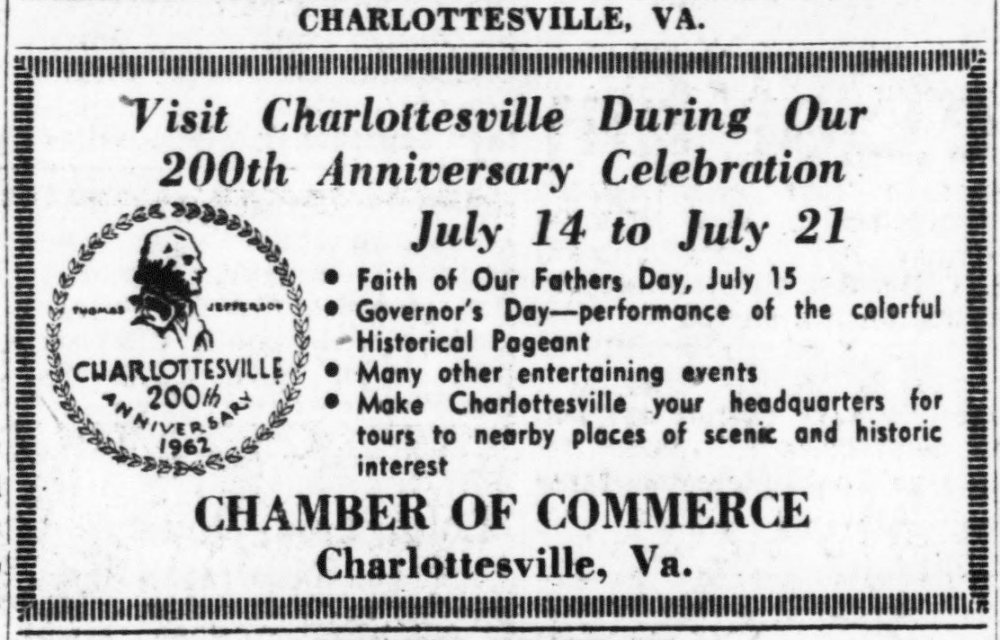 (image Credit: The Sunday Star, June 3, 1962, F4)
Other events included the "Anniversary Costume Ball," a parade, a pie eating contest, a beard growing contest, a fashion show, sporting events, an aircraft and missile display at the local airport and a hobby show that featured coins, stamps and "Indian lore." Special church services were also held on the Sunday during the celebration. The Virginia Governor, Albertis S. Harrison, Jr. was present on Monday, July 16th - Governor's Day - to help kick off the pageant and daily celebrations.
The coin bill proposed 25,000 half dollars be struck on behalf of the 200th Anniversary Commission of Charlottesville, VA (the anniversary celebration planners/organizers). The bill's language did not restrict the coins to a single Mint facility, thus opening up the issue to a potential three-coin P/D/S set.
Though the bill did not specify a date to be placed on the coins, an introduction in Congress date of February 1962, and an expiration of issuing authority being December 31, 1962 -- 1962 would have been the only year the coins could have been struck and thus only "1962" would have been inscribed on them.
The bill was referred to the Committee on Banking and Currency, but was never reported out of Committee. As a result, Charlottesville, VA
would not join the ranks of US cities with its own legal tender US commemorative coin. It was, however, the era of "Good For" tokens, and I've seen two different commemorative, souvenir 50-cent tokens that were issued for the anniversary.
For other of my posts about commemorative coins and medals, including more What If? posts, see:
Commems Collection.






 Posted 04/14/2022 09:53 am





 Classic series proposal it is.


