Lots to cover in this one, so get comfortable! And realize that this is a highly abbreviated account!As might be expected, the first US commemorative coin to be approved by the US Congress was subject to fairly extensive discussion and debate. Securing approval for the coin also took several different tacts in Congress.
Side Note: The term "souvenir coin" was often used rather than "commemorative coin" in the bills that called for the special half dollar. It might be a matter of semantics, but it's an interesting aspect of the series' earliest days.To help celebrate the 400th anniversary of Columbus' first voyage to the New World, Congress approved US Government participation in the World's Columbian Exposition, and created the World's Columbian Commission, via the Act of April 25, 1890. The Act supported "holding at Chicago, in the State of Illinois, a national and international exhibition of the arts, industries, manufactures, and products of the soil, mine, and sea, in such manner as to show the progress made in civilization, and to encourage and promote international trade and commerce, and peace and amity between the nations."
While the Act did appropriate funds to cover expenses related to the Government's participation in the Exposition, it did not make any further general appropriations for the Exposition's management company to help it stage the Exposition. The Act did state that a minimum of $10 million was to be raised locally to finance the Exposition; this figure was based on the estimates of the Exposition Company. The 1890 Act
did not include any reference to a souvenir or commemorative coin.
Approximately two years later, in March 1892, Allan Cathcart Durborow, Jr. (D-IL) introduced a bill in the House of Representatives that authorized additional financial support for thr Exposition by the US Government. The bill was in response to increasing cost estimates for staging the Exposition and the Government's desire for it to be a success - the Government had sent dozens of invitations to foreign nations and had received acceptances from most. (The enthusiasm of the foreign nations was identified as one of the major reasons for increased costs - larger facilities were needed to house all that was expected to be brought for display.) The Government had also worked to encourage participation by a large number of US States and Territories.
(Note: Durborow represented Illinois, the State hosting the Exposition, and thus had a vested interest in helping it succeed.) Durborow's bill
did not include any provisions for a souvenir coin, however. It was for a direct, restricted appropriation of $5 million - the appropriation's funds were restricted to use "for work and labor done and material furnished in preparing and completing the grounds and buildings for installation of exhibits, and the inauguration and holding of said World's Columbian Exposition." The bill was referred to the Select Committee on the Columbian Exposition.
At the same time, the Sundry Civil Expenses bill for Fiscal Year 1893 was being drafted; it was reported by the House Committee on Appropriations in late March 1892. As originally written and passed in the House, it did not include a provision for a souvenir/commemorative coin. The Senate Committee on Appropriations reviewed the House bill and reported it back with numerous amendments.
One of the Senate's amendments called for $5,000,000 worth of "half-dollar silver coins from uncurrent subsidiary silver coins abraded below the limit of tolerance now in the Treasury" - 10 million coins. The amendment, however, was later removed from the bill by the House.
When the Durborow bill was reported out of Committee in June 1892, it was done so with a recommendation that it be Laid on the Table and that it be substituted with the new bill that accompanied the Report. The new bill stated "That for the purpose of aiding in defraying the cost of completing in a suitable manner the work of preparation for inaugurating the World's Columbian Exposition...there shall be coined at the mints of the United States silver half-dollars of the legal weight and fineness, not to exceed
ten million pieces, to be known as the Columbian half-dollar, struck in commemoration of the World's Columbian Exposition." It was a standalone replacement for what had been added to, then removed from, the Sundry Civil Expenses bill.
While Durborow's replacement bill was being considered. Representative William Leake Terry (D-AR) introduced a bill in the House, in late July 1892, that called for up to 10 million silver half dollars of standard specification to be delivered to the designated officers of the World's Columbian Exposition. The coins were "to be of such design and stamped and engraved with such inscriptions and devices as will designate their value as coins of the United States, and also make them suitable souvenirs of the celebration of the four hundredth anniversary of the discovery of America by Christopher Columbus." As with Durborow's bill, Terry's bill was referred to the Select Committee on the Columbian Exposition - it was not reported out.
Less than a week later, in early August, 1892, Representative James Bernard Reilly (D-PA), introduced a coin bill that was very similar in its provisions to Durborow's bill except that it "limited" the souvenir coin's production to 5 million (vs. 10 million). It was the bill that moved forward with extended debate in the House and Senate.
As the bill was debated, a range of amendments were introduced, including: requiring the Exposition Company to deposit the amount of silver bullion needed for its proposed coinage in the US Treasury before any coins could be struck; requiring the Exposition Company to deposit any profits generated from sale of the coins into the US Treasury; and redirecting $50,000 (or as much as needed) of the coins to the Secretary of the Interior for his use in "procuring, preparing, compiling for publication and publishing statistics pertaining to the arts, industries, and manufactures and products of the colored people of African descent residing in the United States from January 1, 1863, to January 1, 1893." None of these proposed amendments was approved.
Ultimately, the Reilly bill was passed by both chambers and sent on to the President for final approval and signature. President Benjamin Harrison signed the coin bill into law on August 5, 1892.
The Columbian half dollar proposal was not without its detractors in Congress; a vocal minority rose in Congress multiple times to argue against the coin. Many were opposed to the fact that the coins were an outight "gift" to a private company without any mechanism by which the US Government could recoup any of the taxpayer's money it used for the appropriation. In the end, however, the appropriation for the Exposition - and the coins that would be struck to deliver it - were supported by the majority and the coin was eventually approved.
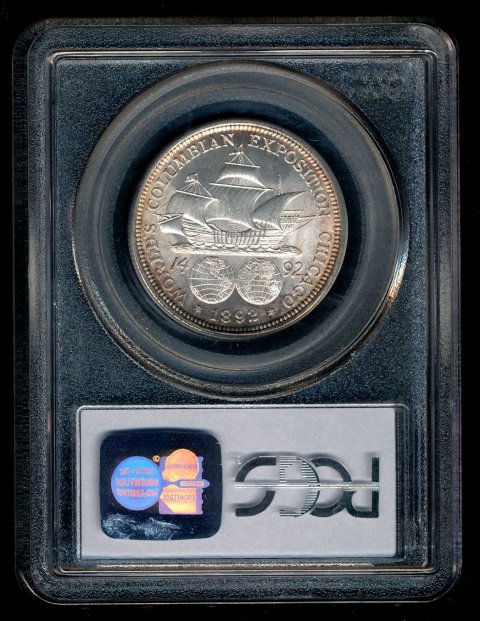
1892 World's Columbian Exposition Half Dollar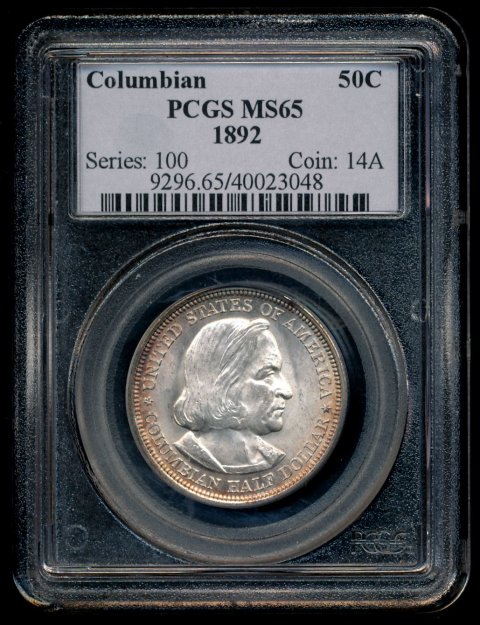
For more on the Columbian half dollar, and other of my posts on commemorative coins and medals, see:
Commems Collection. 







 Posted 05/05/2022 12:04 pm


