The Cumberland Gap is a break in the Cumberland Mountains (part of the Appalachian range) that allows easier passage through the mountains between western Virginia and eastern Kentucky (near where the borders of the two states both meet the Tennessee border). It was used extensively by hunters, fur traders, pioneers, settlers and others as the American frontier was pushed to the west. Of course, it was used by Native Americans long before the Europeans arrived.
The Cumberland Gap National Historical Park (CGNHP) was authorized by an Act of the US Congress in June, 1940. The Act stipulated that the park would be established once the appropriate lands had been secured and turned over to the United States. Kentucky, Virginia and Tennessee set about securing the land, with the states ultimately donating 10,682 acres, 7,478 acres and 2,027 acres, respectively, to the US; the Park has expanded to approximately 24,000 acres today. The Park was dedicated on July 4, 1959.
To read a great history of the Park, check out the booklet on the National Park Service web site for the CGNHP:
-
Cumberland Gap National Historic al Park BookletThe coin bill was introduced in the Senate in August 1958 by Senator John Sherman Cooper (R-KY); Cooper introduced it on behalf of himself and fellow Senators Harry Flood Byrd (D-VA), Thurston Ballard Morton (R-KY) and Carey Estes Kefauver (D-TN).
The bill called for 50,000 "50-cent pieces commemorating the establishment of the Cumberland Gap National Historical Park" to be struck, but did not specify any Mint limitations (i.e., whether limited to one facility or multiple allowed). The bill did, however, specify that the coins "shall bear the date 1959, irrespective of the year in which they are minted."
In an uncommon classic-era move, the bill included specifications for the coin's obverse and reverse designs. It specified two famous Americans with strong ties to the Cumberland Gap states - "the profile of Daniel Boone appearing in the outline of the Cumberland Gap" on the obverse, and a profile of a "Beardless" Abraham Lincoln on the reverse.
The National Bank of Middlesborough (KY) and the Commercial Bank of Middlesborough (KY) were specified as the joint sponsors of the coin, with the coins only being available to them, and only as long as they were ordered in quantities of at least 5,000 and were prepaid. The bill did not include an expiration date for coining authority, so it would have been possible for coins to have been struck in 1958, 1959, 1960 and beyond.
Upon its introduction, the bill was referred to the Committee on Banking and Currency; it was never reported out.
The Cumberland Gap Historical Park may not have gotten its coin in 1959, but, 57 years later, the Park was recognized as Kentucky's entry in the America the Beautiful (
ATB) Quarters Program. All it took was a little patience!
2016 Kentucky - Cumberland Gap Historical Park ATB Quarter - Reverse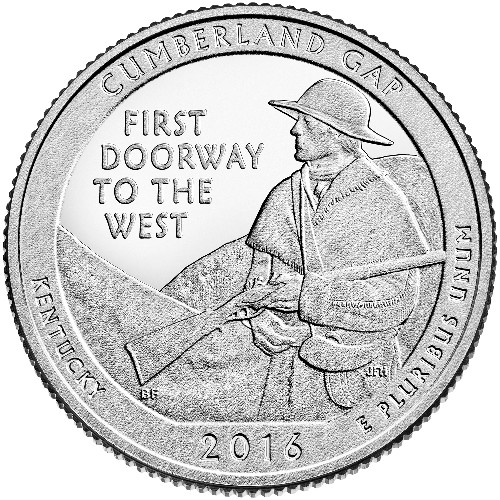 (Image Credit: Image courtesy of the US Mint.)
For other of my posts about commemorative coins and medals, including other What If? stories, see:
Commems Collection.









 Posted 06/13/2022 12:07 pm


