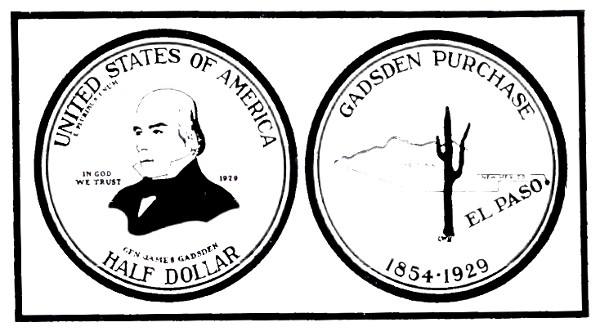
The Gadsden Purchase 75th Anniversary commemorative half dollar is one of the more noteworthy of the failed commemorative proposals - it was the first to fail due to a Presidential veto!
I briefly discussed it here:
-
Did You Know? #3 - The Gadsden Purchase Check that post out for a brief history of the event in question and a map of the territory covered by the Purchase.
US Ambassador to Mexico - James Gadsden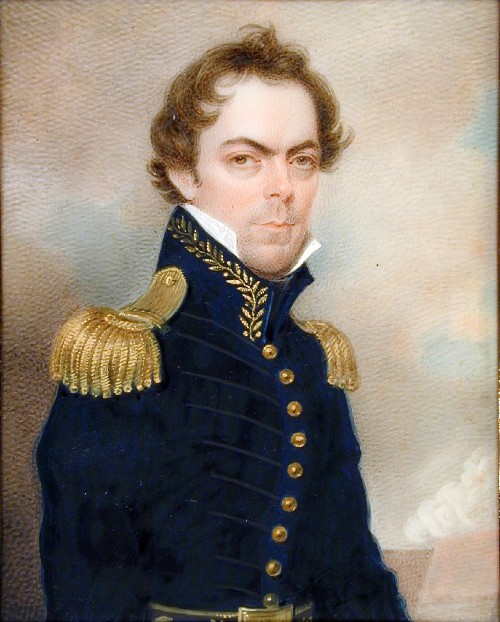 (Image Credit: Public Domain.)
In April 1929, Representative Claude Benton Hudspeth (D-TX) introduced a coinage bill that called for "silver 50-cent pieces in commemoration of the seventy-fifth anniversary of the Gadsden Purchase."
(Side Note: Of the 20 US Representatives for Texas in 1929, 19 were Democrats - they were teamed with one lone Republican.)The bill called for 10,000 coins to be "coined in the mints of the United States" - any or all Mint facilities could be used, and were to be struck on behalf of the Gadsden Purchase Coin Committee. The coin was announced in the American Numismatic Association's magazine -
The Numismatist - in April 1929 via a release from L.W. Hoeffecker; Hoeffecker was Chairman of the Gadsden Purchase Commission. Hoeffecker was the driving force behind the coin, as he would be in the mid-1930s for the Old Spanish Trail half dollar; Hoeffecker also served as the distributor for the 1936 Elgin, IL Centennial commemorative coin. In the news release, Hoeffecker cames across as confident of the bill's passage.
After a Hearing on the coin proposal, the House Committee on Coinage, Weights, and Measures believed the Gadsden Purchase anniversary to be an event "of international importance and of outstanding interest to the people of the Southwest, and is such an event, that, in the judgement of the Committee, should be fittingly commemorated in the coinage of our country." The bill was reported favorably with a recommendation to pass.
The House passed the bill without debate, and it was sent on to the Senate where it was referred to the Committee on Banking and Currency. As did the House Committee, the Senate Committee reported the bill favorably, without amendment, and recommended that it pass. When brought up for consideration, the bill was passed in the Senate without debate or objection.
From there, the bill was examined and signed in each chamber before being sent to President Herbert Hoover for signature and final approval. Hoover, however, vetoed the bill rather then approve it. In his veto message to the House, Hoover stated "The matter is not perhaps one of large importance in itself, were it not for the fact of the great number of other similar proposals by the aggregate of which the principles of sound coinage are being jeopardized. Moreover, the multiplicity of these demands have largely destroyed their interest and value for the purposes intended." Hoover went on to state the Treasury's objections to commemorative coins making them his own vs. naming the Department as the source.
After receiving word of Hoover's veto, the House moved quickly to reconsider the bill and decide if the veto should stand. After ensuring a quorum was present at the start of the following day's session, Representative Randolph Perkins (R-NJ), Chairman of the House Committee on Coinage, Weights, and Measures, initiated discussion on the bill. As part of his introductory remarks, Perkins entered into the record a letter from the Treasury Department that outlined its familiar objections to commemorative coins.
Multiple representatives then rose in sequence to voice continued support for the bill, addressing the objections raised in Hoover's veto message (i.e., the Treasury's objections to commemorative coins),highlighting the importance of the event to the people of the Southwest, the event's importance to the US as a whole, and the fact that financial guarantees were in place to ensure that the coins would not cost the US Government anything.
To conclude the proceedings with an opposing view, Representative John Quillon Tilson (R-CT) presented a defense of Hoover's veto. Tilson stated,
"I believe in celebrating historical occasions, and there is a proper way to do it; but how much does it add to the dignity of the celebration to issue a half dollar purporting to commemorate that occasion? There are other ways and proper ways to celebrate historical anniversaries.
If we wish to authorize a medal, all right; but let us not go on with this policy of really abusing our coinage by the issuance of one after another of these memorial colns.
As I understand, there are now five more bills of the same kind to follow this one; and if these pass there will be numerous other occasions to be commemorated in the same way. Our country's life has been so full of historical events that we might celebrate many of them every year, and where would it end, so far as our coinage is concerned? It seems to me that we have reached a place where we ought to consider this question calmly and dispassionately, and If we do I think we shall make up our minds that the time has come to cease using our coinage for such a purpose. We know In our hearts this is not the proper way to celebrate these events. We know that in this case the President is right In asking that this method of celebrating historical events should stop."After Tilson concluded his remarks, a vote was taken on whether the bill should be passed over the President's veto. The results were "Yea" - 96, "Nay" - 244, "Present" - 2, not voting - 86. So, without a two-thirds majority voting in favor of the bill, the veto stood and the reconsidered bill failed.
If you've ever wondered about the lack of new issues between the 1928 Hawaiian Sesquicentennial half dollar and the 1934 Texas Independence Centennial and Province of Maryland Tercentenary half dollars, you can attribute it to President Herbert Hoover and his veto of the Gadsden Purchase half dollar. It slowed down the rate of new proposals being introduced in Congress, and changed the course of some bills that were already working their way through Congress. (See
1930 Lewis And Clark Expedition 125th Anniversary for an example.)
For other of my posts about commemorative coins and medals, including other What If? posts, see:
Commems Collection.









 Posted 06/25/2022 11:02 am