During the 84th Congress (1955), no fewer than ten bills were introduced in the House of Representatives (9) and Senate (1) that called for a commemorative half dollar "to commemorate the centennial of the admission of the State of Minnesota into the Union." Minnesota had nine US Representatives in the House in 1955, each introduced one of the identical bills. The Senate version of the bill was introduced by Edward John Thye (R-MN); the State's other Senator, Hubert Horatio Humphrey (D-MN), the future US Vice President and US Presidential candidate, did not participate in the "bill party." (Note: Another attempt for a Minnesota Statehood coin was made in 1959 during the 86th Congress via a bill introduced in the House; the bill matched the provisions of the 1955 House bills.)
The State of Minnesota was created/admitted to the Union on May 11, 1858; Minnesota was the 32nd State. It was preceded by the Minnesota Territory which was created on March 3, 1849 when its area was split from the Iowa and Wisconsin Territories and the Minnesota capital was established at St. Paul. The Territory encompassed all of present-day Minnesota, plus significant sections of what would later become North and South Dakota. In 1858, the eastern portion of the Territory was split off to create The State of Minnesota.
Territory Map (Circa 1849) Showing Sources of State of Minnesota Borders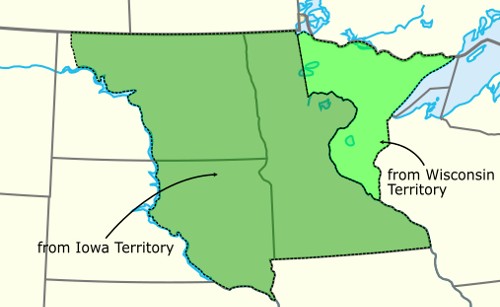 (Image Credit: Source file: Kaldari; This file: Svenskbygderna, CC BY-SA 4.0, via Wikimedia Commons
All of the coin bills were introduced on behalf of the Minnesota Statehood Centennial Commission. The Commission was created by the Minnesota Legislature in 1955, and was tasked with "planning and carrying out a dignified and fitting commemoration of the State's 100th anniversary in 1958." (
1958 Year-End Report of the Minnesota Statehood Centennial commission.) The Centennial Commission had as an objective to: "Sell Minnesota to Minnesotans - And to the World."
The bills in each chamber were markedly different.
The nine identical House bills called for a maximum of 150,000 half dollars, without restrictions placed on the Mint facilities that could be used, the years over which the coins could be struck or the year/date that was required to appear on the coins. The only restriction placed on the coins was that they could only be ordered by the Centennial Commission (or its duly authorized agent). The bills basically called for the type of commemorative coin program that was banned by Congress in 1939. (See:
Prohibiting Certain US Commemorative Coins.)
The Senate bill differed significantly and was in line with the provisions adopted by the Senate Committee on Banking and Currency in the mid-1930s. The Senate version requested just 15,000 half dollars, all of which were to bear the date "1958" and could only be struck in calendar year 1958. The bill did not place a restriction on Mint facilities, however, so it would have been possible for three-coin P/D/S sets to have been ordered by the Centennial Commission under the bill's provisions.
Upon each bill's introduction, it was referred to the chamber's Committee on Banking and Currency. In all cases - 1955 and 1959 - the bills failed to be reported out of Committee and died for lack of action. It was not a good time to be a commemorative coin bill!
Multiple private medals and tokens were produced for the Centennial, but none were created/distributed by the Centennial Commission. The Commission did, however, create a Centennial Emblem that appeared on a large variety of privately-produced souvenirs (including medals) and succeed in getting a US postage stamp issued:
1958 Minnesota Statehood Commemorative Emblem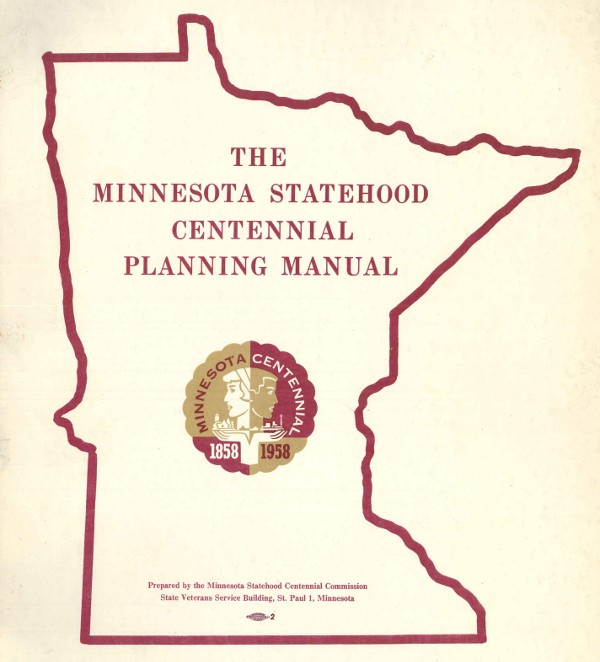 1958 Minnesota Statehood Commemorative Stamp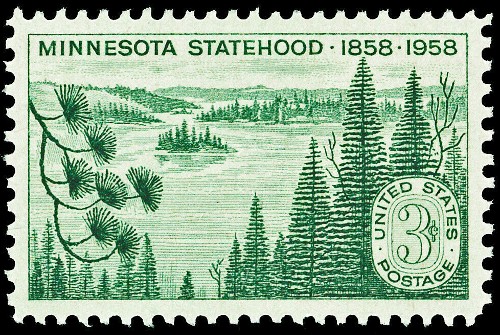
To read about the proposed half dollar for the Minnesota Territory Centennial, see:
-
What If? 1949 Minnesota Territory CentennialFor other of my posts about commemorative coins and medals, including more What If? stories, see:
Commems Collection.






 Posted 07/05/2022 09:50 am





