Note: I'm revisiting this five-year old topic to add more information about the proposed amendment to the original Texas Independence Centennial Coin Act and clean up some of the wording within the original post. The enabling legislation for the original Texas Independence Centennial half dollar was proposed via companion bills in the House and Senate, with the Senate bill ultimately passing Congress and being signed into law by President Franklin Delano Roosevelt on June 15, 1933.
The Act specified the coin was to be issued to commemorate "the one hundredth anniversary in 1936 of the independence of Texas and of the noble and heroic sacrifices of her pioneers, whose memory has been an inspiration to her sons and daughters."
Note: The coin does not mark the anniversary of Texas' admission to the Union, it marks its independence from Mexico. The commemorative half dollar was first issued in 1934.
In January 1936, companion bills were once again introduced. This time, however, the call was for an amendment to the original coin Act that proposed the striking of five different designs for the Texas half dollar vs. the one authorized originally.
The House version of the new bill was introduced by Representative Charles Lacy South (D-TX); Senator Thomas Terry Connally (D-TX) introduced the Senate version. The bills would have given the Secretary of the Treasury the authority "to provide for a series of not more than five different designs to be placed on the reverse side of the 50-cent pieces." The obverse design of an American eagle superimposed on the Texas "Lone Star" was to continue on the proposed new coins.
Upon its introduction, the House bill was referred to its Committee on Coinage, Weights and Measures. The Committee viewed the bill favorably and reported it out with a recommendation for approval. The Committee's viewpoint was accepted by the House; the bill passed without issue. The Senate version of the bill, however, did not follow suit.
The Senate bill was referred to the Senate Committee on Banking and Currency. The Committee organized a Hearing on March 11, 1936 for the purpose of reviewing the merits of multiple pending commemorative coin bills; 13 different bills were considered, including the Texas Independence Centennial Coin Act amendment. The Hearing was presided over by Committee Chairman Duncan Fletcher (D-FL).
Senator Connally was unable to attend the Hearing, but sent his secretary, Robert M. Jackson, to speak on behalf of the bill and answer questions posed by the Committee. In his statement before the Committee, Jackson noted that all proceeds from the sale of the current Texas Centennial coin were going directly to fund a Texas Memorial Museum on the campus of the University of Texas (Austin) vs. a private organization and that the same would be true for the funds raised by the new coins.
Jackson was asked why new coins were being sought. He responded with an honest and straightforward reply, "[the local coin committee] was having difficulty selling [the original coins], and that by changing the design people will want to buy not one coin only but the entire set of coins. In other words, they have one coin now and after they sell that one coin to a person that is the end of it so far as that person is concerned, but by having five different designs people will want to buy the set."
Chairman Fletcher had some experience with commemorative coinage matters and astutely raised the issue that if the bill was approved, it would actually authorize twelve new coins and not just four as it could be assumed that the Texas Coin Committee would want each design to be struck at each of the three Mint facilities. Jackson agreed with Fletcher's observation and conclusion.
After continued discussion and follow-up after the Hearing, the Senate Committee ultimately did not endorse the new multi-design Texas coin amendment proposal. In its Report to the Senate, the Committee recommended that a single new 1936-dated coin be approved with a maximum mintage of one million. The amendment stipulated that the new coin would be struck at only one Mint facility and that it could only be struck for a period of one year following the bill's enactment.
The amended bill passed the Senate, which simultaneously called for a Conference with the House (i.e., an appointed subset of Senators and Representatives) to resolve the differences between the bills passed by each chamber. I haven't found evidence to indicate that the House agreed to Conference or that it ever considered the amended Senate version of the bill.
The lack of follow-up and compromise by the House leads me to think that the Texas Coin Committee was not interested in another single type coin (especially one that could not be turned into a three-coin P/D/S set) and basically informed Representative South that it was no longer interested in pursuing the amendment in light of the Senate's position.
(Note: I haven't seen this stated officially, but offer it as a logical possibility based on the available evidence. Not attempting to resolve the coin bill differences is not the type of decision that would be made unilaterally by the House - it would have sought direction from the coin's sponsor.)Ultimately, no new Texas commemorative coin bill was approved by Congress in 1936 and the original legislation from 1933 remained in force; the original design continued with coins struck in Philadelphia, Denver and San Francisco in 1936, 1937 and 1938.
It would have been interesting to see what designs might have been selected had the bill for the new coin designs passed. In 1933, the American Legion had received many design suggestions from the general public for the original Texas Independence half dollar. Some of these included: a map of Texas, the first capitol building of Texas, the dome of the current capitol building, portraits of Jim Bowie and Davy Crockett, the state seal and scenes from the Battle of San Jacinto. It isn't hard to imagine a series designed around such suggestions.
As interesting as a Texas series might have been, I think it was wise for the Senate to stop the Texas request in its tracks. If approved, it would have become the template used by other organizations to increase the number of coins they requested of Congress and the abuses inflicted upon collectors during the mid-1930s would likely have been even worse. (See a similar story about the Arkansas Centennial Commission's attempt that followed:
1935-39 Arkansas Statehood Centennial - Three Designs Proposal.
1934-38 Texas Independence Centennial Half Dollar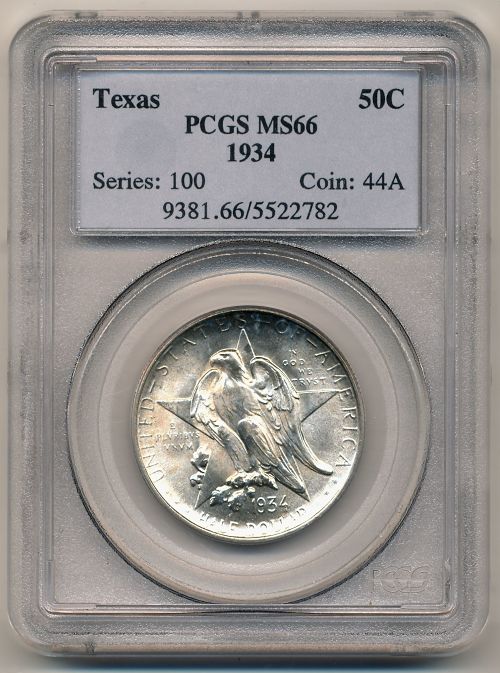
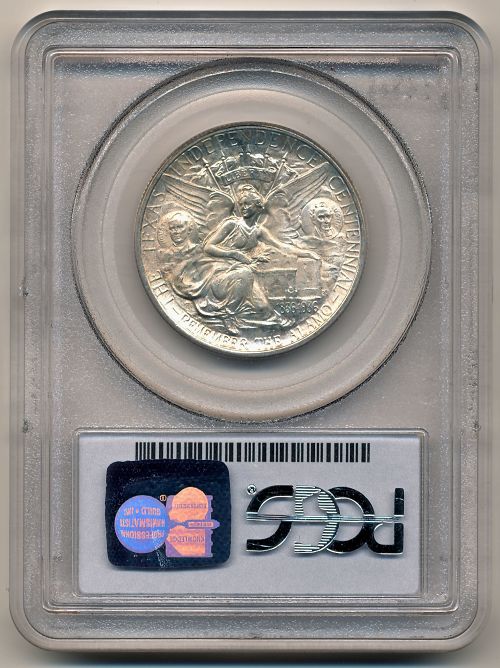
For other of my posts about commemorative coins and medals, including more on the history of the Texas Independence half dollar, see:
Commems Collection.







 Posted 07/28/2022 8:24 pm





