Mount Rushmore, located in the Black Hills region of South Dakota, was commemorated on a three-coin program issued during the 50th anniversary of its completion. Its enabling legislation, signed into law on July 16, 1990, stated the coins were to be struck "in commemoration of the Golden Anniversary of the Mount Rushmore National Memorial."
The 1991 three-coin program consisted of a CuNi-Clad Half Dollar, a Silver Dollar and a Gold Half Eagle. The maximum authorized mintage figures for the coins were 2.5 million, 2.5 million and 500,000, respectively. Final sales for the coins did not approach the maximums allowed. The Half Eagle sold 143,950 units (111,991 Proof / 31,959 Uncirculated), sales of the Silver Dollar reached 871,558 (738,419 Proof / 133,139 Uncirculated) and the final sales figure for the Clad Half Dollar was 926,011 coins (753,257 Proof / 172,754 Uncirculated). As a percentages of "coins allowed" the Half Eagle sold 28.8%, the Silver Dollar hit 34.9% and the Clad Half Dollar reached 37.0%.
Gutzon Borglum was hired as the designer of Mount Rushmore National Memorial, and worked directly on the carving as well as supervising the hired work crew. Borglum was the original designer/sculptor of the Stone Mountain Memorial in Georgia, but was fired by the Stone Mountain Confederate Monumental Association, the organization that was sponsoring the Georgia Memorial's carving, over its slow progress and multiple financial disagreements. Borglum moved from the Stone Mountain project to the Mount Rushmore project.
Gutzom Borglum Working of Face of George Washington on Mount Rushmore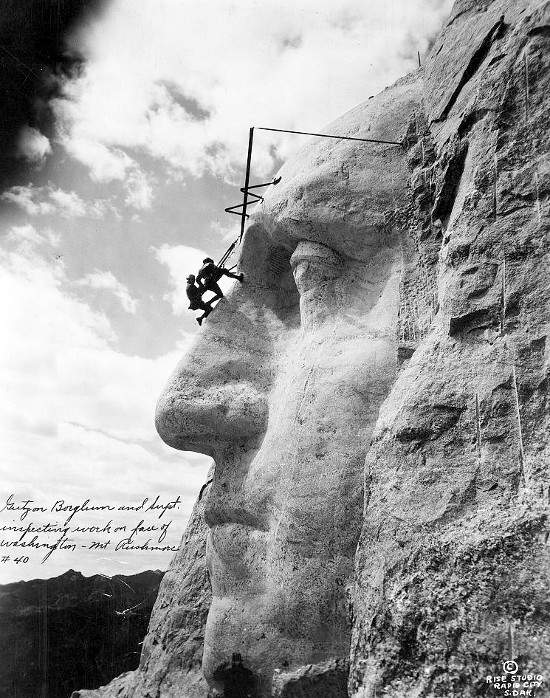 (Image Credit: Library of Congress, Prints and Photographs Division. Public Domain.)
Mount Rushmore features "head shots" of (from left to right) George Washington, Thomas Jefferson, Theodore Roosevelt and Abraham Lincoln (the first, third, twenty-sixth and sixteenth US Presidents, respectively.) Per the Memorial's web site, the four figures "tell the story of the birth, growth, development and preservation of this country [the US]."
The carving was originally planned to include head-to-waist portraits of each of the presidents, but funding for the Memorial was not sufficient for such an ambitious undertaking. Thus, the "head shots" with which we are familiar.
Borglum's Original Model for the Mount Rushmore National Memorial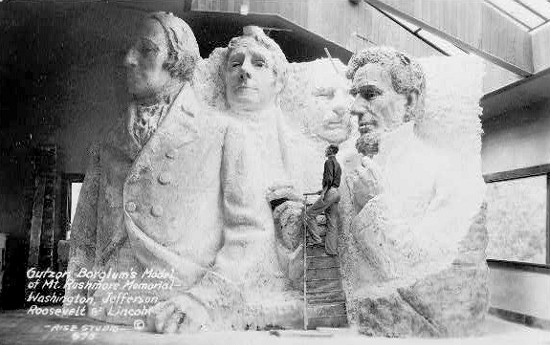 (Image Credit: Library of Congress, Prints and Photographs Division. Public Domain.)
Carving on the Memorial lasted from 1927 into 1941. Gutzon Borglum died in March 1941, a few months before the finishing touches on the carving could be completed; the final work was overseen by Gutzon's son Lincoln Borglum. Lincoln had actually been the primary supervisor for work on the Memorial over approximately the last two years of the project as Gutzon traveled extensively in an effort to raise funds for the Memorial.
The US' pending involvement in World War II had suppressed continued Government funding of the project, and led to the project being declared "Complete!" on October 31, 1941 - little more than a month before Japan bombed Pearl Harbor in Hawaii and drew the US fully into the War. As noted above, Gutzon Borlglum did not live to see his massive creation fully completed.
View of Completed Mount Rushmore National Memorial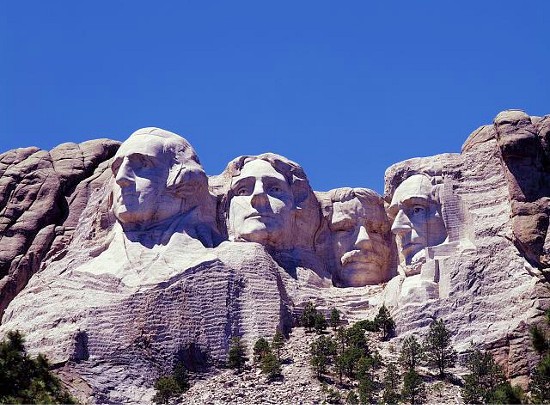 (Image Credit: Library of Congress, Prints and Photographs Division. Public Domain.)
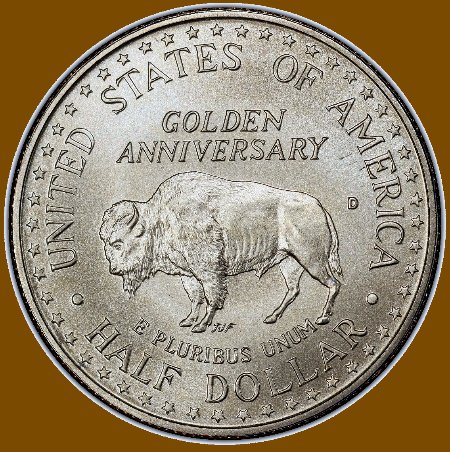
The obverse design of the Clad Half Dollar presents an aerial view of the completed Memorial; 11 rays of sunlight radiate from behind. The reverse of the Half Dollar presents a standing, left-facing American Bison with the coin's commemorative inscription "GOLDEN ANNIVERSARY" above it on two lines. The obverse was the work of outside artist Marcel Jovine; the reverse was prepared by
T. James Ferrell of the US Mint.
The Silver Dollar obverse presents a view of the Memorial that is very similar to the Half Dollar - another aerial view of the completed Memorial. The coin's reverse design features an eagle with a constellation of 13 stars above, all set off in a circular medallion (the design is very reminiscent of the Great Seal of the United States). Rays of light extend outward from behind the eagle medallion; all are presented over clouds that surmount a map of the United States. The map features a star that marks the South Dakota location of Mount Rushmore. Outside artist, Marika Somogyi, designed the obverse, its engraving was done by Chester Young Martin of the Mint. Former US Mint Chief Engraver
Frank Gasparro designed and sculpted the coin's reverse design.
My favorite design of the Mount Rushmore coins is the obverse seen on the Gold Half Eagle. It presents a close-up view of a Bald Eagle in flight clutching stone carving tools in its talons in the foreground, with the Memorial seen in the background. The design was created/engraved by the Mint's
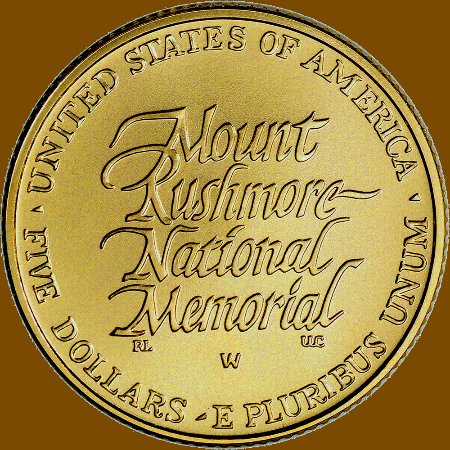
John Mercanti. The reverse of the coin is all inscriptions. It was designed by Robert Lamb, an outside artist and calligrapher; it was engraved by
William Cousins of the Mint's sculpting/engraving team.
The Regular Issue Price for the Clad Half Dollar was $9.50 for the Proof and $7.00 for the Uncirculated. For the Silver dollar, the prices were $31.00 and $26.00, respectively. And for the Gold Half Eagle, the prices were $225 and $210, respectively.
In a somewhat unusual move for me, I purchased the three-coin Uncirculated Set as a unit. I typically purchased the coins individually vs. multi-coin Sets, but went with the Set for some reason with this issue.
1991 Mount Rushmore National Memorial: Clad Half Dollar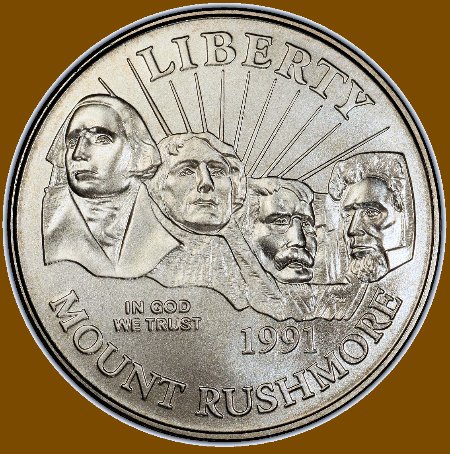
 1991 Mount Rushmore National Memorial: Silver Dollar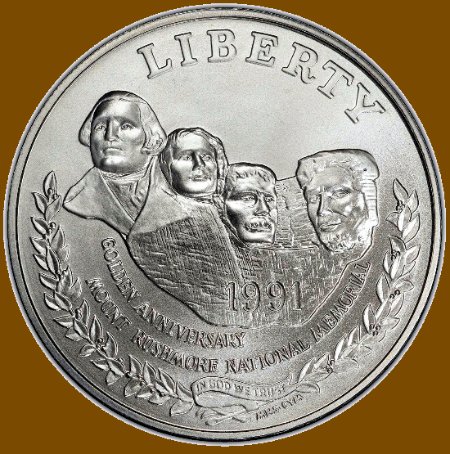
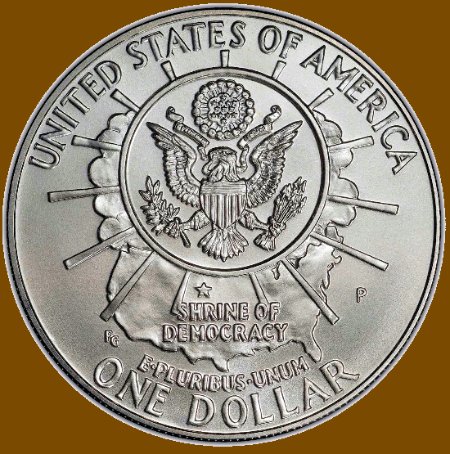 1991 Mount Rushmore National Memorial: Gold Half Eagle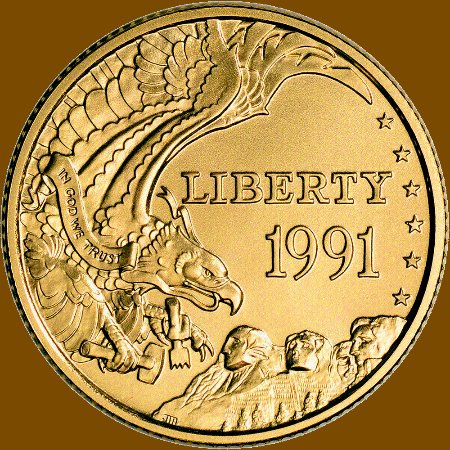
For more of my posts about commemorative coins and medals, including others about Modern US Commemorative Coins, see:
Commems Collection.






 Posted 08/31/2022 11:21 am





