Senator Robert Ferdinand Wagner (D-NY) introduced a bill in the Senate in July 1937 that called for half dollars "in commemoration of the eightieth birthday of George F. Johnson, who has devoted his entire life to the interests of humanity." (Potential living-person-on-a-coin alert!)
George Francis Johnson (1857-1948) was a progressive American businessman in the shoe industry who built his reputation as a business owner and executive in upstate New York - he was a true "rags-to-riches" story.
Johnson, born on October 14, 1857 in Milford, Massachusetts, began his career as an entry-level shoe factory worker in Massachusetts. He left Massachusetts for Broome County, New York to work for the Lester Brothers in their new shoe and boot manufacturing company. The brothers had grand plans, but over-extended themselves financially and were forced to sell their business. Prominent among the business' creditors was Henry B. Endecott who took over but kept Johnson on as a supervisor to oversee the location's operations.
Johnson's energy and business acumen impressed Endicott, and, in 1899, Endicott offered Johnson a partnership and sold him half the business. Johnson rose from a foreman position in the company to become its president. Under Johnson's leadership, the Endicott-Johnson Shoe Company grew to become the world's largest (at one time) shoe and boot manufacturing company.
Portraits of Henry B. Endicott and George F. Johnson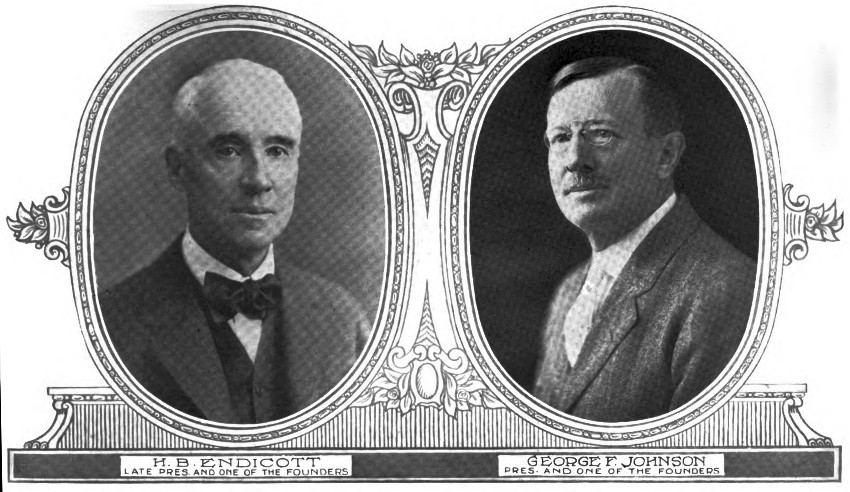 (Image Credit: Souvenir of Endicott-Johnson: World's largest Tanners and Shoe Makers. 1922. Public Domain.)
Johnson was an important figure in the development of better management practices, cooperative management-work force relations and greatly improved worker benefits. For example, he was among the first in his industry to institute an eight-hour work day. The Company also offered housing assistance for employees and full medical benefits - all part of Johnson's "Square Deal" - Johnson's version of welfare capitalism which includes company-provided social welfare benefits.
The workers of the Endicott-Johnson Shoe Corporation earned more vs, most other comparable shoe-industry workers (the company used a pay-per-piece model vs. pay-per-day model), but the company was more productive and profitable due to the workplace reforms and employee benefit programs Johnson had implemented. The company grew under Johnson's leadership in terms of facilities and workers in the 1920s, but did suffer during the Great Depression (like most companies). To his credit, Johnson kept all workers working - even if at reduced capacity - this enabled company workers to maintain at least some income through the Depression. The Company rebounded and became a major supplier of shoes/boots to the US military during World War II. Through it all, Johnson maintained a generally happy and loyal workforce.
Endicott-Johnson Shoe Company Bilboard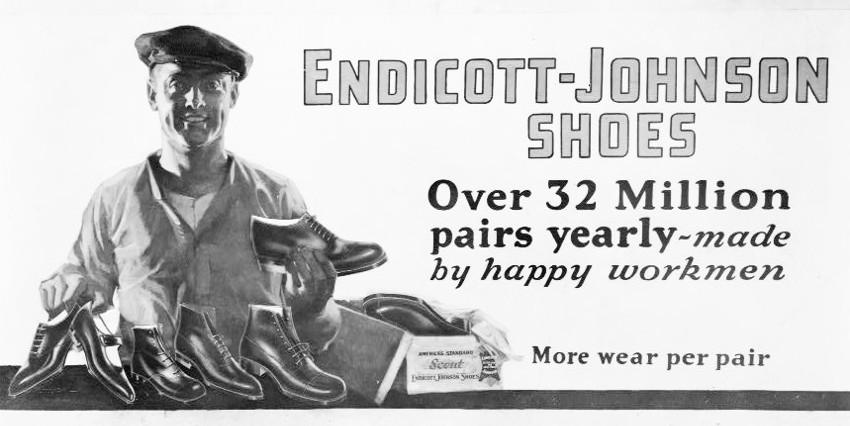 (Image Credit: Library of Congress, Prints and Photographa Division. Public Domain.).
The Johnson bill called for 40,000 half-dollar coins of standard specifications, to be struck for the benefit of the George F. Johnson Memorial Coin Committee of the American Legion Drum Corps of Endicott, Johnson City, and Binghamton.
Drum and Bugle Corps sponsored by local American Legion posts were, at one time, major attractions in the US, often included in local parades; for decades, the American Legion held an annual championship contest with entries from Posts across the country.
Note: The three neighboring municipalities - Endicott, Johnson City, and Binghamton - are located in upstate New York (close to the horizontal center of the State, near the Pennsylvania border), and are often referred to as the "Triple Cities." Today, together, they make up the Greater Binghamton Metropolitan Area of Broome County. The bill specified "the net proceeds shall be used in defraying the expenses incidental and appropriate to the commemoration of such event, or other purposes as this committee shall deem proper." The discretion provided the Coin Committee via the included "other purposes" phrase makes me wonder about how much would actually be spent on birthday celebrations for George F. Johnson vs. going to directly to support the Drum Corps.
The coins were to bear the year/date "1938" regardless of when struck, with an expiration of authority one year after the bill's enactment. The Coin Committee was restricted to a minimum order size of 5,000 coins. With a mintage potential of 40,000 coins, and a minimum order size of 5,000 coins, the math indicates that a maximum of eight coin orders could have been placed (5,000 coins each).
The bill was referred to the Committee on Banking and Currency, but was not acted upon or reported out. When the 75th Congress adjourned, the bill died for lack of action; it was not reintroduced when the following Congress convened.
George F. Johnson celebrated his 80th birthday without a coin struck in his honor, but appears to have "gotten over it." He went on to celebrate 10 additional birthdays without a coin, passing on November 29, 1948, a month after turning 91.
For other of my posts about commemorative coins and medals, including more What If? posts, see:
Read More: Commems Collection.







 Posted 10/24/2022 7:28 pm





