I've written several posts regarding mid- to late-1930s efforts by Congress to stem the rising tide of US commemorative coins (see links below), but the passage of the Booker T. Washington Birthplace Memorial and Iowa Statehood Centennial Half Dollar bills by the 79th Congress (1946), appeared to signal that
US coinage was once again "for sale" to those desiring a commemorative piece.
"Commemorative Coin Season" began in earnest in January 1947, with six bills/resolutions introduced in the Senate and referred to Committee by mid-February; companion bills for three of these were also introduced in the House in January. The Senate Subcommittee on Currency and Coinage (under the Committee on Banking and Currency) initially recommended that all six of the coin bills pass.
However, the flood of commemorative coin proposals garnered the attention of US President Harry S. Truman and Acting Secretary of the Treasury, Joseph J. O'Connell, both of whom wrote letters to the Chairman of the Senate Committee on Banking and Currency, Charles W. Tobey. Each of the letters expressed the author's concerns over the flood of new coin proposals, recommended that the bills not pass and stated the belief that commemorative medals should be struck vs. commemorative coins.
As a result, the Committee on Banking and Currency sent the bills back to its Subcomittee for reconsideration. The Subcommittee took the letters under advisement and changed its recommendations on the proposed coin bills - it reversed course, and reported the bills unfavorably to the full Committee. The Committee accepted the Subcommittee's new recommendation and reported the various bills out to the full Senate negatively
without a recommendation to pass.
At the same time, the Committee drafted a bill "To provide for the striking of medals, in lieu of coins, for commemorative purposes." This medals bill was recommended for approval by the Subcommittee, and reported out for full Senate consideration. Section 1 of the bill stated:
"That in order to promote uniformity in the designs of the various coins of the United States, to facilitate their proper use as circulating media, to enable counterfeit pieces to be readily detected, and to avoid the confusion which arises from special issues of commemorative coins, it is declared to be the policy of the United States to authorize the striking of commemorative medals in lieu of commemorative coins and to discontinue the striking. of such coins." Language crafted by the Teasury Department!
The bill was passed without objection by the Senate and sent on to the House for its consideration. In the House, it was referred to its Committee on Banking and Currency. The bill was never reported out of the House Committee, however, and thus, as it was in the 1930s, the Committee was responsible for ending the medals initiative. I attribute the House Committee's resistance to the switch to medals as one designed to keep the options available to its members "open." As Representatives are elected by locally-aligned residents vs. statewide populations, I believe they wanted to keep every "arrow in their quiver" so as to be able to respond to local commemoration requests and keep their local constituents happy by introducing a commemorative coin bill regardless of potential negative results - a smaller world view, if you will.
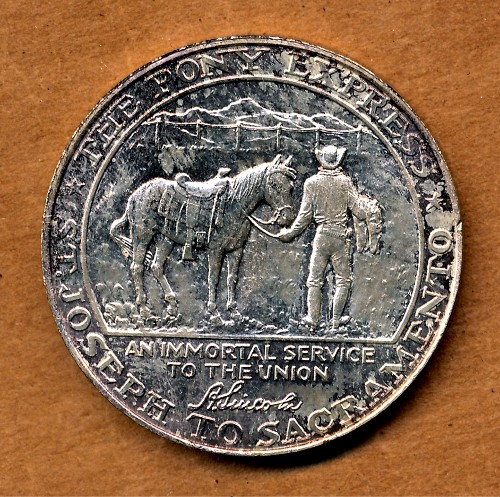
Additional commemorative coin bills were introduced in the 80th Congress (1947-48) and beyond, but none were ultimately approved (the 1951 amendment to the Booker T. Washington (BTW) coin Act that resulted in the George Washington Carver - BTW Half Dollar being the lone exception). Even without defining legislation, medals did eventually take hold as they became the only viable pathway to get a US Mint-struck commemorative piece produced. Here's one example I had lying around:
1961 Pony Express Termination Medal - Silver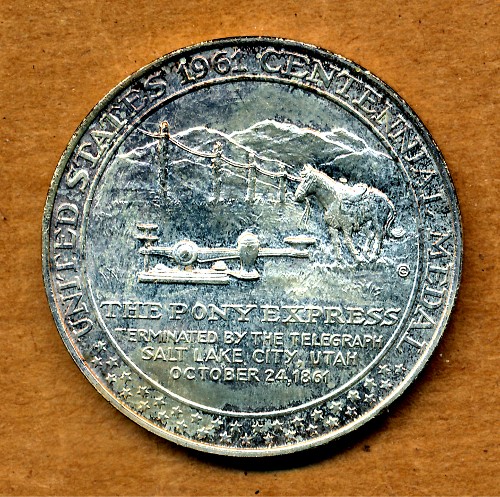
For more on Congress' 1930s efforts to curb the proliferation of US commemorative coins, check out:
-
Medals vs. Coins - 1930s-
Prohibiting Certain US Commemorative Coins-
Regulating US Commemorative CoinsFor more of my topics on commemorative coins and medals, see:
Commems Collection.








 Posted 11/08/2022 2:57 pm


