The South Carolina General Assembly (GA) voted to move the State's capital from Charleston to Columbia in 1786. (More details can be found via the Places link below.) One hundred and fifty years later, Columbia celebrated its sesquicentennial with a local festival, a US commemorative half dollar and a historical pageant (among other activities).
The festival was staged March 22 through 26, 1936; it was organized under the direction of the Columbia Sesqui-Centennial Commission. It was not a commercial venture managed by a for-profit organization, it was a civic celebration intended to "memorialize" Columbia's founding as the "Capital City" of South Carolina.
The celebration opened on Sunday, March 22nd with special services at churches throughout the city, and was followed by the unveiling of a bronze marker in the South Carolina State House that honored the State's signers of the Declaration of Independence - Thomas Heyward Jr., Thomas Lynch Jr., Arthur Middleton and Edward Rutledge. The marker was sponsored by the Ann Pamela Cuningham chapter of the Daughters of the American Revolution (DAR) of Columbia, SC. Later in the day, there was a concert performed on Melton Field of the University of South Carolina.
Monday, March 23rd, saw the official opening of the celebration, a large parade in Columbia and the first public performance of "Spirit of Columbia" - the dramatic historical pageant (11 episodes, 24 scenes) written for the sesquicentennial that presented Columbia's history - founding through (then) present-day.
On Tuesday, March 24th, the celebration was highlighted by Old-Time Fire Department demonstrations, and also included a pet parade, a Pioneer Honor Roll dinner and another performance of "Spirit of Columbia."
Activities for Wednesday, March 25th, included another round of demonstrations by the Old-Time Fire Department, band concerts, horse races and the final performance of the pageant.
The celebration's last day, Thursday, March 26th, featured a horse show, band concerts, the depositing of a time capsule, official closing ceremonies and a Grand Ball.
All-in-all, a fairly low-key event without the blatant commercialism seen at many expositions of the era. Local economic issues - Columbia's Sesquicentennial occurred during the Great Depression - contributed to the decision to proceed with a more subdued celebration.
Unfortunately for the Sesqui-Centennial Commission, its commemorative half dollars were not delivered in time to be made available at the celebration. The coin was approved on March 18, 1936 - less than a week before the celebration opened. It was the first new commemorative coin to be approved by Congress - and the President - in 1936, and its Act authorized the striking of 25,000 coins without a limitation on the Mint facilities that could be used (hence, the three-coin P/D/S sets with which collectors are familiar). It was not a case of First-In-First-Out (FIFO) for the Columbia coin, however. it was more like FILO or First-In-Last-Out as other 1936 issues were struck before it.
The Mint did not begin striking the Columbia half dollars until September and did not finish production until October when Denver struck its last 700 coins. The net mintage figures were: Philadelphia - 9,000; Denver - 8,000 and San Francisco - 8,000. It was late in November when the Commission began filling the mail orders it had received and held pending the arrival of the coins. A tip of the hat is due the Commission as, faced with more orders than coins, it filled single-coin/set orders first (presumably from collectors), ahead of large orders (presumable from dealers and speculators). The Commission exhausted its full supply of coins within a few weeks of receiving them - not having them for its March celebration did not negatively impact their sale.
Side Note 1: The Commission finished the core of its sesquicentennial program with a funds surplus, some of which was used to support the purchase of the land, in 1937, that would become Columbia's Sesquicentennial State Park.Side Note 2: The Commission remained active beyond 1936 (the Sesquicentennial was marked from 1936-39 so as to include the 150th anniversaries of the construction of the SC Capitol in Columbia and the completion of the move of State Government to Columbia). One of its ongoing programs was the placement of historical markers in the Columbia area - such placements continued into 1938.1936 Columbia, SC Sesquicentennial Half Dollar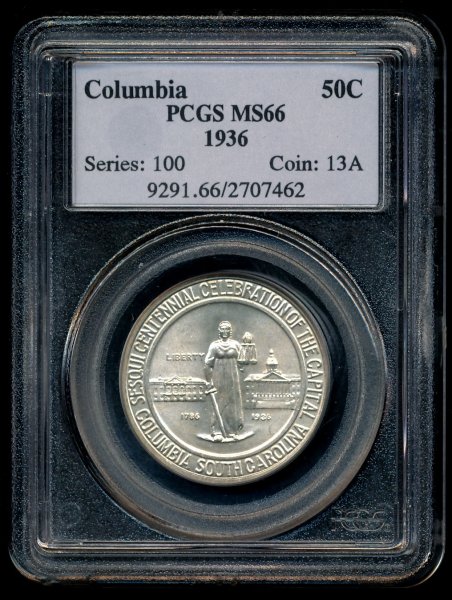
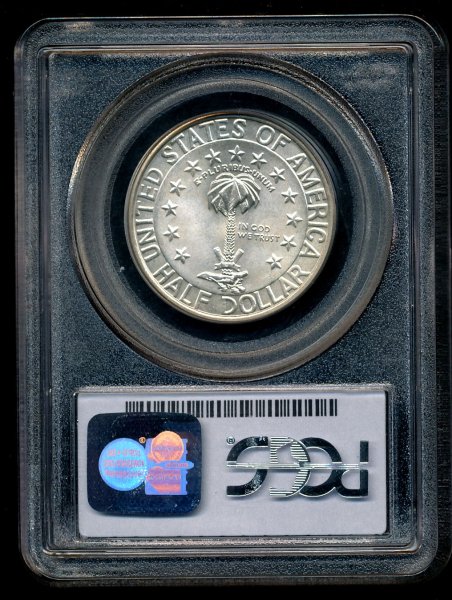
For more about the Charleston-to-Columbia move, see:
-
Coins Depictine Places - 1936 Columbia, SCFor more of my topics on commemorative coins and medals, including more on the history and designs of the Columbia, SC half dollar, see:
Commems Collection.









 Posted 11/18/2022 12:57 pm


