In addition to a commemorative half dollar, Maryland celebrated the 300th anniversary of its founding in 1934 with ceremonies and a pageant at the site of its original permanent settlement - Saint Mary's City. The area was/is located on the eastern side of St. Mary's River, a tributary to the Potomac River, in the southeastern portion of Maryland (mainland not Eastern Shore, i.e., west of Chesapeake Bay).
The Tercentenary celebration at St. Mary's City - Maryland's first capital - opened on Friday, June 15, 1934; the event continued on Saturday, June 16.
Official ceremonies kicked off at approximately 10:30am on Friday with the dedication of new ornamental wrought iron gates serving as a formal entrance to the Trinity Church churchyard (the first church erected at Saint Mary's City); the gates were the gift of the Society of the Ark and Dove. (The
Ark and
Dove were the two ships that brought Leonard Calvert and approximately 150 settlers from England (Cowes, Isle of Wight) to what would become Saint Mary's City in 1634.)
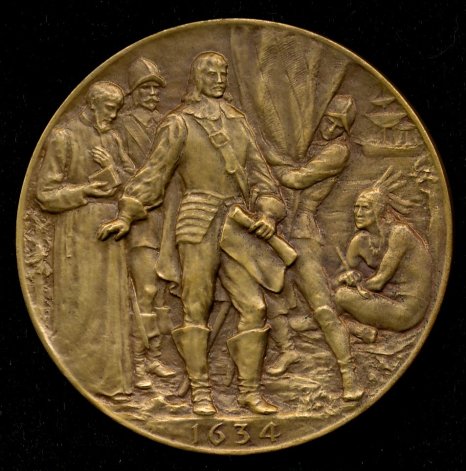
As part of the gate presentation ceremony, a colonial-era brick with two examples of the official Maryland Tercentenary medal embedded in it was presented by Reverend Dr. James M. McGruder (governor of the Society), to Reverend Nelson Maconomy, rector of the church.
Maryland Tercentenary Medal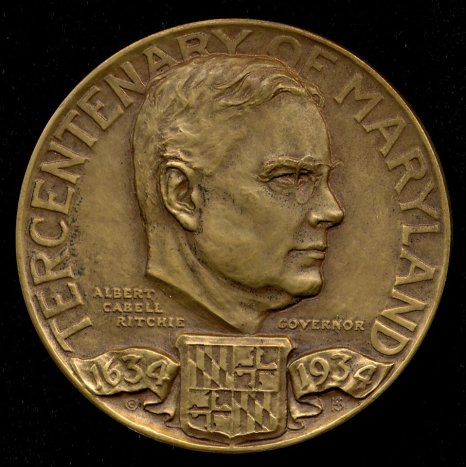
Following the presentation and dedication of the gates, a series of additional presentations were made at the nearby reconstructed State House. These included those by representatives of: The Star Spangled Flaghouse Association, the National Society of Daughters of 1812 in Maryland, the Maryland division United Daughters of the Confederacy (UDC), the Maryland State Society of Daughters of the American Revolution (DAR), the Eastern Shore Society of Baltimore City, the National Society Daughters of American Colonists, the District of Columbia Society, Daughters of American Colonists and the Arkansas Daughters of American Colonists.
The Mayor of Baltimore, Howard Wilkinson Jackson, spoke following the society presentations.
Maryland Governor Albert C. Ritchie attended the dedication/presentation ceremonies, visiting with local VIPs afterward. He remained at St. Mary's City overnight so that he could participate in Saturday's events.
Soon after the presentation ceremony, "Leonard Calvert" and other cast members of the Tercentenary Pageant sailed in on the reconstructed
Ark and
Dove, signaling the start of the first presentation of the pageant (another performance took place on Saturday). A military review/parade was held following the pageant.
On Saturday, Governor Ritchie attended the dedication ceremony for the rebuilt State House, accepting it on behalf of the State. Prior to the State House ceremony, a water parade was held that featured HMS
Dundee, a British light cruiser that traveled to Maryland for its 300th anniversary, and two US Navy destroyers - USS
Overton and USS
Manley, along with multiple smaller, private vessels. Afternoon events included another presentation of the anniversary pageant, a baseball game and another military parade.
The "Freedom of Conscience" statue created by Hans Schuler was unveiled/dedicated at the State House on Saturday. Check out
1934 Maryland Tercentenary And Hans Schuler for an image of the statue.
Attendance was estimated at 10,000-15,000 on Friday (lower than expected), but events bore witness to a larger crowd on Saturday (estimates were 30,000+). The Tercentenary Commission's pre-event estimates for attendance in the 50,000 range were not achieved, however.
The last planned event in Saint Mary's City that weekend was a church service on Sunday morning. It was held outside Trinity Church to mirror the first Christian service in 1664 by Father White, the first pastor of the new settlement - an outdoor service at St. Clement's Island.
1934 Maryland Tercentenary Half Dollar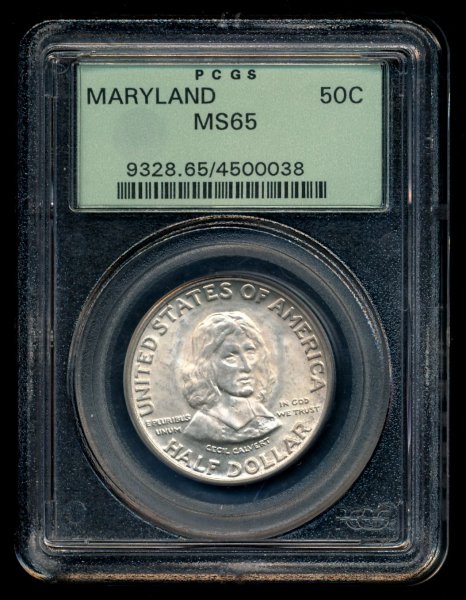
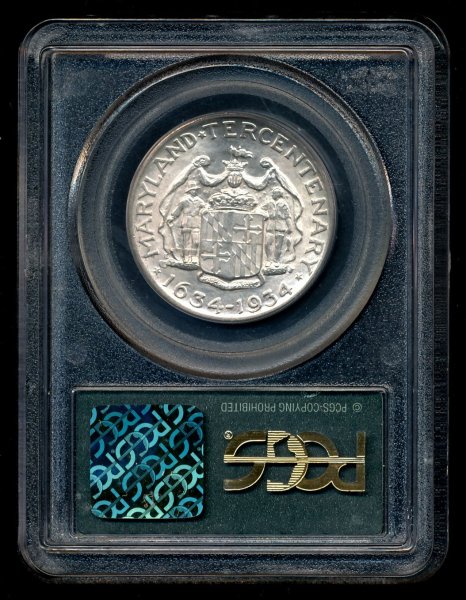
The coins did not arrive from the Mint in time to be sold/distributed at the Saint Mary's City celebration as they were not delivered until the second week of July - nearly a month after the official Tercentenary events. It seems likely, however, that proceeds from coin sales were used to settle a portion of the Tercentenary Commission's accounts for its celebration events.
Note: Leonard Calvert and his followers first landed on an island in the Potomac River. The settlers named the island "St. Clement's Island" in honor of Pope Saint Clement I. It was their temporary home as they negotiated with the local Yaocomico Native Americans to purchase land for their permanent settlement. A 40-foot tall stone cross was erected on the island during the Maryland Tercentenary to celebrate Maryland as the "Free State" - a nod to its founding principle of freedom from religious persecution.)For other of my posts about commemorative coins and medals, including more What If? stories, check out:
Commems Collection.References Consulted: The event details presented here were based on contemporary news accounts of the Maryland Tercentenary celebrations at Saint Mary's City in The Evening Star
of Washington, DC.









 Posted 02/07/2023 07:12 am


